Showing posts with label War and Peace. Show all posts

Friday, March 22, 2013

THE STORY SO FAR: PART 202

THE EXTRAORDINARY GENERAL MATTIS—A MARINE WITH A WAY WITH WORDS

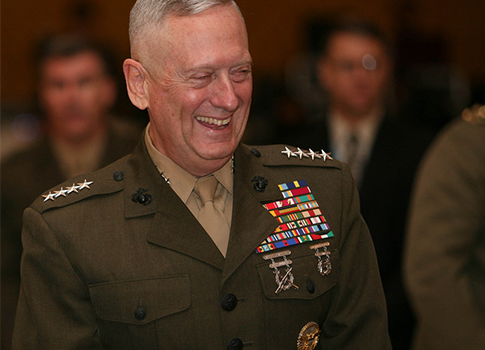
James Mattis

One of my Army friends sent me an e-mail today containing quotes from General Mattis.

Now I mostly know Army generals—who are typically fairly judicious in their choice of language. They know that a poor choice of words can kill a career faster and more certainly than incompetence in command—even in time of war. As Tom Ricks pointed out in his excellent book, THE GENERALS, generals who don’t perform used to be relieved at a fairly rapid rate—especially during WW II—whereas since then the club of generals looks after its own; and the club does not approve of colleagues who are too outrageous, or grab the headlines. Would General Mattis have achieved four star rank if he been in the Army? Probably not—but he is a Marine.

This isn’t to say that the Army doesn’t produce some truly outstanding general officers—fortunately it does—and some are refreshingly candid (here General Jack Keane comes to mind) but I can’t think of any who come close to matching Mattis’s sheer verbal dynamism and ingenuity. What is more General Mattis fights like he talks.

The following is an extract from today’s e-mail.

Gen. James Mattis, known to his troops as “Mad Dog Mattis,” is retiring after 41 years of military service. The Marine Corps Times is calling Mattis the “most revered Marine in a generation.”

Mattis has been commander of the United States Central Command since 2010 and led the 1st Marine Division into Iraq in 2003. According to reports, President Barack Obama decided to force the Marine Corps legend out early because he rubbed civilian officials the wrong way, and forced them to answer tough questions regarding Iran.

Mattis was an inspirational leader of men and his powerful words will go down in history.

Here are some of the best words that the “Mad Dog” has had to offer:

1. “I don’t lose any sleep at night over the potential for failure. I cannot even spell the word.”

(San Diego Union Tribune)

2. “The first time you blow someone away is not an insignificant event. That said, there are some assholes in the world that just need to be shot.”

(Business Insider)

3. “I come in peace. I didn’t bring artillery. But I’m pleading with you, with tears in my eyes: If you fuck with me, I’ll kill you all.”

(San Diego Union Tribune)

4. “Find the enemy that wants to end this experiment (in American democracy) and kill every one of them until they’re so sick of the killing that they leave us and our freedoms intact.”

(San Diego Union Tribune)

5. “Marines don’t know how to spell the word defeat.”

(Business Insider)

6. “Be polite, be professional, but have a plan to kill everybody you meet.”

(San Diego Union Tribune)

7. “The most important six inches on the battlefield is between your ears.”

(San Diego Union Tribune)

8. “You are part of the world’s most feared and trusted force. Engage your brain before you engage your weapon.”

(Mattis’ Letter To 1st Marine Division)

9. “There are hunters and there are victims. By your discipline, cunning, obedience and alertness, you will decide if you are a hunter or a victim.”

(Business Insider)

10. “No war is over until the enemy says it’s over. We may think it over, we may declare it over, but in fact, the enemy gets a vote.”

(Defense News)

11. “There is nothing better than getting shot at and missed. It’s really great.”

(San Diego Union Tribune)

12. “You cannot allow any of your people to avoid the brutal facts. If they start living in a dream world, it’s going to be bad.”

(San Diego Union Tribune)

13. “You go into Afghanistan, you got guys who slap women around for five years because they didn’t wear a veil. You know, guys like that ain’t got no manhood left anyway. So it’s a hell of a lot of fun to shoot them. Actually it’s quite fun to fight them, you know. It’s a hell of a hoot. It’s fun to shoot some people. I’ll be right up there with you. I like brawling.”

(CNN)

14. “I’m going to plead with you, do not cross us. Because if you do, the survivors will write about what we do here for 10,000 years.”

(San Diego Union Tribune)

15. “Demonstrate to the world there is ‘No Better Friend, No Worse Enemy’ than a U.S. Marine.”

(Mattis’ Letter To 1st Marine Division)

16. “Fight with a happy heart and strong spirit”

(Mattis’ Letter To 1st Marine Division)
Flickr

Friday, March 15, 2013

THE STORY SO FAR: PART 195

I HAVE YET TO MEET ANYONE WHO HAS EXPERIENCED COMBAT, WHO IS NOT AFFECTED BY IT

THIS IS A MANIFEST TRUTH—AND YET WE IGNORE IT

The media tells us that the current backlog of veterans’ applications for care is a stunning 900, 000—and that some VA locations are running two years in arrears. Good grief! This is beyond outrage.

Well, one might rant against the media except for the fact that the VA have confirmed such figures in hearings. Despite a major attempt to make the VA paperless—and thus theoretically more efficient—the current situation is a disaster.

Just imagine coming back from a war zone with PTSD—and having to wait a year or two for treatment. At such a point, words fail.

What is so wrong with our culture that we cannot understand that combat is intrinsically harmful to all of those who serve? We train people to do terrible things—which do happen—and then we largely ignore the consequences. This is neglect on an epic scale.

It is even more harmful when those who serve are forced to debate the moral integrity of their actions. On the one hand, they have done the right thing by serving their country. On the other hand, some of their actions could be—and have been—interpreted as war crimes.

We seem to have developed the facility to go to war on a whim—as in our invasion of Iraq—yet to walk away from the terrible consequences while disclaiming any, and all, responsibility.

What are the right words? I have no idea.


Orso Clip Art

Wednesday, March 13, 2013

THE STORY SO FAR: PART 193

THEMOTH.ORG—TALES OF THE MOTH—REPRESENTS THE HUMAN CONDITION, AND THE POWER OF RADIO, AT THEIR FINEST.

IF YOU ARE NOT MOVED BY SUCH TRUE STORIES, YOU ARE MADE OF STONE

I commented some time ago that, as I have been getting older—within the limits of being a member of a different sex—I have been turning into my much loved grandmother in terms of beliefs and lifestyle. Would it were so, in many ways, because she was an admirable human being with a big heart, but I fear my flaws exceed hers.

Nonetheless, there are similarities to our lifestyles—quite a few, in fact—apart from the fact that we both lived, or live, alone. One of them is that we both share (or shared) a passion for the radio. It’s informative, companionable, thoroughly entertaining, and remarkably inexpensive. Here I am referring to NPR in its various forms—not corporate radio (which has pretty much trashed a great medium).

One of the most impressive programs is TALES OF THE MOTH. These consist of nothing more that a single person telling a true story from their own experiences to a small audience—which is then recorded and transmitted. Many are extremely funny. Some are desperately sad. All are moving.

Stories are innate to the human condition. They give us identity, make us laugh—and give us hope. TALES OF THE MOTH represents the zenith of storytelling.

They make me proud to be a teller of stories, part of a fraternity that may just be—though the competition is formidable—the oldest profession.


Orso Clip Art


Sunday, March 3, 2013

THE STORY SO FAR: PART 183

THIS ELUSIVE QUALITY WE CALL LEADERSHIP

I first read J.K. Galbraith when I attended university at the too young age of 16.

No one should go to university that young.

True, I had the necessary academic qualifications, but that was back in the days of military National Service in the UK (conscription), and many of my peers were 20 or more when they arrived, and not a few were older—and certainly looked older.

Being in harm’s way, while presiding over the decline of the British Empire as a young infantry officer, had that effect. Malaya, the Indonesian confrontation, Cyprus, Aden, Kenya—the trouble-spots were endless—and the casualties racked up. And then came Northern Ireland, which was to last for about 30 years. On several occasions, I was on the receiving end. It wasn’t fun.

Given that my university was Trinity College, Dublin, Ireland, you might well wonder why so many British students attended. I think it was as simple as the fact that, at that time, Trinity was a little less expensive than Oxford or Cambridge—and a little easier to get into. However, it still had the cachet of having been established in the late sixteenth century when Elizabeth 1 was on the throne. She was the queen who defeated the Spanish Armada—or, at least got much of the credit for it. The weather was actually a major factor in the whole event; and the English were scarcely trivial opponents. If memory serves, they had smaller ships but superior canons.

My peers were a beer drinking, poker playing, lot; and they had seen the world—or enough of it to regard me, quite rightly, as a kid. Some were very bright, but mostly they wanted—not unreasonably—to forget.

It was hard to get a date, at first, against such competition—and there were few women at university back in the early Sixties; but, life being the way it is, I grew older, and luckier. A Trinity degree course is four years.

I became a great fan of Galbraith. I didn’t agree with all his ideas, but, generally speaking, he seemed to make a great deal of sense; and he wrote beautifully. I can forgive almost anyone if they write to Galbraith’s standard. The following is a marvelous quote on leadership.

"All of the great leaders have had one characteristic in common: it was the willingness to confront unequivocally the major anxiety of their people in their time. This, and not much else, is the essence of leadership." -John Kenneth Galbraith

Galbraith bore more than a passing resemblance to my good friend, Bob Fulton. Both were fine looking men and aged particularly well. I never met J.K. Galbraith and—more is the pity—our paths never crossed. I miss Bob Fulton to this day.


Orso Clip Art


Thursday, February 14, 2013

THE STORY SO FAR: PART 166.

HOW LONG SHOULD A BOOK BE?

File:L.N.Tolstoy Prokudin-Gorsky.jpgMost people have forgotten the Korean War. Nonetheless, it fascinated me even though I was only six when it started in 1950. It finished—more or less—in  1953, though a full peace treaty has never been signed. Given that North Korea is now a nuclear power, that is somewhat disturbing.

While scouring the school library, I ran across an article in the National Geographic about it, which, amongst other things, showed how the Koreans could carry heavy weights on their backs by using a frame.

Why don’t we do that, I wondered?

And, of course, now we do—but it was an early lesson that the West was not the repository of all wisdom (which, essentially, was the kind of thing I was originally taught). I was an early skeptic because attitudes, and what I could see and read, did not seem to match.

There is a nice story about the Korean War I have long remembered. There were press briefings every day, and a constant theme was that a particular position in the U.N. lines—it would vary—had been attacked by “hordes of Chinese.” This phrase became part of the daily ritual until finally one of the journalists stood up and asked: “How many Chinese to a horde?”

The effect of this question was to create absolute confusion because, needless to say, there was no credible answer. It remains one of my favorite lines.

One used to be able to be more precise when talking about a book. A novella used to be about 30,000 words long. A novel started at about 60,000 words—and a classic big thriller (the kind of book I love and write) came in at 120,000 words plus and could easily be 160,000. Assuming a talented author, this substantial heft guaranteed, in my eyes, a really good read.

Apparently, all of that is changing. A recent article by Michael Lewin in Book Publishing today states that:

“Today, however, the closing of the American mind has given way to the collapse of the American attention span thanks to texting, Facebook and Twitter. Neither authors nor readers seek size from their books.”

“If you are writing a business book to brand yourself as an expert in your field, keep it under 50,000 words… You fiction writers should take heed as well; 90,000 is the new optimum maximum length, down from 50,000 words just a few years ago.”

I guess that means I’ll only have to do half the work in future. Assuming I believe that—which I don’t—how do I feel about the supposed demise of the really good read read?

Profoundly sad, if you really want to know. I guess reading WAR AND PEACE by Leo Tolstoy—which I loved—when I was 13 had a lasting impact on me.

Tolstoy is illustrated above.


Orso Clip Art