Tuesday, July 21, 2015

June 21 2015. Writers have a tendency to be obsessive about their routines (which strikes some people as weird—though not other writers). We’re actually a surprisingly disciplined bunch and our routines are fundamental to our productivity.

IT’S SOMETHING OF A PARADOX, BUT ONE OF THE OPEN SECRETS OF WRITING REGULARLY, AND CREATIVELY, IS THAT DULL-AS-DITCHWATER PATTERN OF BEHAVIOR—ROUTINE VICTOR - SHOT BY MICK - WEBSITE 1

THE IDEA IS TO BE ROUTINELY SPONTANEOUS (WHICH SOUNDS WEIRD)

More than a few people have the idea that they cannot really write to best advantage unless they are in the right mood. 

Between you, me, and the all-knowing gatepost, that is not the way it works.

Though it is entirely true that some days one tends to produce rather better work than on others—we humans being variable creatures for a whole host of different reasons—the underlying idea, if you are a professional writer, is to be able to write to the highest possible standard which you, the writer, are capable of—regardless of your mood.

The trick is not to wait for the mood in order to be able to write—but to train your mind so that that the very act of writing creates its own mood.

Hold that thought. It’s key.

If that sounds like magic, that is exactly what it is (even if you don’t believe in magic).

But can you train your mind?

Absolutely—and to a greater extent than most of us realize. In fact, we do it all the time when learning new things. One’s mind might seem confused, chaotic, and, apparently un-biddable (trust me—I know) but the reality is that even the most recalcitrant mind can be trained to be orderly, disciplined, and productive—in some areas. Whether one can tame one’s mind to behave across the board is another matter entirely. But, right now I’m not concerned with such a lofty goal. I’m focusing on writing.

You train your mind to write in a number of crucial ways.

  • READING. By reading a very great deal so that you not only learn how others do it, but you absorb these lessons subconsciously so that they become innate. Here, you want to read widely and well—throughout your life. And read outside your preferences and prejudices. The goal is not merely to learn, but be challenged. Go forth and explore. The world of the printed word is truly wondrous—and without end. It is rich in every way that matters—and either free, or very inexpensive to access.
  • OBSERVING. By learning to notice and describe your  surroundings and circumstances as you go about the daily business of living. Life obligingly provides the raw material for writing—but that material only becomes usable when you can transform it into written form. Fortunately, you can do that without actually having to write physically. You just observe and then describe what you see to yourself—and, over time, you will get better and better at it. Practice may not make perfect, but, with luck—and your particular perspective—it will end up being entertaining. All of that is a long way of saying that you need to learn to observe and record. I tend to think of it as ‘writing in my mind.’ But don’t move your lips or write out-loud, or people in white coats will come and lock you up.
  • THINKING. By thinking a great deal. Many of us seem to get through life—to considerable effect, it is only fair to say—by doing little more than focusing on our immediate needs and reacting to our circumstances. It is hard to knock such an approach—but it won’t serve you well if you are a writer. Writing is all about transforming thought into words—so it helps greatly if you have some original thoughts to transform in the first place. So activate your brain, and keep it active in every way possible. That requires effort, experience, intellectual curiosity, human interaction, a keen eye, a receptive and retentive ear—and a great deal of hard work. Writing is hard work personified—and can be totally exhausting—but  we writers keep going, not because we are a bunch of masochists (though sometimes I wonder) but because, once a writer gets the hang of things, all that slog becomes enjoyable hard work—and then, over time, gets better still. Enjoyable work isn’t work—as the term is generally understood. It remains hard, but it is something you want to do.
  • WALKING. You don’t have to walk to write—but it helps greatly. Firstly, your brain works better if you are physically fit—so it is a really good idea to exercise regularly. For all I know exercising in a gym may make you fitter faster—but I always recommend walking because not only is it a fairly effortless way to exercise, but you notice so much more when you walk (and everything you observe and ponder is raw material). In fact, I have made it a policy, where all my books are concerned, to walk the relevant terrain as much as possible. That doesn’t mean I don’t drive, helicopter, fly conventionally, hitch a lift in a tank, travel by rail, observe from a monorail, climb into a saddle, or otherwise get around—but more that once I’m at my chosen location, I primarily like to explore it on foot. All I can say is that it works wonders—and that many of my best experiences and insights have come from being foot-mobile rather than driving. These experiences have included finding a hanging body, getting shot at, being attacked by a group of Arabs armed with knives, sitting on a snake, having guns pointed at me in an unfriendly way, acquiring a girlfriend by walking into Swiss Interpol unheralded—and other happenings of the kind no good thriller-writer should be without.  So hear my call—and walk while you can. Others will carry you soon enough.
  • WRITING. In the final analysis, you learn to write by writing—more than is easy—every day (even if you can’t). The idea here is to so train your muscle memory that the mere sight of a writing implement—typically a keyboard these days—evokes a desire to write. Clearly, it is best to write something which has a modicum of value, but, if you are so desperate you can’t think of anything to write about, then write out your shopping-list, or copy something from a book. True, that may seem a little crazy, but the point is that what you are initially trying to do is to just get used to the physical act of writing—so that it almost becomes a reflex (and eventually a pleasurable one). Sheer boredom will then make you depart from your shopping-list—there is only so much sensual satisfaction to be gained from writing ‘asparagus’ a hundred times—so before long you’ll be into erotic fantasy—and, after a year, you may be ready to tackle the sequel to War & Peace. But, no matter how daunted you may feel at first—as you stare desperately at a blank screen—you should know that the good news is that writing provokes writing, so, if you persevere, the process will get easier—and you will get better (eventually). Allocate a decade or two to this warm-up period. I never said it was either quick or easy.  

One of the most confusing things about writing is that having stressed the value of gaining a wide variety of experiences—and otherwise being inspired to see the world with fresh eyes—we writers, certainly when actually physically writing, tend to prefer to be slaves to routine. We don’t want any new and fascinating experiences for that period. We shut down and focus all our energies on turning thought into words.

You would think that variety and routine would not go together—and they don’t (but they do).

Essentially, I tend to allocate substantial periods of time to do weird and wonderful things during which I gather raw material, balanced out by periods during which I focus on the actual writing itself—and when I like to follow a decidedly rigid routine.

You might think mixing the two might work—if only to relieve the pressure of writing intently day after day, week after week, month after month—but that is decidedly not my preference.

Once my research is done, I like to focus without deviation until a draft is finished. If I could take a pill at the end of every writing day—and then wake up next day refreshed (without the interruptions of normal life) that would be my preference during such times. The pressure to remain in the writing zone is near overwhelming. To step outside it is painful.  Reality is grossly over-rated.

Somehow, routine seems to help the intense focus required to write at one’s very best. In fact ‘help’ may understate the case.

The truth is that I find a routine essential when it comes to actually writing—and I know many other writers feel exactly the same way. It is our bastion against distraction. Within its confines, we feel safe, focused, intellectually energized, and resolute. The work will be done—no matter what!

It’s an extraordinarily intense feeling. Within the context of our writing routines, we are driven individuals. We have a profound sense of purpose and, in essence, our work is its own reward (and it is hard to imagine a better one).

I tend to think of writing as ‘joyous’ which somehow doesn’t quite go with the relentless seriousness of the process, yet certainly does convey my inner feelings. For instance, I find it near impossible to be depressed for any length of time when I’m writing.

Within short minutes of my fingers touching the keyboard, I’m feeling as good as it gets—and I tend to stay that way for as long as I’m working—and to retain the high for a considerable time afterwards. Actually, the feeling is less that of a high than that of the kind of inner peace that comes from accomplishment. Writing is immensely satisfying just in itself. Fame and fortune are fine things—and, of course we would like them—but the process of writing is the real reward.

Different writers have different routines—and I doubt that any one of them is right (except for the individual concerned. In short, I don’t think there is a best writing routine. What counts is what works for you.

ROUTINE. My routine revolves around.

  • A LONG WORKING DAY. Regular to long working hours. I think nothing of working 12 hours or more a day though I don’t spend all of that time doing creative writing. I also do ongoing research, have correspondence to handle—and so on.
  • SOLITUDE. I’m not anti-social, but can survive without much human contact, if I am writing, for weeks, or months, if necessary. In short, I am fairly self-contained and self-reliant, but like nothing more than dinner with friends.
  • PEACE & QUIET. Reasonable quiet. I’m not fanatic about this and can handle background traffic noise and so on. However, I prefer to avoid intrusive noise.
  • NO DISTRACTIONS OR INTERRUPTIONS. Here I include domestic chores, visitors, phone calls or texts—anything which breaks focus. Society, which clearly thinks mankind hasn’t enough to do, likes to fill our time with obligations. Such time-sinks are rarely compatible with writing. A writer’s primary obligation is to write. That is his, or her, purpose in life.
  • NO FOOD OR ALCOHOL UNTIL WRITING DONE. No food or alcohol until I have finished writing. Occasionally, I’ll have a bowl of soup or scrambled-eggs on toast for lunch, but mostly I don’t have anything—and don’t miss it too much while I’m actually writing. That said, such restraint is not easy. 
  • LOTS OF TEA. I drink tea with milk, Irish style, and Stevia (I avoid sugar like the plague) and find that assuages my hunger and keeps me hydrated. I regard cups as entirely inadequate and only use mugs. Sometimes, I switch to green tea, which I like, but it doesn’t have the comfort factor of conventional tea. 
  • FREQUENT MOBILITY. Moving around every 20 minutes or so. The one great physical disadvantage of writing is that it is sedentary—which is innately unhealthy. I’m planning to get some kind of an exercise machine. Writing and exercise go together.
  • WALKING. Walking for about two miles every day—normally in the evening..
  • SURROUNDINGS & TOOLS. Having the surroundings and tools I need to do the job.
  • A CONSISTENT OUTPUT OF ABOUT  2,000 WORDS A DAY. This means that, theoretically, I can write a full draft of a fairly big thriller in four months, or so—or, arguably, two such books a year. It doesn’t quite work out that way because life gets in the way, a book typically goes through multiple drafts, and I tend to take my time re-writing. 2,000 words a day doesn’t sound a lot but it adds up to about three-quarters of a million words a year—scarcely a trivial quantity. 

SURROUNDINGS & LIGHTING. Here, I like to be in a room, alone, with sufficiently thick walls, a door, and windows, to ameliorate external noise. That means I rather like solid doors and double-glazed windows—but I’m not that fussy.

I also don’t need a room with a view. Some writers crave that—and I probably wouldn’t turn down such an option if offered, but mostly I’m quite content with my desk or table facing a blank wall. The reason is that my mind supplies all the view I need. In fact, the real thing can be a distraction.

Since my eyesight is very far from perfect, lighting is very important to me and I devote considerable attention to getting it right. Typically, I like as much daylight as possible during the day—while avoiding glare. That isn’t always as easy as it seems—especially as not everyone (non-writers in particular) understands such subtleties.

Natural lighting apart, I find I get on best with simple desk-lamps with white shades as opposed to lamps that direct their energy to a small area. This has to do with my eyes preferring to avoid too much contrast. But, I try not to be too fanatic about this and just go with the flow in other people’s houses.

TOOLS.

  • FLAT SURFACES. I am completely obsessed with flat surfaces and sometimes think that my writing life has been dominated by the search for these.

By ‘flat surfaces,’ I mean table or desk spaces to write on—together with shelf-space for my files and books. Such surfaces are rarer than you would think in this world of ours, and, where other people’s houses are concerned, those that are readily available—and kindly offered—are normally in the form of either the dining-room or kitchen tables—both of which tend to be in high demand for other uses, and are rarely in distraction-free zones.

The world, from this biased writer’s point of view, seems to be alarmingly short of tables—so I find myself subconsciously scanning for flat surfaces at every conceivable opportunity. 

I am reminded of that period of temporary insanity, shortly after I installed a wood-burning stove in my cottage in Ireland—when I couldn’t find burnable wood anywhere (though there were tree plantations all over the place). During that phase, every time I saw wood anywhere—regardless of what it was or who owned it—I  would mentally convert it into wood-stove length logs. Doors, cricket-bats, fine-furniture, beds, blanket-chests, and chairs—all were chopped, stacked, and burned in my imagination.

As it happens, I solved my problem in the classic Irish way in the end—by meeting a man in a pub who knew a man who could provide neatly chopped wood in exchange for modest money—providing I didn’t ask where the wood came from. The network that is the Irish pub system predates the internet—and is at least as efficient in its own idiosyncratic way.

As it happens, I wrote my first book on my deceased father-in-law’s sturdy kitchen table with an extra flat surface being provided by an unfinished coffin lid. This was in my thatched cottage in Ireland—where space was decidedly limited—and both served well.

You don’t, of course, need a great deal of space to actually write on if you are using a computer alone—or even a quill pen—but my writing routine involves rather more complexity than that, and consequently demands considerable flat real estate at a workable height. Recently, I had occasion to operate my computer while sitting on a conventional dining chair with the computer propped up on my bed—and God alone knows what damage I did to my limbs. The expression ‘workable height’ needs to be taken seriously.

My writing gear includes computers, a second monitor, a laser printer, two different kinds of label printer, a USB hub, two desk lamps, pen pots, a stapler, a two-hole punch, books, reference materials, ring-binders, innumerable files—and a radio.

Where would the world be without the BBC—or NPR in the U.S.! I don’t play the radio while I am working—focus means just that—but it is my companion and invaluable information source at other times 

Some writers get great satisfaction from working from an antique desk, or owning some table of particular significance or value. I felt much that way at one stage in my life. Now, I am entirely focused on the utility of my furniture and nothing more. As far as I am concerned, a folding plastic table is fine with me. What matters is not the table, but what I do on it—which is to write. I have become somewhat minimalist in relation to physical possessions as I have aged. Functionality is all. I haven’t lost my aesthetic sense—but I favor stuff that works.

  • CHAIR. If you spend as much time as I do sitting in a chair, then the comfort of that chair becomes decidedly important. For most of my writing life, I have enjoyed the ease of reasonably comfortable swivel chairs, but more recently—since I have not been at home—I have been making do with upright, straight-backed dining chairs. My bruised bottom apart—these things are lamentably short on padding—I have survived much better than I would have expected. Does this mean I don’t need a swivel chair? I don’t really know as yet—but I have come to the view that how you sit (your posture) is really important. It is also clear that even if we writers are discouraged from using long words—in the interests of clarity—we are wise if we know something about ergonomics

ERGONOMICS. 1. : an applied science concerned with designing and arranging things people use so that the people and things interact most efficiently and safely —called also biotechnology, human engineering, human factors.

  • LAPTOP COMPUTERS x 2 + MONITOR. I like to work with a laptop and a second monitor. Typically I keep my reference material on the second monitor—which is to my left—and write on the laptop. I value screen space and am giving serious consideration to adding a third screen.
  • LASER PRINTER. I like to print for a number of reasons. It is gratifying to see my own work printed out—there is something tangible to read and hold. I find it easier to spot errors on a printed page. I use the printed version of an article as a reminder—and so on. And I like to work with paper. It has played a major role in my life and I deeply appreciate its utility, flexibility, touch, and texture. For all that, I’m trying to wean myself off printing nearly as much as I used to. I have too many files for paper versions to be practical any more—they take up a considerable amount of space, are slow and expensive to maintain, and are costly to transport. Accordingly, I am trying to show restraint. I rather like the idea of the gear I need for writing being light and compact enough for me to travel with it just about anywhere. I haven’t got there yet, but that is where I am heading.

Have tools—will travel. There are few things better than travel to broaden the mind and inspire creativity. It is virtually guaranteed to drag a writer out of his comfort zone—and it is not in the nature of writers to be comfortable.

CONCLUSION.

I would like to be able to write that decades of experience have now meant that my writing routine has been polished to consistent perfection—but nothing would be further from the truth.

True, I do naturally start writing with ease—and find it relatively effortless to focus—but, such fundamentals apart, I still find my writing routine is evolving with no end in sight. The villains here are my intellectual curiosity, my drive to do better, and the ever evolving world of computers and software.

Perfection remains an impossible dream—but we seek it nonetheless. It is our nature.


Monday, July 20, 2015

July 20 2015. Financialization strikes again. There is a hole in the funding of U.S. pensions—a rather large one. Think in terms of trillions of dollars. But, that is just one financial problem in a long list of structural defects in what is generally called The American Business Model.

FINANCIALIZATION IS NOT GETTING THE ATTENTION IT DESERVES

VICTOR - SHOT BY MICK - WEBSITE 1

WHY NOT? IT INFLUENCES VIRTUALLY EVERY FACET OF OUR ECONOMIC WELLBEING—NEGATIVELY IN ALL TOO MANY CASES

Financialization is a catch-all word which essentially means an excessive financial sector which, in a myriad of ways, is able to so game the economy as to extract money from it—without, by and large, contributing any real value (or what most of us would consider to be value).

It functions as a something of a cross between a technically legal protection racket, and a system of excessive taxation. Either way, it largely extracts rather than constructs. It is predatory in style and execution. It lacks a moral core.

Research shows that when financialization gets too dominant a grip on the economy, it actively hinders growth. In fact, all in all, it is a seriously bad thing—which gets remarkably little attention. As with death, bad weather, and government taxation, we just sort-of accept it.

We really shouldn’t. It is not inevitable. In fact, there is a great deal we could do about it if we were so minded. We don’t for several reasons—all of which are capable of being rendered invalid. We have a solvable situation here.

  • Most of don’t know enough about it to be concerned.
  • The financial sector has more than enough money to block any drastic reforms, and generally to bend Congress to its will.
  • The same ultra-rich people that largely control the financial sector (and other major corporations) control the media—so the U.S. public is not informed as to the sheer scale of the problem.

Here are just a small selection of the downsides of financialization as it currently (and recently) influences the U.S. economy.

  • THE GREAT RECESSION. The 2008 Great Recession—which was caused by the FS (Financial Sector)—did more damage to the U.S. and global economies than any other financial event since the Great Depression of 1929. The resultant legislation has only partially remedied the legal deficiencies that led to this disaster. It, or something like it, is almost certain to happen again. As far as many people are concerned, the full effects of the 2008 recession are not yet over.
  • THE CORRUPTION OF THE U.S POLITICAL SYSTEM. Research has shown that elected representatives do not listen to those who elect them. but only to those who fund them. In effect, representative democracy has now been replaced by plutocracy—government by the rich for their own advantage.
  • PENSIONS & RETIREMENT. The high fees charged by the FS (Financial Sector) have led to significantly smaller pensions for many.
  • A PERVASIVE CLIMATE OF DEBT. People tend to forget that debt wasn’t always as pervasive as it is today. The economy is now so structured that it is virtually impossible for most Americans to function without getting heavily into debt. Educational debt alone now stands at $1.5 trillion—a truly intolerable burden for Millennials.

Another way to consider all this is to start from scratch and consider whether an effective financial structure could be set up which would out-perform the existing one without its disadvantages.

Not only can it be done, but other countries are doing just that.

The U.S. is putting up with its current level of financialization—and its consequences—for no good reason.

It is making a small group of the ultra-rich even richer. The earnings of most Americans, once inflation is accurately factored in, are in decline.


pension short fall


Sunday, July 19, 2015

July 19 2015. I confess! I think about this stuff.

IF WE DON’T LOOK AFTER THE ENVIRONMENT, WHY DO WE

VICTOR - SHOT BY MICK - WEBSITE 1

ASSUME IT WILL NURTURE US?

I have my much loved grandmother, Vida Lentaigne, to thank for being environmentally aware and concerned. She had a farm in Brittas Bay, Co. Wicklow, Ireland, for the first ten years, or so, of my life—primarily to benefit her grandchildren—where I absolutely adored spending time. In fact, I normally spent a good portion of my long summer holidays there.

Bliss! 

I was free of an extremely fractious home, my grandmother was truly wonderful—and a great teacher—and I had 60 acres of wonderfully varied arable land to explore. There was marshland to keep the wildlife happy, a river, shallow enough to paddle across,  sand-dunes to climb and slide down, a long sandy beach to swim from, and the extremely cold Irish Sea to swim in (complete with jellyfish and a dangerous current which nearly drowned me on one occasion). What more could a little boy want!

Animals? There were cattle, pigs, hens, cats, and an abundance of wild-life. Back in those days, rabbits were so common we ate them about as often as people today eat chicken.

I still can’t hear the name ‘Brittas Bay’ without a frisson of pleasure. It represents an exceptionally happy portion of what was otherwise a difficult childhood—and it made all the difference. One can endure a great deal if you have something to look forward to—and though home was difficult, and boarding school felt like prison, I always had Brittas Bay and my grandmother to look forward to—and they never let me down.

In fact, after granny sold the farm—which was never really her scene, she bought a house in London which became a similar refuge for the balance of my childhood. She was an exceptional human being.

She cared greatly about the environment—though she never called it that, and we didn’t known nearly as much then about it as we know now. But she was opposed to monoculture, was greatly concerned about water quality, had free-range hens, rotated her crops, let one field lie fallow as part of the cycle, and planted trees. She regarded herself as a steward of the land rather than an owner—and was determined to leave it in better condition, if possible, than how she had found it.

I have watched what has happened since to agriculture—and the environment generally—with considerable dismay. Mostly, we seem to act as if the earth is able to sustain indefinite punishment—and this despite ever increasing evidence that mankind is not only capable if damaging it severely and permanently, but is currently doing so.

But all the trends aren’t gloomy. One particularly positive development is the evolution of regenerative agriculture which looks like not only outperforming monoculture in terms of both cost and quantity, but restoring the soil and producing more nutritious food.

What is regenerative agriculture? I’ll probably write about it in more detail in another blog, but for now I’ll leave you ate the mercy of Google.

It’s worth investigating.

As with so many of our seemingly intractable problems, the answers are out there—if you care to look.

avoid fluoride exposure

Saturday, July 18, 2015

July18 2015. Some people call Dr. Mercola—quoted below—a quack because of his opposition to vaccination (and his views on some other issues). I find him, mostly, pretty sound. He supports his arguments with data—normally a great deal of it—so he tends to advance his positions based upon facts rather than mere assertions. That makes him almost un-American!

IT IS BECOMING INCREASINGLY CLEAR THAT THE QUALITY AND QUALTITY OF WHAT WE EAT IMPACTS DIRECTLY ON BOTH OUR HEALTH, AND THE GENERAL QUALITY OF OUR LIVES

VICTOR - SHOT BY MICK - WEBSITE 1

NO MORE THAN COMMONSENSE, SOME MIGHT SAY.

A great many things which U.S. corporate propaganda endeavors to persuade us are good for us—are, in fact harmful. In all too many cases, they are harmful to the point of being lethal. They are killing us—slowly, but inevitably—and often unpleasantly. If you have seen a smoker die of lung cancer, or emphysema, you will know exactly exactly what I mean.

These days, though deaths from smoking are diminishing in the U.S. itself (though a massive problem on a global basis) we have an alarming rise in  medical conditions—and a truly disturbing number of people, about 23,000 (and rising), are dying because they have developed antibiotic resistance from the meat they eat.

The carnage that American corporations are inflicting  year after year, is more insidious than a quick death. The corporate ‘way of death’ is, in the main, a more profitable, drawn-out affair, where cause and effect are less obvious.

They are glaringly clear if you think things through—and the data remove any further doubt—but this pattern of corporate behavior is so routine that, by and large, it is just taken for granted. It is socially normal and accepted. It is often referred to as, “Just part of life,” (a somewhat ironic phrase given the subject matter). True, death is inevitable, but ‘how’ and ‘when’ are important matters of detail.

Such egregious corporate behavior is also protected in other ways.

#1. FREEDOM OF CHOICE. By the argument that we all have freedom of choice—so if large numbers of people decide to shorten their lives by smoking or eating fast-food, why should anyone intervene.

The arguments against that are:

  • Corporate propaganda is now so effective that what passes for freedom of choice is, in effect, nothing of the sort—but more a consequence of mass manipulation. But can people be manipulated to that extent? The answer is clear and un-ambivalent—and the data are  extensive. It is, “Yes.”
  • Only very rarely do corporations make all the facts available, so most consumers are making decisions based upon inadequate information. Smoking is a classic example of this. Big Food and Big Pharma are just beginning to be recognized as probably inflicting harm on a comparable scale. The producers of something like 84,000 chemicals in general use—most of which have never been either tested, or determined to be safe for humans to consume, are waiting in the wings. Behind them is a very long queue. 

#2. CORPORATE POWER. U.S. corporations are now so strong that they have, in effect, hijacked the Constitution. Subject to rare exceptions, they pick the candidates, fund their campaigns, determine the political agenda through an army of lobbyists—and fund the political demise of those who do not conform. Corporations now spend more money on lobbying Congress than the government does running it.

Legally, corporations have been treated as people since the late 19th century (without the legal rationale for that decision ever being determined).

The arguments against such corporate power are:

  • It is unjust and unfair.
  • It is the antithesis of democracy.
  • It violate the Constitution.
  • It leads to the political and economic systems being rigged to favor both the corporations themselves and the ultra-rich who control them.
  • It is immensely damaging to the environment.
  • It is socially disruptive.
  • It doesn’t deliver the quality of life for the population as a whole which more balanced economies manage to achieve. 

In other cases, where corporations are not actually killing us, they are still causing immense damage to the environment—even though they inhabit that very same environment. Like much corporate behavior, that makes no sense at all—except as a consequence of short-term greed.

Despite our positive vibes about Mars—and the current enthusiasm about Pluto (a somewhat long commute, in my opinion) Earth is the only world we’ve got—yet corporations seem hell bent on destroying it.

  • They are flooding the planet with toxic chemicals.
  • They are polluting the air we breathe, the soil we grow our crops in, and the very water we drink
  • They are causing serious damage to the food chain—starting off by producing sub-standard ingredients.
  • They are causing climate change.
  • They are making both living creatures and plants extinct at a truly frightening rate.

I don’t subscribe to the view that either capitalism or corporations should be abolished. The free market, policed by competition, has proven to be a highly effective way of channeling both resources and human endeavor to the best advantage of society as a whole—but I think it is self-evident that the American Business Model (ABM)is deeply flawed and needs to be overhauled fairly drastically.

We shouldn’t be either surprised or particularly upset by this. All human institutions and systems—no matter how well they start—degrade over time.

Good grief! Just look at Christianity! If Jesus Christ, reportedly the son of God (I’m taking no position here) can’t get it right—it is scarcely surprising that Congress has turned into a deeply corrupt nest of mediocre opportunists after a couple of hundred years.

Human organizations run up against that  that well established set of human characteristics known as human nature—and nothing survives that unscathed. In addition, we have the rather depressing fact that a not insignificant minority of the population are psychopaths—and that such people, by nature of their dispositions (and who lack a moral code), have a natural tendency to gravitate to the top—a truly fundamental flaw where democracy is concerned.  Throw in greed, ignorance, and a few other foibles for good measure—and it is rather surprising that we do as well as we do.

In the following piece, www.mercola.com raises the long neglected issue of processed food.

We seem to think about it much less than we should, but what we eat has consequences.

Scientific Links Between Processed Foods and Depression Keep Getting Stronger

July 16, 2015 | 18,581 views

By Dr. Mercola

Research shows that the food you eat can have a profound effect on your mental health. So, regardless of your mental health problem, the importance of addressing your diet simply cannot be overstated.

In a very real sense, you have two brains — one in your head, and one in your gut. Both are created from the same tissue during fetal development, and they’re connected via your vagus nerve, the tenth cranial nerve that runs from your brain stem to your abdomen.

It is now well established that the vagus nerve is the primary route your gut bacteria use to transmit information to your brain, which helps explain why mental health appears to so intricately connected to your gut microbiome1 — the bacteria and other microbes living in your gut.

For example, researchers recently found that fermented foods helped curb social anxiety disorder in young adults.2,3 Another study4 found that mice engaged in obsessive-compulsive repetitive behaviors were pacified when given a strain of the bacterium Bacteroides fragilis.

Gut bacteria also produce mood-boosting neurotransmitters like serotonin, dopamine, and gamma-aminobutyric acid (GABA). In fact, the greatest concentration of serotonin is found in your intestines, not your brain.

At the end of the day, if you’re trying to address your mental state, optimizing your gut health should be toward the very top of your list.


Friday, July 17, 2015

July 17 2015. Greece has long been a pretty screwed up economy. Once again, U.S.banks—are seriously complicit. Once again, they are getting off scot-free.

WHY ARE WE SO RELUCTANT TO GET TO GRIPS WITH THE TRULY CATASTROPHIC CONSEQUENCES OF FINANCIALISATION?

VICTOR - SHOT BY MICK - WEBSITE 1

PARTLY, BECAUSE SUCH CORPORATIONS HAVE A GREAT DEAL OF CONTROL OVER US—AND WE ARE AFRAID. 

Partly, because getting to grips with financialization takes some work—and a great many of us are intellectually lazy. We might (or might not) put in the hours at work—almost certainly disengaged (if the statistics are to be believed)—but that’s our limit.After that, we seek escape, distraction, and pleasure. 

Taking the time—free time away from the job—to understand how we are being ripped off at just about every conceivable level by the financial industry seems too much like a stressful slog. And no salary is attached. And we deserve some relaxation time—don’t we?

The following is from a Robert Reich mailer.

People seem to forget that the Greek debt crisis—which is becoming a European and even possibly a world economic crisis—grew out of a deal with Goldman Sachs, engineered by Goldman's Lloyd Blankfein.

Several years ago, Blankfein and his Goldman team helped Greece hide the true extent of its debt—and in the process almost doubled it. When the first debt deal was struck in 2001, Greece owed about 600 million euros ($793 million) more than the 2.8 billion euros it had borrowed. Goldman then cooked up an off-the-books derivative for Greece that disguised the shortfall but increased the government's losses to 5.1 billion euros.

In 2005, the deal was restructured and the 5.1 billion euro debt was locked in. After that, Goldman and the rest of Wall Street pulled the global economy to its knees—whacking Greece even harder.

Undoubtedly, Greece suffers from years of corruption and tax avoidance by its wealthy. But Goldman Sachs isn't exactly innocent. It padded its profits by catastrophically leveraging up the global economy with secret, off-balance-sheet debt deals.

Did any of its executives ever go to jail? Of course not. They all got fat bonuses and promotions. Blankfein, now CEO, raked in $24 million in 2014 alone. Meanwhile, the people of Greece struggle to buy medicine and food.

Economists Thomas Piketty and Jeffrey Sachs also have weighed in, writing in The Nation that the results of European austerity in Greece have hit the vulnerable the worst—"40 percent of children now live in poverty, infant mortality is sky-rocketing and youth unemployment is close to 50 percent."1

Debt restructuring must be part of any solution for economic reforms in Greece. But instead of doing that, the European powers have made eleventh-hour, draconian demands: slash pensions, privatize even more core state functions, and attack unions and workers' collective bargaining rights.2

All of this is connected, folks, and the sooner we wise up to the fact the better. Much as our pension funds are ravaged through excessive fees, and our cities are tied into complex financial schemes at egregious costs, so are entire countries pillaged. Greece is such a one. There are, and will be, others. 

We are dealing with predators—who need to be treated as such. Terrorism is a nuisance, but not the problem. Financialization certainly is.


Thursday, July 16, 2015

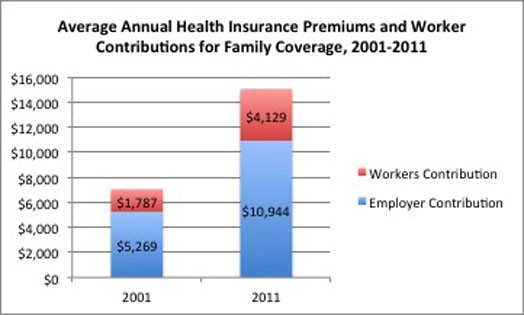
July 16 2015. Think of U.S. healthcare as a form of economic cancer—and you will have the right idea. And, yes, it is metastasizing. No, it’s not the only problem.

A DISASTROUS BYPRODUCT OF U.S. HEALTCARE IS THAT EMPLOYER LABOR COSTS GO UP

VICTOR - SHOT BY MICK - WEBSITE 1

BUT THE EMPLOYEE HAS LESS TAKE-HOME PAY ONCE INFLATION IS FACTORED IN

This (and a long list of other reasons) makes employees unhappy so they become disengaged from their work—and ever increasing numbers leave the workforce. It’s just plain not worth it.

Because such employee purchasing power helps to make up demand—and people who have left the workforce, generally speaking, earn less—overall,  consumer demand suffers.

Productivity suffers because discouraged workers don’t care, and therefore don’t try very hard—even if they don’t actually gives up their jobs.

As for growth—the figure politicians love to tout—it is increasingly meaningless to most Americans, because they are finally (if slowly) beginning to realize that the benefits accrue only to the rich.

It is my contention, by the way, that the U.S. has the worst labor relations of any developed nation—and that situation plays no small role in the current rather miserable productivity situation. It is not the only factor—under-investment by business in everything from R&D, to training, to plant and equipment plays no small role—but the mindset of the workforce is no small issue.

The following is from an Atlantic article by David Frum on why Jeb Bush is so wrong about American workers. The points which hit me hardest were:

  • That Florida did grow at 4 percent a year under Jeb Bush—but only on the back of a property bubble, which burst—and the Florida economy collapsed.
  • The combination of the corrupt American Business Model and U.S. healthcare is destroying the U.S. economy.
  • The disillusionment of underpaid American workers is very real—and they are voting with their feet—thus depressing demand.

Those who work less, earn less: In 2011, only 18.5 percent of the poorest quintile of households contained a full-time worker, as compared to 60.5 percent in the middle quintile, and 78.2 percent in the top quintile.

Are people up in arms over these developments and trends—because the longer-term outcome will be horrendous? No. Most Americans seem to be either unaware, or indifferent.


Wednesday, July 15, 2015

July 15 2015. Corporations? A case of too much of a good thing. Having mastered the art of conditioning us commercially, they have now seized the political high ground. They finance and dominate Congress. Their owners are our real masters.

LIFE IS A LARGELY ONE-SIDED PROPAGANDA WAR OF EXTRAORDINARILY SAVAGE INTENSITY

VICTOR - SHOT BY MICK - WEBSITE 1

AND CORPORATE POWER IS WINNING

Corporate propaganda is so intense, pervasive, and egregious that—paradoxically—we mostly don’t notice it. We would only become aware of it, if it ceased.

Image the silence! I doubt any of us can. Corporate propaganda is a cradle-to-the-grave service. As a consequence, we are as about as thoroughly conditioned as is possible.

Being conditioned means we are trained to accept a great deal as normal, reasonable, and right—pretty much without thought—whereas we might react entirely differently if we hadn’t been conditioned and had to think things through ourselves.

Conditioning doesn’t just mean acceptance. In many cases, it means we act in accordance with the wishes of those who condition us. In particular, we buy things, and otherwise spend money, as our conditioners wish—which is serious enough in itself—but it also means we vote without thought, make war without consideration of the consequences, trust the wrong people, lose faith in perfectly good institutions—and generally behave in a controlled manner while deluding ourselves that we are rugged individuals who think for ourselves.

Would we make better decisions if we really did think for ourselves?

I don’t know the answer to that—but I would truly like to find out.

I’m rather attached to that phrase, We The People. It reflects a noble aspiration—sadly betrayed by the reality.

We The Manipulated doesn’t have the same ring. However, it is superior in one fundamental way.

It is the truth.