Thursday, September 17, 2015

September 17 2015. Is it possible to buy a profession? You know, I rather think it is. Consider Big Pharma, the medical profession, and the disaster that is American healthcare. Now, think about economists—and wonder why so many Americans are faring so poorly—while the economy, itself, appears to be growing.

BACK WHEN I WAS STUDYING ECONONOMIC AT UNIVERSITY, I BECAME VERY SCEPTICAL OF THE TREND TOWARDS MATH  MODELS OF AN ECONOMY AS BEING  CAPABLE OF PROVIDING THE ANSWERS

VICTOR - SHOT BY MICK - WEBSITE 1

IT SEEMED TO ME CRYSTAL CLEAR  THAT ECONOMICS SHOULD BE MUCH MORE CONCERNED WITH HUMAN BEHAVIOR—AND THE PRAGMATIC SEARCH FOR WHAT WORKS.

I still hold to that view—and am delighted to see that it is becoming more widely accepted (after a modest delay of 50 years).

Why is the self-evident such a mystery to so many people—including so-called experts!

Don’t get me wrong. I’m not against number-crunching as such—it is highly desirable, indeed essential, to quantify where you can—but am merely making the point that there is a great deal about the human condition, and its behavior, that we cannot quantify as yet—and possibly ever.

Anyway, I was both amused and pleased when I read the following in a piece entitled How Stanford Took On the Giants of Economics in the New York Times of September 10 2015. The following is merely a short extract, but it made me chuckle.

But the recent recruiting success of Stanford shows something broader about how the economics profession is changing. The specialties of the new recruits vary, but they are all examples of how the momentum in economics has shifted away from theoretical modeling and toward “empirical microeconomics,” the analysis of how things work in the real world, often arranging complex experiments or exploiting large sets of data. That kind of work requires lots of research assistants, work across disciplines including fields like sociology and computer science, and the use of advanced computational techniques unavailable a generation ago.

I have never practiced as an economist, so am reluctant to call myself one, but after 55 years studying it with zeal and dedication, I guess you could say I have learned a thing or two. In truth, I find it fascinating—and fun.

My focus is pragmatic. I am in search of what works—in the sense of yielding the greatest economic advantage for the population as a whole, with the least negative environmental side effects. I’m interested in quality of life rather that any particular “ism.” When people talk about “freedom” when it remains an abstract ideal without wealth, I tune out. Though I think everyone should be as personally responsible as their abilities and circumstances allow, I am not a believer in “rugged individualism.” We live in a world where cooperation isn’t just desirable—it is essential. I don’t believe anyone accomplishes anything worthwhile entirely alone. They are always helped—directly or indirectly—along the way. We don’t necessarily build on “the shoulders of giants”—though I like the concept. We build on what others have done, flaws and all.

That said, I remain decidedly uneasy about the economics profession which seems to focus far too much on developing arguments to support ideologies and not nearly enough on identifying what works. If you work in a Right Wing think-tank, for instance, your findings had better support Right Wing ideology or you will lose your job. Quite how that is compatible with intellectual honesty is a good question. I don’t think it is.

All too many economists have, in effect, been bought. It’s a great pity, because increasingly we have enough data to identify what works—and with Big Data, the necessary tools to monitor, store, and analyze it.

Whether we will or not is another matter entirely. Data have a disturbing tendency to be corrupted by ideologies—and all the computing power in the world is of scant benefit if some zealots are fiddling with the figures.

We have Taliban in the West too—under other names—and they are just as fanatical and dangerous.

I’ll expand on that thought some other time.


QUOTE OF THE DAY

"The salary of the chief executive of a large corporation is not a market award for achievement. It is frequently in the nature of a warm personal gesture by the individual to himself." -John Kenneth Galbraith


Wednesday, September 16, 2015

September 16 2015. Mine is bigger than yours—or is it?

UNFORTUNATELY, BOTH WEALTH AND INCOME DISTRIBUTION IS SO DISTORTED IN THE U.S THAT BEING THE RICHEST NATION IN THE WORLD DOESN’T MEAN MUCH TO ALL TOO MANY AMERICANS—Who live paycheck to paycheck, and seem to be too busy surviving to fight back.

VICTOR - SHOT BY MICK - WEBSITE 1

HERE, I’M NOT ARGUING FOR EQUALITY—JUST A SYSTEM WHICH OFFERS EQUAL OPPORTUNITY AND ISN’T SO BLATANTLY RIGGED.

IT IS MY BELIEF THAT ALL  AMERICANS WOULD BENEFIT IF SUCH WERE THE CASE.

RIGHT NOW—IT ISN’T!

I am seriously critical of the current American Business Model—and make no apology for that stance (because I believe it is supported by the evidence).

Nonetheless, I am decidedly not against a competitive free-enterprise system (which is, let me stress, a form of capitalism).

But, the point about capitalism is that it comes in many varieties—like ice cream (though with less sugar)—and some are a great deal more acceptable than others. Putting it simply, some work a great deal better than others—particularly if the interests of the population, as a whole, are factored in. If that is not a concern—and you are happy with a winner-take-all environment, well that is another matter entirely.

Capitalism isn’t one rigid thing. It is an approach, which works exceedingly well—let me stress this—if there are ground rules. Unfettered capitalism also works—but it benefits only a few.

I tend to believe that my kind of capitalism should benefit the many—and I am convinced that it can.

Why so?

Because Northern Europe (plus some other European nations) is demonstrating it right now—and has for many years. Add the populations of all the countries concerned together and you end up with a population roughly equivalent to that of the U.S. so the argument that the U.S. is too large to operate that way does not hold water.

Please note that I’m stressing Northern Europe rather than Europe as a whole because quite clearly some members of the EU are still struggling. However, most of the outliers seem to be heading in the same direction—towards the Northern European approach. As for Italy, it is a riddle inside an enigma—and I have absolutely no idea where it is heading (and I don’t think the Italians are any the wiser). All I can say is that parts of it seem to work a great deal better than you might expect—and it’s a great place to visit.

I have no doubt at all that Northern-European-style Socially Democratic capitalism would work fine in the U.S.—and would be to the great advantage of the American people.


1 September 2015

The US as a whole had a GDP of $17.3 trillion in 2014, making it the richest nation by a large margin (about $7 trillion ahead of China). But, as it is well known, the value of economic activity is unevenly distributed throughout the country. The diagram below shows the relative economic value (in 2014 dollars) of each US state. The states are also grouped by color according to the region that they comprise. The first thing you will notice is that most economic activity is concentrated in three regions: Far West (18.6%), Southeast (21.3%), and Mideast (18.2%). All of these regions contain major US States and cover the US coastline, which is where most large cities are located – so it is not surprising that most of the economic value in the US is generated in these regions.


In terms of states, California (13.3%), Texas (9.5%), and New York (8.1%) have by far the largest economies. The states with the smallest economies are Vermont (0.2%), Maine, Rhode Island, North and South Dakota, Montana, Wyoming, and Alaska (all representing about 0.3% of the US economy).

How has this relationship changed over time? All states have increased their economic outputs between 2011 and 2014, but some have grown faster than others. In terms of regional influence, the Southeast economy has shrunk in relation to other regions by just 0.4% over the last four years, while the Southwest economy has grown by 0.8% relative to other regions. Texas increased the size of its economy by almost $300 billion, more than any other state, growing from 8.8% of the US economy in 2011 to 9.5% in 2014. This growth in Texas was fueled by mining and manufacturing. California grew by just under $300 billion, but only increased its share of the total economy by 0.1%.

It seems as though the largest economies in the US are poised to stay that way for the foreseeable future thanks to healthy economic growth rates. The smaller states are growing in terms of economic output, but in most cases at slower rates.

If you have any thoughts on this subject, drop us a line! We would love your feedback.

Get the best of HowMuch delivered to your inbox weekly. You are going to love it! 


Tuesday, September 15, 2015

September 15 2015. We all start creative—but something happens along the way.

I’M VERY MUCH OF THE VIEW THAT WE COULD DO A GREAT DEAL MORE TO FOSTER CREATIVITY—AND A WHILE LOT LESS TO KILL IT

VICTOR - SHOT BY MICK - WEBSITE 1

THE FOLLOWING PIECE PUTS THE SITUATION WELL

edwardboches

edwardboches

https://medium.com/@edwardboches

Professor of Advertising, Creative Director, Writer, Hacker, Advisor to Brands, Ad Agencies and The Next Generation. Boston University, Mullen and Beyond.

“Do you think you are creative?”

Surprisingly when I ask that question of students in my introductory creative class only about half the class raises their hands. They’re often taking Fundamentals of Creative Development because it’s required for all advertising majors, not just those interested in becoming a writer, art director, or designer.

If I have one goal it’s to convince everyone in the class that he or she is creative. We’re all creative. Everyone is creative.

Sadly, most of our public schools, in their misguided efforts to prepare students for standardized test taking, destroy kids’ natural creativity. Studies have even shown that creativity drops precipitously as early as first grade when you’re told that a house has four sides, a door in the middle and a triangular roof, contradicting that amazing half bird house, half ant hill you’d been drawing. Conformity is not a friend of creativity.

There’s also some confusion about what it means to be creative. So it might help to distinguish between being artistic and being creative. Not everyone is artistic. That requires both imagination and the skill to draw, paint, sculpt, or compose music. Creativity simply asks that we use our imagination to solve problems. You don’t have to draw to do that.

You do have to look at the world around you in new ways, find hidden patterns, and connect seemingly unrelated phenomena to generate solutions.

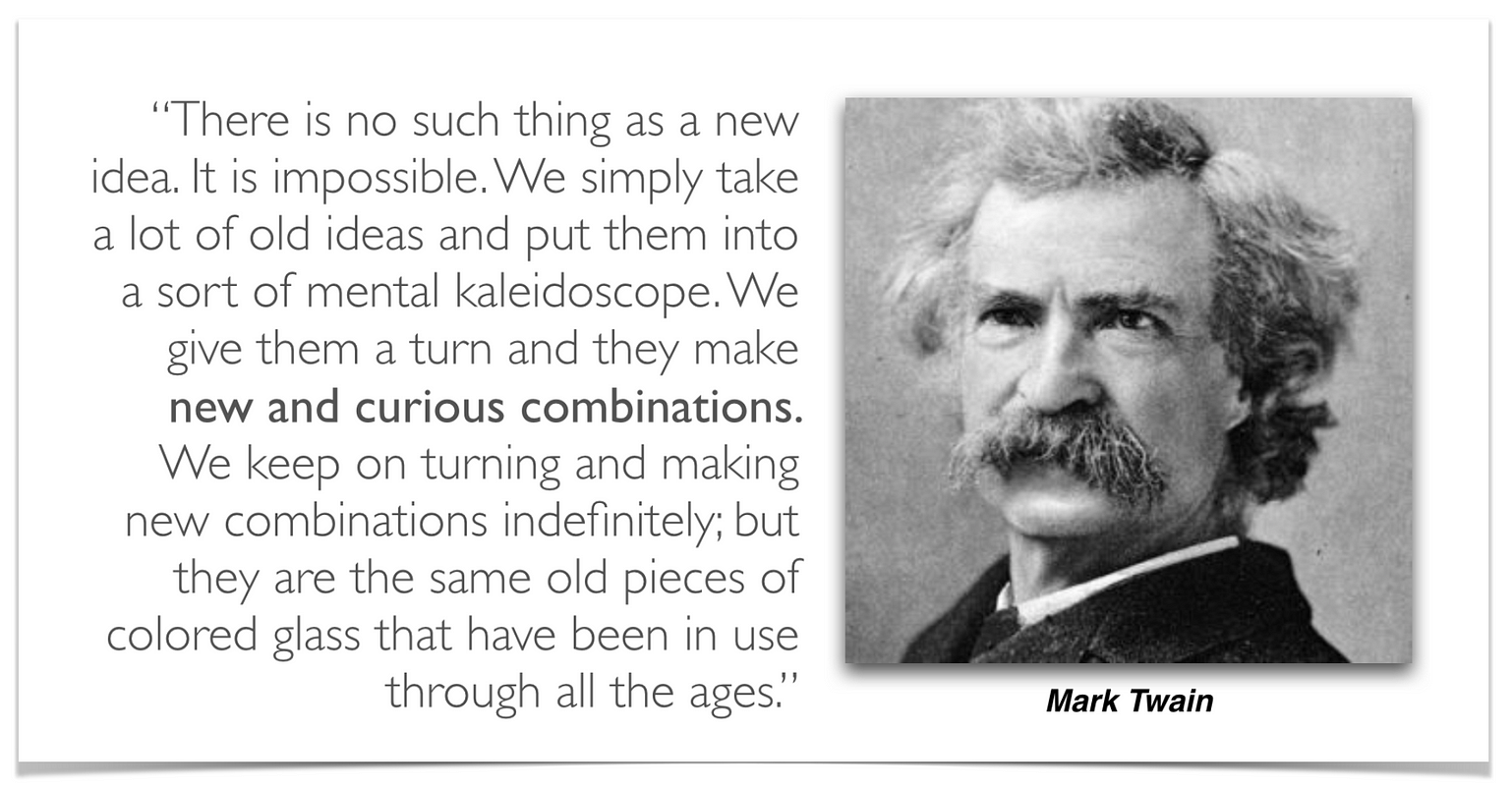
It’s a process that can be learned, practiced and mastered, as James Webb Young explained in his 1940 classic, A Technique for Producing Ideas. I suggest you read it. Or perhaps Neil Pavitt’s How to Be Creative, a variation on the same topic. Both adhere to Mark Twain’s claim that there is no such thing as an original idea, just new combinations of old ideas. The trick is simply to have a drawer full of thoughts, images, facts and experiences out of which you can try combinations.

A core problem is that socialization is equated with conformity—and conformity to the social norms makes children much easier to manage.

In short, we adults stunt our children’s creativity for our own convenience (a rather appalling thought which also happens to be the reality).

Strangely enough, though my mother was both physically and verbally abusive to excess—and my childhood was decidedly difficult and brutal by any standards, my innate creativity was very far from crushed.

Why not?

  • I am genetically intellectually curious so have always been reluctant to accept virtually anything at face value.
  • I came to the conclusion, at a very early age, that a great deal of what I was told wasn’t true.
  • I wasn’t too impressed with the job society was making of life and soon decided that there had to be a better way to conduct the business of living. I was doubtless influenced in that regard by being a WW II baby and growing up observing what a mess those adults—who professed to know everything—had made of the world.
  • Despite being educated to be a lady by a series of French governesses—against who she had rebelled with near total success (though she learned to speak French with some fluency) my mother had never been socialized so had absolutely no idea how to socialize me.
  • Both she and my step-father were extraordinarily creative and created an atmosphere which was nothing if not stimulating—and peopled with the most extraordinary characters.
  • Once I discovered reading I was able to escape from the rigid socialization that boarding school endeavored to enforce. My body was confined by boarding school—which I hated—from the age of five, but my mind roamed the world to find adventure.

It still does.


Monday, September 14, 2015

September 14 2015. Screwed up priorities. One all powerful god—generally referred to as MONEY. It’s the one religion that most Americans have in common—and they practice it with zeal.

ROBERT REICH IS EXPRESSING OUTRAGE ABOUT A DEEPLY SERIOUS

VICTOR - SHOT BY MICK - WEBSITE 1

SITUATION—WHICH CONTINUES TO BE LARGELY IGNORED BY AMERICANS. THE FACTS SUPPORT HIS ARGUMENTS.

But do facts carry any weight any more? As far as U.S politics are concerned, one can but wonder. Yet many people are decidedly uneasy about the direction of the country.

If it is a pity to waste a good crisis, it is even more of a pity to waste one of this magnitude, which is continuing for so long—and providing endless provocations and opportunities for the kind of nationwide response that is called for.

Perhaps its very normality as a backdrop to the American Way of Life is the problem. It is just accepted as being inevitable. If it’s all people know—and they assume that the American Way of Life is innately to superior to any and all alternatives—they won’t seek change. Why should they—if what they have got is the best there is?

If that is the case, it does not speak well of the U.S.’s political health—or the vitality of American Democracy.

But then American Democracy doesn’t exist any more except as theater. The actual government of the country is in the hands of a plutocracy which is strengthening its grip on the country by the day.

Meanwhile the media are filled with politics as entertainment.

How so? In too many ways to list, but fundamentally for the simple reason that the plutocrats concerned are getting richer by the day—and money is what has given them control of the political system. More money give them more control. More money for them tends to mean less money for their opponents. Critics can not merely be outfought through highly sophisticated propaganda and suborned politicians, but out-bought. Money, unfortunately, does buy votes. It is not always successful, but mostly it is.

Money is an extremely useful thing, but when just about everything is monetized—from the Constitution to religion, from National Security to sports—as is nearly the case in the U.S.—you have a culture whose values are in serious trouble.

When you have a population which seems to  be largely unconcerned, regardless of the provocations—it is difficult to retain faith in the belief that this is just a bad patch, and the U.S. will get back on track, and become, one again, “The Bastion of Democracy.”

Personally, I would settle for it returning to being a democracy.

I haven’t given up hope yet—but I’m getting increasingly concerned.


Robert Reich: Americans Obsess Over the Sex Lives of Strangers While CEOs Rob the Country Blind

alternet.org

Published on Alternet (http://www.alternet.org)

Home > Robert Reich: Americans Obsess Over the Sex Lives of Strangers While CEOs Rob the Country Blind

By Robert Reich [1] / Robert Reich’s Blog

September 8, 2015

At a time many Republican presidential candidates and state legislators are furiously focusing on private morality – what people do in their bedrooms, contraception, abortion, gay marriage – America is experiencing a far more significant crisis in public morality.

CEOs of large corporations now earn 300 times the wages of average workers. Insider trading is endemic on Wall Street, where hedge-fund and private-equity moguls are taking home hundreds of millions.

A handful of extraordinarily wealthy people are investing unprecedented sums in the upcoming election, seeking to rig the economy for their benefit even more than it’s already rigged.

Yet the wages of average working people continue to languish as jobs are off-shored or off-loaded onto “independent contractors.”

All this is in sharp contrast to the first three decades after World War II.

Then, the typical CEO earned no more than 40 times what the typical worker earned, and Wall Street was boring.

Then, the wealthy didn’t try to control elections.

And in that era, the wages of most Americans rose.

Profitable firms didn’t lay off their workers. They didn’t replace full-time employees with independent contractors, or bust unions. They gave their workers a significant share of the gains.

Consumers, workers, and the community were considered stakeholders of almost equal entitlement.

We invested in education and highways and social services. We financed all of this with our taxes.

The marginal income tax on the highest income earners never fell below 70 percent. Even the effective rate, after all deductions and tax credits, was still well above 50%.

We had a shared sense of public morality because we knew we were all in it together. We had been through a Great Depression and a terrible war, and we understood our interdependence.

But over time, we forgot.

The change began when Wall Street convinced the Reagan Administration and subsequent administrations to repeal regulations put in place after the crash of 1929 to prevent a repeat of the excesses that had led to the Great Depression.

This, in turn, moved the American economy from stakeholder capitalism to shareholder capitalism, whose sole objective is to maximize shareholder returns.

Shareholder capitalism ushered in an era of excess. In the 1980s it brought junk bond scandals and insider trading.

In the 1990s it brought a speculative binge culminating in the bursting of the dotcom bubble. At the urging of Wall Street, Bill Clinton repealed the Glass-Steagall Act, which had separated investment from commercial banking.

In 2001 and 2002 it produced Enron and the corporate looting scandals, revealing not only the dark side of some of the most admired companies in America but also the complicity of Wall Street, many of whose traders were actively involved.

The Street’s subsequent gambling in derivatives and risky mortgages resulted in the crash of 2008, and a massive taxpayer-financed bailout.

The Dodd-Frank Act attempted to rein in the Street but Wall Street lobbyists have done everything possible to eviscerate it. Republicans haven’t even appropriated sufficient money to enforce it.

The final blow to public morality came when a majority of the Supreme Court decided corporations and wealthy individuals have a right under the First Amendment to spend whatever they wish on elections.

Public morality can’t be legislated but it can be encouraged.

Glass-Steagall must be resurrected. Big banks have to be broken up.

CEO pay must be bridled. Pay in excess of $1 million shouldn’t be deductible from corporate income taxes. Corporations with high ratios of executive pay to typical workers should face higher tax rates than those with lower ratios.

People earning tens if not hundreds of millions of dollars a year should pay the same 70 percent tax rate top earners paid before 1981.

And we must get big money out of politics – reversing those Supreme Court rulings, providing public financing of elections, and getting full disclosure of the sources of all campaign contributions.

None of this is possible without a broadly based citizen movement to rescue our democracy, take back our economy, and restore a minimal standard of public morality.

America’s problems have nothing to do with what happens bedrooms, or whether women are allowed to end their pregnancies.

Our problems have everything to do with what occurs in boardrooms, and whether corporations and wealthy individuals are allowed to undermine our democracy.

Robert B. Reich has served in three national administrations, most recently as secretary of labor under President Bill Clinton. He also served on President Obama’s transition advisory board. His latest book is “Aftershock: The Next Economy and America’s Future.” His homepage is www.robertreich.org [2].

alternet.org


Sunday, September 13, 2015

September 13 2015. It strikes me that the Kindle is a very good thing. Their owners buy nearly 9 books a month. Who are those guys?

INFOGRAPHICS ARE A WONDERFUL INVENTION THOUGH THEY ARE A LITTLE SMALL WHEN REDUCED TO FIT IN THIS BLOG.

VICTOR - SHOT BY MICK - WEBSITE 1

I USE THEM ANYWAY—IF ONLY AS A POINTER TO THE ORIGINAL SITE

Check out writtenwordmedia .com

For some years now, while continuing to write—and keep up to date with my other areas of interest (principally military matters and the U.S. economy), I have been trying to understand the book market a little better—and have been investing a formidable amount of time to do so.

If I told you how much, you would look concerned, and suggest I seek therapy—or you would arrange for people in white coats to lock me up somewhere. Most people seem to think you can research almost anything adequately in three months—and absolutely nothing should take years unless you are trying to establish a colony on Mars, or do something of equal difficulty.

What can I say! The book market is large, complex, and ever evolving—and practically as fast as you think you have the hang of something, the ground rules change. Then there is the fact that it is extremely useful to monitor the annual sales cycle a few times and soak up the rhythm of the thing.

I’m also a great believer in not moving until you are ready to move—and then, ideally moving at speed. But, as ever, it depends on the situation. I have also a tendency to take the long view—which many regard as nuts. I don’t find it so.

How do you know when the moment is right? I tend to rely on my inner voice. Advice may or may not be well meant, but I have found such peer group contributions to be of debatable quality over the years—though it is always tempting to go with the flow.

But, you don’t have to give in to it.

Of course, the price of moving at your own particular pace is high—in all kinds of ways including financial, relationships, and stress—but the price of not being true to yourself is a whole higher, and nothing worth doing is ever easy.

But, it is satisfying.

In this case, given my age (72 next May) I am much influenced by the fact that this will probably be my last significant entrepreneurial venture (don’t count on it)—so I would like to do it right.

I’m not after perfection, just a sense I’m on top of things, and am as prepared as any entrepreneur can be for the inevitable setbacks, unexpected events—and opportunities. Sudden sales success, for instance, can overload your administration and do a great deal of damage. .

The unexpected, as I have written before, is to be expected.

Incidentally, Nicholas Taleb—the intense looking guy pictured below—is the author of BLACK SWAN about precisely that subject. It’s a thought-provoking book.

Frankly, I think there is a great deal to be said for a monthly salary—except the price. I expect most writers and other creative artists would agree.

Are the stresses and insecurities of a creative life worth it?

Well, like most people, I would like a secure comfort zone—but the pleasures, satisfactions, and joys of writing have exceeded my wildest dreams.

I’m downright surprised—but most agreeably so.

Anatomy-of-a-Kindle-Owner-Written-Word-Media

Saturday, September 12, 2015

September 12 2015. The militarization of America.

THE UNCRITICAL ADULATION OF THE U.S. MILITARY—

VICTOR - SHOT BY MICK - WEBSITE 1

WHILE KNOWING VIRTUALLY NOTHING ABOUT IT—IS MORE THAN A LITTLE UNHEALTHY.

Od course we should support the fighting troops—but the MICC, the Military Industrial Congressional Complex, is another matter entirely.

It is deeply corrupt and a threat—just in itself—to National Security. It regards war as a profit opportunity—and business is good. Its wars are extraordinarily expensive, drag on for ever, and are rarely won. Shouldn’t that tell us something?

I wrote recently that the U.S. was on the slippery slope toward fascism—and I often comment that the U.S. is a plutocracy rather than a democracy because the ultra-rich, and the corporations they control, have, in essence, bought control of the political system from federal to local level—and the masses (us) have been largely neutralized through propaganda—aided, to no small extent, by legal and other drugs.

When the majority of the population are on legal meds, something is seriously amiss. When such legal drugs are taken in untested combinations, you get what we have got—a dysfunctional democracy which has allowed some exceptionally greedy people to control it.

Enter the Drombie (Drugged Zombie) Culture. That’s a little harsh, but not a lot. Americans are alarmingly prone to be on medication, singularly misinformed, distracted by entertainment, and politically supine. They do all sorts of good and amazing things too—but you would have to be deaf, dumb, blind, and dead not to notice that there is something deeply wrong with the political culture—including the voters. It is not good enough to dump on the politicians alone when you have helped to put, and keep, those people there. The voters are complicit.

Look at the research and the voting patterns. There are a lot of fine people out there—but, palpably, something isn’t working.

Thanks to the Supreme Court, which pretty much has allowed unlimited money to be deployed, the ultra-rich now have a disproportionate influence influence on the political system. At a certain point, influence becomes power.

Have we reached that point? I think we have. As the recent Great Recession demonstrated, the most egregious behavior by the ultra-rich largely goes unpunished. The fundamentals of financial reform were blunted.

Just because Congress walks like a duck, and quacks like a duck, doesn’t mean it is a Congress—if you see what I mean.

This raises the interesting question of what the plutocracy would do if seriously challenged by the trappings of the democratic process—which still continue.

The plutocracy, at present, is more content to block reform, than to do anything too overt. Gridlock suits them just fine.

What they would do if Bernie Sanders looked like winning, and appeared to be likely to have enough support to push through his ideas, is an interesting question.

Is a Bernie Sanders success a possibility? I would like to think so—though all the pundits say pigs will fly in formation first.

Is a military coup possible? Though, on the face of it, it seems a fantastic ideas, I rather think it is. It is unlikely, but it is no longer beyond the bounds of possibility—should it prove necessary. At present, the movers and shakers have been able to gain control by using the system itself. We’ve already had a coup of sorts—courtesy of the weaknesses in the Constitution. Appreciate that it is supposed to be revised regularly. Instead it has been turned in a Sacred Cow.

A Sacred Cow does not a Constitution make.

When people lose faith in their system of government to the degree that Americans have, they eventually look for an alternative.

History shows that such alternatives have a habit of presenting themselves first. I think it is called opportunism.

Americans think coups and dictatorships are for other people (they used to think that about terrorism—but learned better).. I have experienced both firsthand in Spain, Greece, Portugal, and Hungary.

They are not. They sneak upon you—and then it is too late.

The figures in the piece below are truly worrying.

The American tragedy continues.

A Military Coup in the U.S.? A Surprising Number of Americans Might Support One

thefiscaltimes.com

		<p>Significant defense savings can be achieved by simply relocating a fraction of our troops in Europe to the United States. The Cold War ended more than 20 years ago, and we no longer need to station troops in Europe to hold the line against the Soviet

Getty Images

By Millie Dent

Follow

September 10, 2015

Imagine you’re watching the evening news, kicking back after a long day in the cubicle. Suddenly a breaking news alert flashes across the screen: “Military Coup Overthrows the Government.” What would be your reaction?

While most Americans say they can’t imagine supporting a takeover of the government by the armed forces, or least aren’t sure about it, a substantial number of people say they can imagine supporting the military in such a scenario.

In a new survey by YouGov, 29 percent of respondents said they can imagine a situation in which they would support the military taking control of the federal government – that translates into over 70 million American adults. Forty-one percent of respondents said could not imagine supporting the military taking over the country.

Related: With $8.5 Trillion Unaccounted for, Why should Congress Increase the Defense Budget?

Republicans (43 percent) were more likely to say they can envision a scenario in which they could support a military coup than Democrats (20 percent). Perhaps that difference is related to having a Democratic president who some critics on the right see as overstepping his power.

Regardless of political ideology, one reason people might support a military coup is because they respect officers in the military far more than they do people in Congress. According to the same YouGov survey, almost three-quarters (70 percent) of respondents believe that military officers want what is best for the country, while only 29 percent think the same of members of Congress.

Lawmakers better shape up or they might be shipped out — literally.

image


Friday, September 11, 2015

September 11 2015. A growth economy combined with declining pay. Hmmm! That sounds about as healthy as cancer. And most people aren’t complaining! And this is supposed to be a democracy! It sound more like a plutocracy to me—or do I mean fascism?

I KEEP ON TALKING ABOUT THE INADEQUACIES OF THE AMERICAN BUSINESS MODEL. (Structural flaws etc.)

VICTOR - SHOT BY MICK - WEBSITE 1

NOW AND THEN IT IS USEFUL TO LOOK AT THE DATA. THEY  SHOW THAT I AM TELLING YOU NO MORE THAN THE TRUTH.

IT WON’T CHEER YOU UP (It is not intended to)

I DO HOPE IT WILL PERSUADE YOU TO DO SOMETHING.

You are dealing with a predatory system largely entirely lacking culturally in social concern—and need to respond accordingly—or this depressing situation will continue.

Some countries are intrinsically poor. They lack a decent government, an educated population,  infrastructure, and natural resources. They are geographically isolated. The weather is terrible. Corruption is rife. The rest of the world doesn’t give a damn about them. They have no oil.

All in all, their predicament is regrettable—but understandable.

The U.S. should not be in the state it is in.  It is the richest country in the world, physically extraordinarily well endowed, and downright brimming with resources. And yet large numbers of Americans are living financially insecure lives and millions are living in poverty.

There is no excuse for this.


This chart shows America badly needs some raises

Vox · by Matthew Yglesias

The labor market is a lot healthier in 2015 than it was five years ago, and with the unemployment rate falling, a lot of people are expecting the Federal Reserve to start acting to slow economic growth before workers demanding raises can generate inflation.

A new report from the National Employment Law Project puts that choice in context, by showing that inflation-adjusted wages fell substantially between 2009 and 2014 for almost every occupation under the sun.

One cut at this sorted different occupations into quintiles based on their average 2014 wages and then looked at how each quintile has fared. Researchers found that the rich have gotten poorer, and the poor have gotten a lot poorer:

NELP

Wages have fallen for the most common high-paid jobs

Delving into finer-grained data, they look at the 10 most commonly held high-wage jobs in America. They find that for all 10 occupations, wages have fallen.

The rightmost column shows the percentage change in wages from 2009 to 2014. The middle column shows the average hourly wage. And the left column shows the number of people who have the job:

NELP

Wages have fallen for the most common low-paid jobs, too

The good news for high-wage workers is that, with the exception of lawyering, pay has only fallen a little. If you look at the 10 most commonly held low-wage jobs, you see a much worse situation:

Americans could use a raise

The message in these statistics is pretty clear: A little upward pressure on wages would be a welcome corrective to years of falling pay. Under the circumstances, the itchy trigger on the Federal Reserve staff seems out of touch with the basic reality that a years-long spell of high unemployment has given bosses an unprecedented ability to squeeze their employees.