Friday, August 14, 2015

August 14 2015. CEO PAY. The financialization of the economy—and its many unfortunate manifestations

ANOTHER FACET OF THE AMERICAN ECONOMIC MODEL

VICTOR - SHOT BY MICK - WEBSITE 1

AND AN INTERESTING CONTRAST WITH THE FACT THAT THE EARNING POWER OF MOST AMERICANS IS IN DECLINE

CAUSE AND EFFECT?

CEO PAY—UP 997 PERCENT SINCE 1978. The problems with the current American Business Model are so severe that CEO pay is very far from the top. In fact, does it matter at at all?

It might not if a rising tide was genuinely raising all boats. However, it is not.

In the context of the failure of the ABM to deliver the kind of economic wellbeing other systems are delivering—egregious CEO pay matters a great deal. It also shows a marked contempt for corporate employees which is symptomatic of the prevailing authoritarian ethos of much of U.S. management.

The following is from The Fiscal Times of August 6 2015.

CEO compensation in America is the highest in the industrialized world. Pay for the leaders of the largest public firms has gone up 997 percent since 1978, almost twice as fast as the stock market and almost 100 times as fast as compensation for the average worker over the same period.

The ratio between a CEO and the typical worker is now 303:1, up from 20:1 in 1965 (though down from its peak, 376:1, during the dot-com bubble of 2000). Last year, Discovery Communications’ David Zaslav, took home $156.1 million in salary, bonuses, stock options and other benefits. He wasn’t in the top-paid CEO, though: GoPro’s Nick Woodman made $285 million.


Thursday, August 13, 2015

August 13 2015. STOCK BUYBACKS. The financialization of the economy—and its many unfortunate manifestations.

THE SCALE OF STOCK BUYBACKS IS TRULY STUNNING—NEARLY $7 TRILLION SINCE 2004

VICTOR - SHOT BY MICK - WEBSITE 1

IT REPRESENTS A DISTORTION OF THE AMERICAN BUSINESS MODEL (AND INSIDER TRADING) ON AN EPIC SCALE

WHY ISN’T IT ILLEGAL—AND PROSECUTED?

DEFININITIVE INSIDERS. As far as most of us are concerned, trading with special knowledge of a company’s situation—knowledge which is not generally available—is illegal. In fact, it can earn you a prison sentence. It is not regarded as a trivial crime. It is not a technicality. It is cheating and is a felony (as Martha Stewart found out to her cost).

An underlying principle (and myth) of a free market economy is that we all compete on an equal basis—so called ‘fair competition.’

Is the current American Business Model really based upon fair competition? No! Of course it isn’t. This is an ABM (American Business Model) propaganda fiction. Some degree of competition does, of course, exist—but corporations work very hard to minimize or eliminate it. They do that in numerous ways. These include.

  • MERGERS & ACQUISITIONS. You buy up the competition. U.S. business is now more concentrated than ever before. Large businesses have the advantage here. They can raise the necessary funds required more cheaply and more easily than their smaller competitors. For instance, the financial system is so structured that the Big Banks can borrow more easily and cheaply from the Federal Reserve than smaller banks (and no one else can borrow from the Fed at all). Is that free competition? No, it is not.
  • INFORMAL (& ILLEGAL) PRICE FIXING AGREEMENTS. Such agreements are not written down, but are very much the standard. They are easy to maintain, on a nod and a wink basis, when most market sectors are dominated by only a few corporations—with one normally recognized as de facto leader.
  • USING THE LEGAL SYSTEM TO RESTRAIN TRADE. This is particularly an American phenomenon. The fact that many states will not allow car manufacturers to sell their vehicles directly is a perfect example. Car dealers have to be involved by state law—thus raising car prices. Tesla have been a victim of this. Restrictions of this type are common.
  • RAISING THE ENTRY BARRIER THROUGH COMPLEXITY. Smaller companies have a very hard time dealing with large bureaucracies so this is particularly a feature of any activity involving the government. The little guy with the better idea, or cheaper quote, is filtered out—or only allowed in if he works under a big guy. Sub-contracting is not quite what it seems..   
  • HAVING REVOLVING-DOOR TYPE RELATIONSHIPS WITH GOVERNMENT. These constitute a blatant conflict of interest, but are so so common, they may be considered the norm. They are virtually the standard in the MICC (Military Industrial Congressional Complex) but most other sectors are not far behind. Indeed, it is now common for former congressmen to become lobbyists. The expression ‘crony capitalism’ has a great deal of validity—and it is the cronies who get the cake.

However, the fact that fair competition is the exception rather than the rule will have to be the subject of another blog. It is relevant to know the context, but my focus here is on insider trading.

If any group could be classified as “insiders” it should be the CEO’s and senior executives of public corporations who buy back their own stock. They do it from earnings and sometimes they borrow—and they do it on a scale that defies credulity. Trillions of dollars is serious money. They also do it as a conscious choice instead of paying out the money as dividends to shareholders, or investing it in such fundamentals as research and development, plant and equipment, information technology, and training. 

In short, it may well be argued that they choose to gamble on the stock market, with limited corporate resources, instead of investing them productively.

It is no accident that productivity has declined in parallel with this trend towards share-buybacks. Similarly, wages and salaries have been squeezed in an unprecedented way. This has certainly lowered labor costs, and increased corporate profitability in the short-term, but it has also.

  • Reduced demand.
  • Lowered growth.
  • Demotivated workers.
  • Lowered productivity growth.
  • Failed to make the U.S. adequately competitive globally. In fact, the U.S. balance of trade has been negative for decades.

Priority is given quite blatantly towards pushing up the share price. It is based upon the notion that a corporation’s only focus should be on maximizing shareholder value—and that all are interests (of workers, customers, suppliers, the local community, and the nation) are irrelevant. It is a key credo of the American Business Model—and represents a fundamental difference with the kind of socially democratic capitalism that is practiced in Europe.

WHY DO THEY DO IT? They do so because it puts up the share prices—which, since they are largely paid in stock, benefits them directly. Because they are employed by such companies at senior level, it is self-evident that they have information about their corporations which is not generally available. They are the very definition of insiders—yet what they do is not regarded as illegal.

TWO LEGAL SYSTEMS. Why not? No good reason has been given. It is just another example of a rigged economy, regulators being muzzled (the SEC in this case) and two legal systems. There is a law for the rich—and a law for the rest.

CONSEQUENCES.Share buybacks should be illegal. Other insider trading is. They:

  • Accentuate short-term thinking—so called ‘short-termism.’ In contrast, our competitors largely think and plan strategically and take the long view.
  • Distort the stock market. Prices are not a reflection of genuine supply and demand.
  • Represent a misuse of corporate resources.
  • Sometimes leads to quite unnecessary borrowing.
  • Lead to underinvestment in R&D, plant,. equipment, training—and other factors to do with the long term health of the company.
  • Fail to add real value.
  • Have coincided with a loss of international competitiveness, poor productivity, and a decline in the real earning power of most Americans. Cause and effect?

The following is an extract from the New York Times of August 10 2015.

Since 2004, companies have spent nearly $7 trillion purchasing their own stock — often at inflated prices, according to data from Mustafa Erdem Sakinc of the Academic-Industry Research Network.

That amounts to about 54 percent of all profits from Standard & Poor’s 500-stock index companies between 2003 and 2012, according to William Lazonick, a professor of economics at the University of Massachusetts Lowell.

The buyback craze, in which virtually every big company from Apple to General Electric to Walmart has participated, has led to a backlash from some investors and government officials, who have questioned whether such use of profits is a productive way to deploy capital rather than reinvesting in businesses and jobs.

Laurence D. Fink, the founder of BlackRock, the largest asset manager in the world, with more than $4 trillion under management,started a debate about the topic this year among chief executives, suggesting the buyback phenomenon “sends a discouraging message about a company’s ability to use its resources wisely and develop a coherent plan to create value over the long term.”

At this point, you may well ask which economic system works better—the ABM (American Business Model) or European Social Democracy. The answer is: It depends.

  • The ABM seems to work extremely well for a very small number of U.S. CEOs, senior executives, and the ultra rich. It is proving to be disastrous for most Americans, their communities, and the National Interest.
  • European Socially Democratic Capitalism—as far as most Europeans are concerned—is hands-down the winner.

Do most Americans know this—or care? It would appear not.


Wednesday, August 12, 2015

August 12 2015. The unexpected consequences of war—are to be expected. Mostly, we choose not to anticipate them—and we try and ignore them.

THIS IS A SINGULARLY DISTURBING STORY ABOUT THE VERY AIR WE BREATHE—AND THE DUST IT CONTAINS—KILLING US UNPLEASANTLY

VICTOR - SHOT BY MICK - WEBSITE 1

IN THIS CASE, THE VICTIMS ARE OUR SOLDIERS—BUT TINY PARTICULATE MATTER IS KILLING CIVILIANS TOO.

US, FOR INSTANCE? OUR LIFESTYLES PRODUCE IT IN ABUNDANCE

Though I generally consider myself Irish—with a name like O’Reilly I have had little choice in the matter (nor desire to be otherwise)—but I was actually born in London, England. I was largely brought up in Ireland but educated in both. Damnably confusing!

SMOG. We lived in or near London, for a while when I was small, and I vividly remember London smog at its worst. The combination of smoke from hundreds of thousands of coal fires—maybe million—now and then combined with fog, to produce what was known as a “pea-souper” (which maligns pea soup). Car exhaust doubtless added to the murk.

DANGEROUS STUFF. It was unpleasant to breathe, dangerous to travel through, and fatal to significant numbers of people. It was also rather exciting, as far as far as this little boy was concerned, because it made the city feel mysterious—and I was convinced Jack the Ripper was hidden behind every corner. I wasn’t too frightened, because the good news was that, reportedly, he only killed women—but one could never be quite certain.

AIR POLLUTION KILLS. Be that as it may, such encounters with smog have left me particularly aware of air pollution. Witnessing a number of people dying from breathing problems—induced by smoking—or from coal mining (I lived in Wales for a while) have also made me sensitive to the consequences. COPD (Chronic Obstructive Pulmonary disease) results in a dubious quality of life, is incurable, and is not a pleasant way to go.

Indeed, I have something of a horror of air pollution and regard our general indifference to it unless it is highly visible, or smells, as decidedly unwise. In fact, in that spirit, I regard our acceptance of traffic as a strange human eccentricity—and am a great believer in public transport and anything that cuts down on car exhaust.

Yes, I accept we need vehicles—up to a point—but have no doubt at all we could manage with fewer and would be a great deal healthier if we all walked a great deal more. But, I will admit a bias—I have always loved walking.

INVISIBLE, BUT LETHAL. I have long suspected that invisible pollution may matter a great deal more than we think—and recent research would seem to support that disconcerting situation.

Will we do anything about it? Probably not a great deal. We went through a phase of being environmentally concerned some decades ago, but that seems to be out of fashion now.

Wars, however, are decidedly in vogue. They have unpleasant consequences.

I read the following story with concern—I have many friends who have served—and sadness.

Surely, we can do better. When I read about the seemingly implacable Republican opposition to cleaning up our air—coupled with their willingness to throw money at defense, virtually regardless of the need, I am just plain dumbfounded.

Don’t they breathe too? Mostly, politicians don’t fight in the wars they arrange. They let others do the dying.


New research links Iraq dust to ill soldiers

usatoday.com · by Kelly Kennedy, USA TODAY 12:21 a.m. EDT June 2, 2014

AFP_IRAQ-US-TROOPS-SANDSTORM_1741293

Dozens of Iraqi veterans have been diagnosed with constrictive bronchiolitis, a narrowing of the lung’s smallest passageways.(Photo: Jim Watson, AFP)

WASHINGTON — Titanium and other metals found in dust at a base in Iraq have been linked to the dust found in six sick soldiers’ lungs, according to a study set to be released Monday.

“We biopsied several patients and found titanium in every single one of them,” said Anthony Szema, an assistant professor at Stony Brook School of Medicine who specializes in pulmonology and allergies. “It matched dust that we have collected from Camp Victory” in Iraq.

The dust is different from dust found elsewhere in that human lungs are unable to dispel it through natural immune-system processes. The Iraq dust comes attached to iron and copper, and it forms polarizable crystals in the lungs, Szema said. The particles — each bit 1/30th the size of a human hair — have sharp edges.

“They’ve inhaled metal,” Szema said. “It’s not a little; it’s a lot.”

All of the veterans came in for help because they were short of breath, said Szema, who also heads the allergy clinic at the Veterans Affairs Medical Center in Northport, N.Y. Dozens have been diagnosed with constrictive bronchiolitis, a narrowing of the lung’s smallest passageways that occurs only after exposure to an environmental toxin or in lung-transplant patients.

There are several theories as to why the dust is different, said Szema, who will release his study at the Symposium on Lung Health after Deployment to Iraq and Afghanistan.

It may have been created by burn pits used to eliminate everything from Styrofoam to vehicles to computers to unexploded ordnance in both Iraq and Afghanistan. At Balad Air Base in Iraq, workers burned 240 tons of trash a day in an open pit a mile from servicemembers’ sleeping quarters.

It may be naturally occurring.

Or it may have been produced in the 1991 Persian Gulf war when Iraqi missiles and U.S. bombs melded dust to metal, said Antonietta Gatti, a member of the Italian Scientific Committee for Prevention and Control of Diseases in soldiers of the Italian Ministry of Defense. She specializes in studying nanoparticulate matter.

Szema and his team had the lung biopsies analyzed at the Department of Energy’s National Laboratories, where they could hit it with “world’s brightest light,” Szema said. Each sample showed a crystal with dust inside.

In March, his team published a study in the Journal of Occupational and Environmental Medicine after exposing mice to samples of the same dust. The mice developed lung inflammation similar to that seen in humans, including the inability to push the crystals out of their lungs. Their T-cell counts also went down to less than 30% of what they’d had before exposure. A T-cell is a white blood cell key to immunity.

“The cells that defend lung cells can not engulf and digest the titanium,” Szema said. “It’s different from other dust.”

Titanium and iron are both associated with pulmonary fibrosis and pulmonary hypertension in humans, Szema said.

Last month, the Defense Department released its annual relative morbidity report. A USA TODAY analysis of reports dating from 2001 to 2013, as well as Defense Manpower Data, shows that the number of people reporting respiratory and chest symptoms increased from a rate of 406 per 10,000 in 2001 to 744 per 10,000 in 2013.

Chronic obstructive pulmonary disease, a disease typically associated with smoking that usually strikes in people older than 40, increased from a rate of 98 per 10,000 in 2001 to 147 in 2013. It hit a high of 218 per 10,000 in 2009.

“All other respiratory disease” increased from a rate of 150 per 10,000 in 2001 to 273 per 10,000 in 2013.

An Armed Forces Health Surveillance Center report from 2012 also showed a 150 per 1,000 rate of clinic visits for respiratory diseases before the wars in Iraq and Afghanistan, and a rate of 173 per 1,000 rate during the war years.

Szema’s research has shown that 14% of servicemembers who deployed to Iraq or Afghanistan had new-onset respiratory problems, including shortness of breath, coughing, wheezing and chest tightness.

Bob Miller, a pulmonologist at Vanderbilt University Medical Center in Tennessee, diagnosed chronic bronchiolitis in 50 101st Airborne soldiers at Fort Campbell, Ky., after they complained of being short of breath. He had to perform biopsies to make the diagnosis as the disease is hard to spot with an X-ray or other imaging technology.

“This looks pretty similar to Bob’s data,” Szema said. “It’s pretty scary.”

Follow @KellySKennedy on Twitter.

usatoday.com · by Kelly Kennedy, USA TODAY 12:21 a.m. EDT June 2, 2014

Tuesday, August 11, 2015

August 11 2015. The creative mind must create and do to survive. It’s an imperative.

HOW DOES ONE DEVELOP AND MAINTAIN A CREATIVE MINDSET?

VICTOR - SHOT BY MICK - WEBSITE 1

I’M FAR FROM SURE I KNOW THE ANSWER TO MY OWN QUESTION—BUT I WILL CERTAINLY TRY

Creativity works in weird and wonderful ways which I don’t pretend to understand fully (or at all, in some cases). I do know the following has helped me significantly.

  • INTELLECTUAL CURIOUSITY. Being innately intellectually curious. I always seem to have been this way, so I guess you can say it is genetic. It means I have a voracious appetite for knowledge which seems to increase as I get older (and become increasingly aware of how little I know). Where my areas of interest are concerned—and they are wide—I love to learn nearly as much as I love to write. Of course, the two are intertwined. I learn before I write—and I learn from writing (because the process of writing demands clarity of mind).
  • BEING DYSLEXIC. Suffering from a form of dyslexia which means I have had to develop a whole series of workarounds in order to remember things. In essence, dyslexics are not less intelligent, but we are wired differently. There are downsides, but also advantages. As a consequence, we see things that many others do not. It is scarcely a coincidence that so many entrepreneurs are dyslexic.
  • CREATIVE ENVIRONMENT. Growing up in a creative environment—as far as my home life was concerned. My mother was a writer, and painter with a keen interest in the theatre, movies and in creative people in general. She was a difficult, complex, charismatic, dangerous woman—and not remotely intellectual—but she was creative.
  • ADVERSITY. I have had a very difficult upbringing—and life since hasn’t been much easier. Adversity forces you out of your comfort zone and makes you question, think, and push the envelope. There were certain parts that I would gladly have missed—-I am not a masochist—but, on balance, such difficult times and experiences have served me well.
  • READING. I don’t believe that reading is a substitute for real life—because it is an entirely real experience in itself even if you are not physically involved (other than holding a book and moving your eyes). But it is an endless and fascinating joy, an endless fount of knowledge, and, even if indirectly, allows you to experience the wonders of the world. All of that apart, reading stimulates you creatively like few other activities.
  • A FULL LIFE. An interesting, varied, and adventurous life. I cannot stress the importance of this too much.
  • THE COURAGE TO TRY, FAIL—AND TRY AGAIN. I tend to be slow before making a move though how much of that is perfectionism compared with a lack of courage is hard to say. But, whatever about my slowness, I do try—and seem to keep on trying—new (and normally difficult) things. Some degree of failure is inevitable under such circumstances—because you just don’t have the experience initially. You just have to accept it and persevere. It is something of a cliché—but true—that failure is how you learn.
  • RESILIENCE. The issue is not whether you fail or not, but how you handle it. Since failure is inevitable in the creative field—rejection apart, you never write, for instance, quite as well as you would like—and financial chaos is almost guaranteed (which doesn’t make your nearest too happy)—what counts is your response to it. My performance has been very far from exemplary—but I have always just managed to hang in there. My fears—which I have never entirely overcome—seem to be compensated for by my stamina (which truly astonishes me). Does that add up to fortitude? I don’t know—but I would like to think so. What I will say is that I will stay with a project for as long as it takes, despite every setback—until the outcome is certain, one way or another. If that adds up to years, so be it. I’m doing what I love and what I believe I am meant to be doing—and that is as good as it gets.
  • THE CULTIVATION OF YOUR OWN INNER VOICE. I have received some very good advice in my time—but most advice has been terrible. The trouble is that most people advise you from the basis of the status quo—which is damn all use if you are trying to break new ground—or they don’t have your best interests at heart—or they are just plain ignorant. Jealousy also enters the picture. Human nature isn’t set up to make creativity easy. Accordingly, you have got to develop the confidence to trust your own judgment. This is absolutely vital—because creativity, by and large, is a lonely business—and you will be actively opposed on many occasions, often for no good reason at all. People don’t like, fail to understand, and are uncomfortable with those who are different. That is just the way it is. The first man to invent fire must have had a hell of time! It’s hot; it burns; it hurts; it destroys; it’s hard to store; and harder still to carry. And what use is it!
  • A STABLE WRITING BASE. Though I have stressed the importance of having a variety of adventures, and living life to the full, I am not suggesting that you shouldn’t have a castle to retreat to as well. Well, it doesn’t literally have to be a castle (though my main protagonist, Hugo Fitzduane, lives in one) but you need some haven to which you can retreat to write—and at least one friend who believes in you (Surprisingly, it’s all it takes—but to retain even one believer can be tough at times. Most people are attuned to fast results and the conventional—whereas creatives, by definition, tend to be unorthodox). A stable writing base is vital as far as I’m concerned—equipped with plenty of flat surfaces. From this writer’s point of view, there aren’t nearly enough them! The world needs more tables!

An article by Zachary Slayback reminded me that being creative involves a great deal more than having the right mental attitude. If you want to be effective creatively, you have got to execute—to build up a body of experience, to push yourself to your limits.

In short, you have got to do stuff—not just think about it. If you don’t, your creative talents—no matter how considerable—will atrophy.

Work is involved—a truly extraordinary amount of it—and absolute commitment. 

The man is entirely right.

There’s no formula for a good idea. Good ideas are creative. To develop a good idea, you must engage in the moment of creation. Many company founders, authors, and artists will note that their best ideas don’t come to them during sessions of brainstorming, but simply on a whim — in conversation, while walking, or just as a passing thought.

If your company were rational, somebody else would have done it already.
— Evan Baehr, cofounder, Able

Billionaire investor Peter Thiel says in his 2014 book, Zero to One that the moment of creation isn’t about rehashing old ideas or simply moving existing resources around to make them more efficient — it’s about discovering secrets. The tricky thing about secrets is that they are secret. Discovering secrets takes work and time. Some will be dead-ends, but some will lead to the next big thing (who would have thought that you could build a $40B+ company off of connecting people with empty seats in their cars with people who need rides?). If there was a formula to discovering secrets, there would be no more secrets.

So discovering your next venture or project isn’t about following a formula, but you can inculcate certain habits and attitudes that help move towards innovation.

Ultimately, innovation comes down to creatively producing, which can be broken down into:

  1. Productivity — are you creating something new at a good rate?
  2. Contrarianism — are you looking to create things in places and in ways that others aren’t? You can create a widget every day that is the same as one somebody built the day before, but that won’t lead to anything new in itself. Are you creating something nobody else is?

Achieving a mindset that begets productive contrarianism is key. Looking for new ways to create value and new ways of doing things will help uncover the secrets of the world. Doing what everybody else is won’t lead you to producing ways to secrets, even if it may lead to increased productivity overall.

Putting yourself in a productive mindset requires a series of habits. Here are some ways to achieve this:

  1. Blog every day — Blogging is the act of creation. Write a review of a book you read, commentary on an idea you’ve been thinking about, a poem, a story, or simply write about writing. The core idea here is to actually go about creating something every day — even if it is just a string of words and sentences that convey ideas.
  2. Undertake a self-development project — Self-development projects are simply projects where you look to improve on some element of yourself. This can mean going to the gym every day, reading every day, launching a new venture, or just inculcating some habit that you believe improves on yourself as an open-ended project.
  3. Actively look for places to add value — Look for the places where things can be done better, where you can go above and beyond expectations, and where solutions are being overlooked. Maybe your expectations at work require you to do A, B, and C. Nobody is doing D, though. Do D — add value to your organization, and see the world as a place for more and more things to be done in.

Creation begets creation, so getting in the mindset of creating — blog posts, value in the self, value in work — will help prime the mind for a bias for action.

Zachary Slayback is the Business Development Director for Praxis, a twelve-month program for entrepreneurial learners. Zachary dropped out of the University of Pennsylvania after seeing firsthand how college fails the most ambitious students. He writes regularly on education, schooling, and philosophy atzakslayback.com.

Originally published as “Productive Contrarianism: How to Create the Next Big Thing” at blog.discoverpraxis.com on February 17, 2015.


Monday, August 10, 2015

August 10 2015. Sunlight is the best disinfectant. It’s in exceedingly short supply in Washington DC.

PEOPLE HAVE EVERY RIGHT TO KNOW JUST ABOUT EVERYTHING ABOUT THEIR FOOD—PARTICULARLY IF THERE ARE HEALTH IMPLICATIONS.

FOOD CAN—AND DOES—KILL..

IT MAKES A MUCH GREATER NUMBER OF PEOPLE EXTREMELY ILL AT TIMES.

BUT IT CAN BE DELICIOUS—AND YOU END UP IN BAD SHAPE WITHOUT IT.

VICTOR - SHOT BY MICK - WEBSITE 1

THIS KIND OF CONGRESSIONAL BEHAVIOR IS JUST PLAIN CONTEMPTABLE.

I don’t pretend to know the ins and outs of the GMO (Genetically Modified Organisms)  debate in detail. What I can say is:

  • NEED TO KNOW. People need to know what is going on in the food industry—and any legislation preventing that is wrong in more ways than I have space to say.
  • WANT TO KNOW. If asked, most people want to know pretty much anything that is different about their food. They may decide to eat it anyway—but then it’s a clear choice (though you can argue that point given the degree of manipulation Big Food gets up to).
  • HONEST LABELING. We need honest labeling and effective enforcement of the regulations.
  • BIG FOOD CANNOT BE TRUSTED. I know from first hand experience (a previous life) that the food industry is not to be trusted. It is a high volume, tight margin business which means there is every incentive to substitute an ever cheaper ingredient. As a consequence, for example, you get soy included instead of meat (because soy counts as protein) and so on. Cheap substitutes are generally referred to as ‘fillers,’ and their use is widespread. Given that the quality of food ingredients in the U.S. is poor, in the first place, the cumulative effect of such behavior has been to make processed foods highly suspect—and frequently downright harmful to your health. Add in Big Food’s habit of using excessive quantities of sugar, salt, fat, and chemicals—not just to make food acceptable, but addictive—and we have a serious problem here. It is evident in American health. Americans live sicker, are more highly medicated, and die sooner—by roughly two years plus—than the citizens of other developed nations. That said, it is arguably wise to regard Big Food with caution regardless of its national origin. Processed food can be invaluable, but the devil lies in what you cannot see—processing hides a multitude—and the evidence clearly supports the finding that fresh and natural are ever better.
  • CONSISTENTLY APPALLING CONGRESS. There seem to be no limits regarding how low Congress will sink. Something is deeply wrong with a political system that produces such negativity and mediocrity so consistently and predictably. It is scarcely surprising that Congress’s approval rating has sunk to single figures. What is singularly disturbing is that such a low rating has not encouraged its members to mend their ways. It is clear evidence that they don’t listen to the electorate, but only to those who fund them. So much for U.S. democracy.
  • MERCOLA. Though I don’t agree with all the stands he takes, Dr. Mercola’s opinions are generally sound and deserve serious consideration. He is always worth reading—and he backs up his views with data.

House Passes Bill to Ban GMO Labeling Laws

August 04, 2015 | 6,329 views

By Dr. Mercola

On July 23, 2015, the US House of Representatives passed HR 1599,1ironically misnamed "The Safe and Accurate Food Labeling Act"2,3,4 more commonly referred to as the "Deny Americans the Right to Know" or DARK Act.

Despite heavy opposition, the measure was approved 275-150.

The “DARK” Act (HR 1599) specifically preempts states’ rights to create their own GMO food labeling laws and, if passed by the Senate, will effectively block Vermont’s GMO labeling law, set to take effect in 2016.

This is a significant blow to Americans’ right to truthful and transparent information about the food we eat, and Republican dissention in the Senate is our last hope to put a stop to this latest and most monstrous incarnation of the “Monsanto Protection Act.”

Pro-GMO Forces Spent Nearly $64 MILLION on Lobbying This Bill to Pass the House

According to a report5 by the Environmental Working Group (EWG), food and biotechnology companies spent $63.6 million in 2014 to lobby specifically for this kind of anti-labeling legislation. That’s nearly three times the amount spent on anti-labeling lobbying efforts in 2013.


Of the $25.4 million spent by the Grocery Manufacturers Association for GMO related lobbying last year, nearly half ($13.3 million) came from Coca-Cola and PepsiCo. These numbers dwarf those of the pro-labeling lobby, which spent a mere $2.6 million in 2014.

The report also notes that between 2012 and 2014, labeling opponents spent $105.8 million to defeat GMO labeling ballot initiatives in California, Washington, Colorado, and Oregon, and that doesn’t even include funds used to lobby state legislatures. 

HR 1599 Eliminates State Rights

In addition to barring states from creating their own food labeling requirements for genetically modified organisms (GMOs), HR 1599, introduced by Rep. Pompeo, also preempts any and all state and local regulation of GE crops, and further weakens federal oversight.6

Moreover, rather than simply labeling foods containing genetically engineered (GE) ingredients, the bill calls for the creation of a USDA non-GMO certification program similar to its National Organic Program — essentially shifting all of the costs over to those who want to declare that their foods are not GMO.

This system is as backwards as it gets. If GMOs were labeled, as they rightfully should be, there would be no need for GMO-free labeling, which was originally nothing more than a workaround to give consumers what they want — the right to make an informed purchasing decision.

The basic premise and purpose of general food labeling is to inform you of what’s in the food you’re buying; its basic ingredients and additives — not what’s NOT in the food (unless it relates to a known health risk, such as peanut allergy or gluten intolerance).

Due to industry manipulation aimed at hiding controversial and potentially hazardous ingredients and residues, we’ve seen this shift in burden, starting with non-RBGH labels for dairy products using milk from cows not given synthetic, genetically engineered recombinant bovine growth hormones, which have been linked to cancer.

Now any food that does not contain a man-made genetic experiment will be forced to declare that they’re “normal” on the label, or be assumed to contain GMOs. It’s completely nonsensical and the only beneficiaries of such a convoluted, backward system are the biotechnology and the processed food industries.

GMO Salmon Labeling OK’d

Interestingly, just days before HR 1599 was passed by the House of Representatives, a provision was added to a Senate spending bill for the Agriculture Department and Food and Drug Administration (FDA) that requires genetically engineered salmon to be labeled. 

As reported by AgriPulse:7

“The... biotech salmon labeling requirement are not in the House bill. The Senate committee approved both provisions without a roll-call vote. Differences between the two bills will have to be worked out later between Senate and House negotiators.

The salmon labeling requirement proposed by Sen. Lisa Murkowski, R-Alaska, would add a wrinkle to the congressional debate over labeling for genetically engineered crops.

Murkowski told colleagues that farmers shouldn't be concerned that the salmon labeling would set a precedent for labeling biotech crops. ‘Corn doesn't swim from one field to another and propagate with other corn in another state. Fish move. Fish escape,’ she said.”

The labeling of GE salmon is a perfect example of everything that’s wrong with HR 1599, and why the Senate should not pass it when the time comes. Whose responsibility is it to label their fish? Should traditional salmon suppliers be forced to certify theirs as non-GMO, which HR 1599 would require, or should the transgenic fish (which has been engineered with eel genes to make it grow three times faster) be labeled as genetically engineered?

The cost and burden for proper identification really belongs with the transgenic species, which has never existed in nature before; not the traditional fish you would expect to purchase when buying a package labeled “salmon.”

Would GMO Labeling Really Raise Food Prices?

There’s little doubt that the House of Representatives was swayed by false and deceptive propaganda. The Grocery Manufacturers Association (GMA), which was one of the hidden architects of HR 1599, managed to convince many of the representatives that GMO labeling would increase food prices — on average by $500 for a family living in New York.8

However, what’s so contradictory is that food makers are so nervous about denying their customers transparency that they’re willing to print a QR code on the box instead of the four words: “Produced with Genetic Engineering.” QR stands for Quick Response, and the code can be scanned and read by smart phones and other QR readers. It provides details about the product and may be linked to a coupon or other marketing ploys.

In a July 16 article for PoliticoPro, Jenny Hopkinson discusses the implementation of company-supported QR apps for your smartphone, noting that the program is being coordinated by the GMA. Hershey’s will likely be the first company to try out the QR code, with a wider rollout by the middle of next year.

However, there are still issues to be resolved before the smart-label program can begin. Ingredient names need to be standardized, and adding the QR codes to packaging will take time. What’s not addressed is that it will also, most likely, cost money. As reported by Hopkinson:

“The bar code idea is a way of finding that balance, because it creates a process by which a great deal of info can be supplied to a consumer who is interested but it doesn’t indicate that there is anything wrong with a product like a label does, (Agriculture Secretary Tom) Vilsack said.

Rep. Collin Peterson, the ranking Democrat on the House Agriculture Committee, supports the idea too. Peterson told POLITICO in May that such a system would mean that: ‘[I]f someone wants to know what’s in these products they can read it on their smartphone and that solves the problem” without “cluttering up the label.’”

Changes to Food Labels Have Never Impacted Price of Food

How can printing a QR code on food packaging be cheaper than adding four words? Won’t adding a QR code also increase the cost of food? And why this focus on avoiding the suggestion that there might be something wrong with the food, or that four more words will “clutter up” the label? The only way to interpret this run-around is that they’re liars trying to hide the facts from their customers.

Their willingness to add QR codes defeats the argument that adding a few words to the label would raise food prices. There’s also no guarantee that companies will actually tell the truth about GMOs on these voluntary online labels, so promises of voluntary transparency through this system should probably be taken with a big grain of salt.

On the whole, it seems their chief aim is to keep the information about GMOs out of direct sight of the consumer. It really isnot about the cost of a label. As noted in a Boston Globe Op-Ed by Rep. Jim McGovern (Massachusetts) and Rep. Chellie Pingree (Maine):9

“Supporters of the bill (HR 1599) claim that GMO labeling will increase food prices. While plenty of things impact the prices we pay at the grocery store — including transportation costs and ingredient costs — GMO labeling is not one of them. In study after study, we have seen that a simple GMO disclaimer on food packaging will not increase prices.

Food companies change their labels all the time to make new claims, and all food companies will soon have to change their labels to make important changes to the Nutrition Fact Panel. Adding a few words to the back of the food package about genetic engineering will not have any impact of the cost of making food.

Opponents of updating food labeling made the same bogus arguments when they fought nutrition labeling in the 1980s. Back then, they claimed that disclosing the presence of calories, salt, fat, and sugar would require costly reformulations. But those much more significant changes to foods labels — adding the Nutrition Facts Panel and including more information about ingredients — didn’t change the price of food at all.” [Emphasis mine]

GMOs — Another Too Big to Fail Enterprise?

In a recent article published in The New York Times,10 Mark Spitznagel, senior economic advisor to Senator and Presidential candidate Rand Paul11,12 (son of the well-known libertarian, Texas congressman, and former Presidential candidate Ron Paul) addresses the inherent risks of promoting GMOs without safeguards. 

Before 2007, when the financial crisis began, Spitznagel and co-author Nicholas Taleb, a scientific advisor and professor of risk engineering, warned that the “financial system was fragile and unsustainable, contrary to the near ubiquitous analyses at the time.” Now the pair is issuing another warning, noting that:

“The GMO experiment, carried out in real time and with our entire food and ecological system as its laboratory, is perhaps the greatest case of human hubris ever. It creates yet another systemic, ‘too big to fail’ enterprise — but one for which no bailouts will be possible when it fails.”

Back then, Spitznagel and Taleb predicted a collapse of the financial system. Now they’re predicting a collapse of the global ecosystem. In both instances, the same set of false arguments is used to dismiss the call for more prudent action:

  1. Critics accuse those concerned about GMOs to be “anti-science,” and invoke “scientific consensus” claiming safety and being in favor of forging forward.  But, as noted by Spitznagel and Taleb: Had science operated solely by consensus, we would still be stuck in the Middle Ages. According to scientific practice, scientific consensus is used in telling us what theory is wrong; it cannot determine what is right. Nor can it apply to risk management, which requires much greater scrutiny.”

    The oft-repeated mantra claiming there’s a scientific consensus that GMOs are safe is in fact a lie. Scientists have become so concerned about this fallacy having taken root that 300 scientists, researchers, physicians and scholars signed their name to a statement published in the peer-reviewed journal Environmental Sciences Europe,13 asserting that there is no scientific consensus on the safety of GMOs.

    According to this paper, the claim of scientific consensus on GMO safety is in actuality “an artificial construct that has been falsely perpetuated.” It also states that such a claim “is misleading and misrepresents or outright ignores the currently available scientific evidence and the broad diversity of scientific opinions among scientists on this issue.”

  2. The salvation through technology argument. “In fact, only a small minority of technologies end up sticking; most fail because of some flaw identified over time,’ they note. ‘The technological salvation argument we faced in finance is also present with GMOs, which are intended to ‘save children by providing them with vitamin-enriched rice.’ The argument’s flaw is obvious: in a complex system, we do not know the causal chain, and it is better to solve a problem by the simplest method, and one that is unlikely to cause a bigger problem.”
  3. The no-reward-without-risk argument. According to Spitznagel and Taleb: “We were told that had ideas such as ours prevailed in the past, they would have hindered risk-taking. Yet, the first rule of risk-taking is to not cross the street blindfolded.”
  4. Relying on primitive risk models. “What is most worrisome, is that the risk of GMOs are more severe than those of finance. They can lead to complex chains of unpredictable changes in the ecosystem, while the methods of risk management with GMOs — unlike finance, where some effort was made — are not even primitive.”
  5. Relying on prediction models without taking into account or preparing for prediction errors

GMOs Are Less Safe Than Conventional Foods by Design

The claim that GE foods are materially comparable to conventional foods, and therefore inherently safe, falls flat when you consider that GE crops are designed to be different. Among crops, two primary GE modifications have taken place: so-called Roundup Ready crops are designed to withstand the herbicide Roundup, which would normally threaten the survival of the crop if sprayed too liberally.

Another example of these kinds of herbicide-resistant crops include Dow Chemical’s Enlist Duo 2,4-D and glyphosate resistant corn and soy. Other GE crops are designed to produce their own internal pesticide; these are the so-called Bt-crops.


With the advent of Roundup Ready crops, use of glyphosate, the active ingredient in
Roundup, has significantly risen, with about one billion pounds being sprayed on crops each year. GE crops are far more contaminated with glyphosate than conventional crops, courtesy of their inherent design, and this fact alone blows a massive hole in the safety claim.

Glyphosate was recently classified as a Class 2A “probable human carcinogen” by the World Health Organization’s (WHO) research arm on cancer, and the US Department of Agriculture (USDA) admits foods are not tested for glyphosate residues due to the high expense of doing so.14 So, GE corn, soy, cottonseed, and sugar beets are known to contain higher levels of a probable carcinogen, which the government does not test for, andthat in and of itself is cause for labeling GMOs — not hiding it on some website that you can only get to by scanning a QR code and hoping the company is completely transparent in its reporting.


Sunday, August 9, 2015

August 9 2015. Since WW II the U.S. has been the de-facto leader of the free world. The value gap is now too great for that to continue—except militarily. But, leadership does not depend solely on military power. The issue is not so much hostility as profound differences in values and economic performance. The U.S. regards the American Business Model as the best economic system in the world. European social democracy is beating it hands down virtually across the board. However, since most Americans don’t know this—it has no impact.

EUROPEAN SOFT POWER—LITTLE UNDERSTOOD IN THE U.S.—IS SURPRISINGLY EFFECTIVE

VICTOR - SHOT BY MICK - WEBSITE 1

NONETHELESS, ITS HANDLING OF GREECE DOES NOT IMPRESS.

WILL EUROPE EVOLVE TO BE MORE CONSTRUCTIVE AND DECISIVE?

IT HAD BETTER

The following is a truly impressive—and disturbing—article on the fundamental differences between the U.S. and Europe by the ever perceptive Roger Cohen (see photo) of the New York Times.

After 14 years in the U.S., I cannot but agree. Unfortunately, the differences are profound—though not, I’m glad to say, normally to the point of hostility. We just have different outlooks on life—and, insofar as we think about such matters (less than we should) we agree to differ.

I am extremely fond of the U.S., and of my American friends, but my values—I have learned—are European.

I am no fan of governments in general—but I don’t believe in rugged individualism (to the degree Americans do). I do believe in personal responsibility, but it is in the nature of life that we all need help at some time or other—and government is (or should be) cooperation write large.

The Right Wing American argument is that government doesn’t work—and it is always less efficient that private enterprise.

The evidence—and there is a great deal of it, from many counties, over decades—is that such an American viewpoint is wrong.

Governments, like private companies, vary hugely—some are abysmal—but a substantial number, where economic wellbeing and quality of life are concerned, serve their populations well. Look no further than Northern Europe.

A few years ago, Americans and Europeans were asked in a Pew Global Attitudes survey what was more important: “freedom to pursue life’s goals without state interference,” or “state guarantees that nobody is in need.”

In the United States, 58 percent chose freedom and only 35 percent a state pledge to eradicate neediness. In Britain, the response was the opposite: 55 percent opted for state guarantees and just 38 percent for freedom. On the European Continent — in Germany, France and Spain — those considering state protection as more important than freedom from state interference rose to 62 percent.

This finding gets to the heart of trans-Atlantic differences. Americans, who dwell in a vast country, sparsely populated by European standards, are hardwired to the notion of individual self-reliance.

Europeans, with two 20th-century experiences of cataclysmic societal fracture, are bound to the idea of social solidarity as prudent safeguard and guarantor of human decency.

The French see the state as a noble idea and embodiment of citizens’ rights. Americans tend to see the state as a predator on those rights. The French ennoble the dutiful public servant. Americans ennoble the disruptive entrepreneur.

To return from Europe to the United States, as I did recently, is to be struck by the crumbling infrastructure, the paucity of public spaces, the conspicuous waste (of food and energy above all), the dirtiness of cities and the acuteness of their poverty. It is also to be overwhelmed by the volume and vital clamor of American life, the challenging interaction, the bracing intermingling of Americans of all stripes, the strident individualism. Europe is more organized, America more alive. Europe purrs; even its hardship seems somehow muted. America revs. The differences can feel violent.

In his intriguing new book, “The United States of Excess,” Robert Paarlberg, a political scientist, cites the 2011 Pew survey as he grapples with these divergent cultures. His focus is on American overconsumption of fuel and food. Why, he asks, is the United States an “outlier” in greenhouse gas emissions and obesity, and what, if anything, will it do about it?

Per capita carbon dioxide emissions in the United States are about twice those of the other wealthy nations of the 34-member Organization for Economic Cooperation and Development. American obesity (just over a third of American adults are now obese) is running at about twice the European average and six times the Japanese.

Paarlberg argues persuasively that these American phenomena are linked. He finds their causes in demographic, cultural and political factors. A resource-rich, spacious nation, mistrustful of government authority, persuaded that responsibility is individual rather than collective, optimistic about the capacity of science and technology to resolve any problem, and living in a polarized political system paralyzed by its “multiple veto points,” tends toward “a scrambling form of adaptation” rather than “effective mitigation.”

Americans, in their majority, don’t want to increase taxes on fossil fuels or tax sugar-sweetened drinks because they see such measures as a regressive encroachment on individual freedoms — to drive an automobile and consume what you want. They won’t go the German route of promoting renewables like solar and wind power by guaranteeing higher fixed prices for those who generate it because higher electricity costs would result. Whether it comes to food or fuel, they don’t want measures where “voting-age adults are being coerced into a lifestyle change.”

Individualism trumps all — and innovation, it is somehow believed, will save the country from individualism’s ravages.

Paarlberg notes that: “Americans eat alone while at work, alone while commuting to work in the car, alone at the food court while shopping, alone at home while watching TV, and alone in front of the refrigerator both before and after normal mealtime.”

But if all that eating continues to generate obesity — as it will — Americans tend to put their faith in “improved bariatric surgeries, and new blockbuster diet drugs” that “will be challenges welcomed by America’s innovative and responsive private market institutions.” Rather than cut back, they prefer to consume more — whether fuel or food — and then find ways to offset excess.

With the strong policy measures needed to control excess consumption — taxes, regulations and mandates — blocked, political leaders are “tempted to shift more resources and psychological energy toward the second-best path of adaptation,” Paarlberg writes: Easier, and potentially more profitable, to develop drought-resistant farm crops or improve coastal protection systems than tackle global warming by cutting greenhouse gas emissions.

His conclusions are pessimistic. The world should not expect America to change. Its response to overconsumption is inadequate. On global warming, the country adapts but does not confront, content “to protect itself, and itself alone.” On obesity, it shuns the kind of coordinated policy action that will help the less fortunate, particularly disadvantaged minorities.

The question, of course, is whether America’s virtues — its creative churn, vitality and energy — are intrinsic to these vices. My own pessimistic conclusion is that they probably are.

Roger Cohen’s insightful article largely skips over one decidedly relevant aspect—and that is whether both are equally valid approaches to life, each capable of delivering what their respective populations expect, and require.

Neither Europeans nor Americans are entirely happy with their respective situations—it would be contrary to human nature if they were—but it is my observation that the European approach is delivering markedly superior results (despite aberrations like Greece). Here, it is worth appreciating that the European Union consists of at least 28 nations, so the fact that a few of them are experiencing some crisis or other should scarcely be surprising. Similarly, the performance of some U.S. states is scarcely stellar.

It is worth asking what will happen if the U.S. continues along its current egregiously unequal individualist path—complete with ever growing underclass and the income of most Americans in decline.

It seem to me that there will have to be some change in direction—or the results will be catastrophic.

But the recent Great Recession was as blunt a warning as a country is ever likely to receive—short of full scale war—and that seems to have changed little—so perhaps the momentum of the U.S. is such that it will continue on its current course regardless.

I cannot see that such an outcome will be good—for Americans, in particular, or the world in general.


Saturday, August 8, 2015

August 8 2015. It seems to be amazingly easy to deceive people these days. Perhaps it always was. Blatant manipulation clearly works. You don’t have to be subtle about it. I have to wonder if we can handle the truth—or is it easier to believe the lies! It is certainly less work! Can democracy survive if people are unfit (mentally and physically) and drugged? Perhaps not.

IT IS NOT YOUR IMAGINATION.  MOST AMERICANS ARE BECOMING POORER

VICTOR - SHOT BY MICK - WEBSITE 1

HERE ARE SOME FIGURES JUST TO RUB SOME SALT INTO THE WOUND. IT WILL HURT—BUT MAY JUST GET YOUR ATTENTION.

I SHOULD KNOW BETTER, BUT SOMETIMES I’M AN OPTIMIST

This is explained in much more detail by www.MyBudget360.com However, several points are absolutely clear.

  • The official inflation figures have been modified in such a way that the true costs of inflation are being suppressed. The published figures are not exactly fraudulent. They are mainly grossly misleading. Intentionally so? I could not possibly comment (yes).
  • The purchasing power of most Americans is declining.
  • There are some consolations in that you now get a more powerful computer for less money (for instance)—and a nicer flat-screen TV—but these don’t remotely compensate for the swingeing (not a misprint—it is a word meaning: severe or extreme in size, amount, or effect—as in "swingeing cuts in public expenditure")increases in major costs like Healthcare, Education, Cars, and Automobiles. But, they keep you entertained, distracted, biddable, and docile—even if you are in debt up to your eyeballs, and pretty much owned by the financial sector!
  • And the good news? You will almost certainly be (legally) drugged as well.

Such is the American Way of Life these days.

cost of living chart

The following is from mybudget360.com  an excellent site that lays out many of the basic economic realities that many of us—particularly Congress-- choose to ignore.

This is a very telling chart.  First, let us look at the biggest line item with housing.  A new home today costs $270,200.  That 1975 home adjusting for inflation would cost $209,417.  This is a “real” increase of 29 percent.  A new car costs $31,252 while that 1975 car adjusting for inflation would cost $16,578.  This is a true doubling of cost here.  Public college costs are up over 150% while private college costs are up over 160%.  And you wonder why we have over $1.3 trillion in student debt outstanding.

What is more affordable relative to inflation?  Milk, eggs, and a postage stamp.  Unfortunately these are tiny line items on your household budget.

What you need to look at is the median income here.  US households overall are simply poorer.  They have less to spend relative to the cost of goods and services.  Money is only as good as what it can purchase.  You can’t eat hundred dollar bills.  This is part of the reason why many people feel like they are poorer.  It is also a big reason as to why the homeownership rate continues to fall.

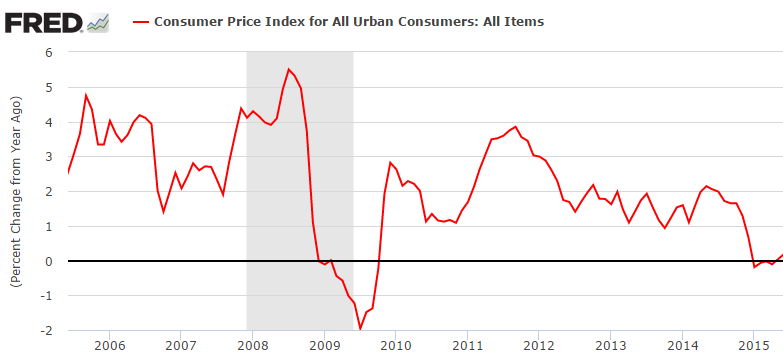
The Fed uses the Consumer Price Index (CPI) to gauge if inflation is within range.  Take a look:

cpi data

According to recent data, we have nearly no inflation!  How about that.  Well look at the above chart.  We have some major inflation going on but recent policy is dictated by recent changes in inflation.  And you are also missing out on bigger changes like many young Americans having most of their debt and spending being consumed by college.  The CPI gives only a tiny portion allocation to college education.  Keep in mind the CPI is a weighted basket.  So this misses out on a large cost for millions of Americans.

The government cites various technical reasons for changes they make regularly in how they are measuring inflation. Some of these changes are credible. Others are a stretch—though are not actually lies (they merely fail to communicate the truth).

Nonetheless, no matter how you dance around, the bottom line is that real inflation—as far as most real Americans are concerned—is significantly higher than the figures the government announce. The Cost & Price Index is not accurate. That is extremely disturbing because so many things are based on it. 

The U.S. Economic system—and, by extension, the American Business Model, is based upon bad data in certain key areas.

Bad data leads to bad decisions—and undermines democracy.

2000 to present