Sunday, December 14, 2014

(#74-1 ) December 14 2014. Speaking as a change-maker (which, for better or worse, I am) one of the great things about change is that just when you think your cause is hopeless—too many vested interests, too much ignorance, too much inertia—too few resources at your disposal—change starts to happen. The problem is—despair (or close) comes first. The trick is to not quite go over the edge. Cling on! That’s why the gods gave you finger-tips. They are also useful for poking the doubters in the eye—AFTER you have achieved your goal. You probably won’t though. You’ll be focused on the next adventure.

THROUGHTS ON THE STRESS OF CHANGING THINGS

VICTOR - SHOT BY MICK - ENHANCED

EMOTIONAL RESILIENCE IS THE KEY—THE ABILITY TO ROLL WITH THE PUNCHES, TO KEEP YOUR COOL

I DON’T HAVE IT—OR NOT ENOUGH OF IT (THOUGH I SEEM TO BE GETTING BETTER).

I GET HURT WHEN I FIGHT FOR A CAUSE. I HESITATE, I FALL, I FREEZE. I TRULY WISH I WAS AS RESILIENT AS THE CHARACTERS IN MY BOOKS.

ALL I CAN SAY IN MY FAVOR IS THAT I PICK MYSELF UP AND KEEP GOING. I’M DAMNED IF I KNOW WHY. SOMETIMES, I’M DAMNED IF I KNOW HOW.

I KEEP GOING ANYWAY.

I GUESS, IT APPEALS TO MY SENSE OF HUMOR

The British financial newspaper, The Financial Times, once ran a piece—it was some decades ago (pre-internet)—called THE ART OF BEING SECOND.

The thesis was that innovation—indeed effecting significant change of any kind—was so tough that the pioneers often ended up exhausted and the opportunists reaped the rewards. They then supported their argument quite convincingly with a series of case histories.

The lesson was clear—and was spelled out. To be first was dumb. Much better to hold back, and then nip in and claim the prize.

Change-makers, pioneers, innovators and similar adventurers tend not to be deterred by that kind of argument—however valid it may be. We tend to do what we do because we have to. We are driven by our passion—and so we continue virtually regardless of the consequences. Such is our nature.

The fates cheated me a bit. They gave me most of the attributes of a  true adventurer—including an  impressive ability to get myself into difficult situations and go up against impossible odds, but then they topped up this impressive package—they included considerable imagination and intelligence into the bargain—with the heart of a cowardly lion.

Then they threw in a sense of humor. It tipped the scales.

I keep going.

Besides, despite my doubts and rocky ability to mange my fears, I truly love what I do. The arena of thoughts into written words is a magic place full of powerful, stimulating, entertaining and significant ideas—some are dangerous—and I get to play in it all day, and sometimes until late at night.

The sand covers the blood that is spilled—and plenty is. Well, what else can you expect in an arena?.

What is not to love? I may even learn to embrace my fears.

VOR words 399


Saturday, December 13, 2014

(#73-1) December 13 2014 Sometimes simple questions are hard to answer

BLOGGING—NOT SOMETHING I THOUGHT I WOULD TAKE TO.

I HAVE LEARNED TO LOVE IT.

VICTOR - SHOT BY MICK - ENHANCED

WHY DO I WRITE IT? IS IT WORTH THE TIME IT TAKES? WHO DO I WRITE THIS BLOG FOR?

At heart, I suspect I’m a fairly private person. At one stage the primary reason for that was almost certainly because I didn’t want to expose my insecurities. Now that I have learned that I don’t seem to have any more than anyone else—and don’t much mind that I’m not perfect (It came as a shock!), it has more to do with both a desire, and a need, to be left alone so I can work without distraction.

I like people, and can be very social in the right context—like when I’m in the field doing research or having dinner with friends—but absolutely need long periods of uninterrupted time when I am left alone to think, read, and write.

What is a ‘long period of uninterrupted time? Half a day would be the minimum—but I can easily spend a week or more with scant human contact—and not miss it.

It would be very different if I was living with a loved one—which I am actively considering. But while I live alone, writing rules. It is a benevolent ruler—but demanding to a degree that I think most people fail to understand. Writing is not just difficult in itself, but it touches just about everything in your life.

Many people—who spend most of their waking hours interacting with others, and needing to do just that—regard my desire for solitude as odd, and almost offensive—and seem quite happy to tell me just that.

I generally reply that my requirement for solitude is based upon the dictats of my work—true but not the whole truth—and not an aversion to the human race. I’m far from sure I’m believed. People oriented people are so accustomed to company that they just cannot accept that anyone else would prefer solitude unless they were abnormal in some way.

At that stage I don’t explain further. I’m not a missionary seeking converts. I’m a writer doing what he loves as well as he can—and trying very hard to do better still. It is the struggle that gives writing its very particular edge.

Would I crave the company of people most of the time if I was not a writer?

Here I cannot advance my work argument—which at least has the merit of implying I’d be just like you except that I need to focus—and say I doubt that I would, that I have always been fairly self-contained, am largely content enough with my own company, and require a great deal of solitude so I can read and think.

That doesn’t tend to go down well—but one of the many pleasures of solitude is that, when I’m alone, by definition, such social friction doesn’t come up. Solitude may be considered weird by some, but it does have its advantages.

Does my pattern of behavior make me a recluse?

That depends on which definition of recluse you go by. One definition from Merriam-Webster is:

a person who lives alone and avoids other people.

Well, I currently live alone—so I partly qualify. But do I avoid other people? While working—yes. Socially—no. On the other hand, I don’t seek out people the way many do. I just don’t feel the need.

But, do I have friends? Yes, and many of them. One reason is that the empathy which helps me so much as a writer, helps me make friends. Another reason is that my writing, in itself, seems to make many people (not all) predisposed to like me. If they have read one of my books, they think they know me—and, in many ways, they do. Writing tends to be revealing—and my writing style is particularly so. Beyond that, I put great effort into reaching out through other forms of writing—including e-mails, which I treat as letters, and this blog.

I’ll let you make your own mind up. I rather like the Urban Dictionary definition. The first half doesn’t really apply to me—or not as implied, my motive is the need to write—but the second half makes me feel warm and fuzzy. I’m quite happy to be labeled ‘reclusive genius.’

recluse

Often times a person who rather than being crazy, is merely beyond tired of and fed up with the blatant narcissism, rudeness, ignorance, stupidity, cruelty, fakeness, hatred, etc. of the human race and chooses to detoxify themselves from the vices societies are swimming in to a greater extent than most.

Often times recluses have been known to possess extraordinary genius, talent, and/or vision often mistaken as abnormality and eccentricity by the adherents of a culture's status quo.

Labels apart, I seem to be driven by an intense desire to communicate to my fellow human beings—which scarcely strikes me as reclusiveness. After all, if I held you guys in such low esteem, why would I bother? Writing—to put it mildly—is hard work. Learning to write competently—let alone well—can take years, if not decades.

Why am I driven by such a desire to communicate?

I don’t have a ready answer to that. The drive is so strong that I accept it without further analysis—which is decidedly unlike me since I tend to analyze almost everything. But the fact that my calling is be a writer is something I accept without question. And it has been much tested. Somehow it has withstood every test from financial hardship to rejection to humiliation—and, if anything has become stronger.

Beyond that, not only do I love it with a passion beyond words, but it feels like the right thing to do. I also have the strongest feeling that it will enable me to accomplish something important beyond merely entertaining people. I’m arrogant enough to believe that I will write something which will be a force for positive change. That, if you will, is my destiny.

Do I worry about my legacy after my death? Well, I would like my heirs to benefit for some time in the future. Beyond that, I am not concerned. I suspect that most of the books I write will date and no longer be read—but one never knows. Since I won’t be around, I’m not overly interested either way. 

We now come to this blog—and its rationale.

The first thing I need to say is that I didn’t want to blog initially—and for some time afterwards. I regarded social media as being trivial and a serious waste of time, and many of the blogs I read were pretty terrible.

Beyond that, I didn’t particularly want to publicize my life—specially when I was going through a difficult patch. It is one thing for a writer to issue a series of press releases announcing his latest successes. It is another thing entirely to write about his struggles—his insecurities, his rejections, his failures. I felt it would be humiliating. My ego stopped me. Shame on it!

Of course, when I thought it through, I realized that writing about my struggles would be much more interesting—but was reluctant to do that because of good old-fashioned pride. It is still a factor, though I’m coming around to the view that I would like to do it when I can figure out how.

So why did I start blogging when I had been so much against it?

I realized that I need to keep a presence for my readers—and, beyond that—that I needed to become comfortable with social media if I was to sell books—whatever about my initial reservations.

Beyond that again, my good friend, Tim Roderick—the nearest thing to a guardian angel that has ever flown an Apache AH-64 Longbow—cajoled me to keep going.

We have ways of making you write. All are painful. Some are more painful than others.

“Cajole’ might not be the right word.

I didn’t enjoy blogging at first at all. I couldn’t think what to write about, I regarded it as a major waste of time, and I couldn’t find a format I was comfortable with. That is not to say the my initial attempts were terrible—they weren’t—but they didn’t feel quite right to me.

I stopped for a while—and then a bunch of people I regarded highly contacted me and asked me why I had stopped. They liked what I was writing.

That got my attention. My readers always do.

For a short period, I then wrote the blog as a political satire in which an Eagle is picked by the powers-that-be to save the U.S. I liked that so much I turned it into a book. Why an eagle? Because humans had become so corrupted by Fast Food, consumerism, and money. In the trilogy, Eagle eventually morphs into human form and saves the day.

Inspiration then hit. I was overthinking the whole thing. I decided that in future I wouldn’t plan the blog at all. Instead, I would write about whatever occurred to me at the time. I would make the whole exercise spontaneous. It would be good exercise for my brain—if nothing else. It would drag me out of my comfort zone.

I’m not a great believer in suffering for no good reason—even if does make you stronger. In this case, I expected to suffer somewhat because trying to write several hundred words (or more) when you have nothing planned struck me as self flagellation.

On the other had, I have great faith in my brain. It just might save the day. I would only find out by trying.

Somewhat to my amazement, the effect of not planning seemed to free me up and release inspiration to a degree I would not have believed possible. I thought that would would flag after a while. Not a bit of it. Day after day the blog just flows. I’m now in my second year of just sitting down and writing.

For better or worse, you are getting a pretty good insight into what this particular writer thinks about. That said, I don’t write about confidential matters or people in any great detail though I certainly think about them—probably much more than they realize. But I write about writing and creativity a great deal—and the issues and interests that concern me. And sometimes I push the envelope and focus on the ridiculous—because where would be all be without humor? Damn depressed. It’s the WD4o of life—and I truly love the ridiculous

Do I understand why this is all working?

No. I can theorize, but there it ends.

So who am I writing for? That is the question which started this piece—and I have taken a long time to get to the answers. I have done so because every now and then I think it’s a good idea to examine why you do something—especially if it is a matter of routine (something you don’t normally think about).

Am I happy with my findings? Yes, I am. I have done a real volte-face compared to how I felt when I started blogging and now love it with a passion. The downside is the time it takes—but the benefits it brings are so considerable, it is well worth it.

  • It is relaxing.
  • It is enjoyable.
  • It is therapeutic.
  • It exercises and stimulates the brain.
  • It both improves and speeds up my writing.
  • It keeps me in touch
  • It is fun
  • It get me into the zone—the writing zone—where focus is so intense, you are freed of all stress. you just write.

Ah, but is it easy? Writing thought into words—and is is never easy—but lets just say that it flows.

I write for.

  • Existing readers of my books.
  • Potential readers.
  • A small number of very special people starting with my #1 fan, Deb Wagoner
  • Family
  • Friends
  • All with similar concerns and interests
  • Any and all writers—particularly aspiring writers—so that we can share the journey. I know how hard it is. Frankly, it doesn’t necessarily get any easier after you have had success. I’ll explain that some other time. The good news—writing is more satisfying than you can believe.
  • Any and all creatives—for the same reason as stated above.

Is there anything I don’t like about blogging? Yes, there is—the name. I have tried to learn to take in my stride—but it still jars. But blogging is about writing, and that is pure joy.

VOR words 2003


Thursday, December 11, 2014

(72-1) December 12 2014. Words by themselves are just noises or symbols. It is the ideas behind them that make them matter.

STYLE IS A WONDERFUL THING VICTOR - SHOT BY MICK - ENHANCED

BUT WRITING IS ABOUT THE RECORDING AND COMMUNICATION OF IDEAS.

SOME DAYS, YOU HAVE MORE THAN OTHERS. SOME TAKE MORE TIME THAN YOU HAVE

I’m not conscious of having an individual style—though I have been told I have one. That point was brought home with some force when a contentious report I wrote in the Pentagon was identified by it.

I am reminded of that great crazy line in Catch-22: “I recognized his shot.” Senseless—if you stop to think about it—but perfect.

“Elementary, General Watson. The writer hasn’t used a single acronym in the entire document. He’s clearly not military. Besides, I understand what he’s saying. That means he is not a civilian employee of the Pentagon. The real giveaway is that there is humor in this report. Has the man no respect? It has to be that damned Irishman.”

Normally, I sign everything I write, but in this case it didn’t seem appropriate to personalize it. Institutions do not encourage personalization –and MS Word clearly tagged who had written it. Either way, my ‘style’ was identified very quickly (I was told) and all hell broke loose—four star general hell. I think they like to call it ‘shock and awe.’

Generals can be rather cute sometimes.

Regardless of the other consequences, it is always rather gratifying to hear when one’s writing has that effect.

Looking back, I have to wonder whether it was less that I write in a certain style—or more than most military communication is quite deliberately stripped of personality in the interests of producing conformity.

The military—in fact bureaucrats in general—love conformity. It turns them on. They feel macho and powerful and have huge erections—especially Scottish generals. Why do you think the kilt was invented? The sporran is there to keep the damn thing under some sort of control.

I’m surprised the U.S. Army has never adopted the kilt—and it would seem downright natural for the Marines.

I don’t much appreciate conformity..

I understand the need for uniforms—because it clearly identifies who it might be wise not to shoot at—and marching in unison can stir the blood—but, doubtless as a consequence of my boarding-school days, I tend to associate conformity with mindless discipline and the suppression of creativity.

There are, of course, many good applications for conformity—it would be awkward if a vehicle’s tires were different sizes—but what I’m really talking about is conformity for its own sake (not sensible standards like condom sizes or light bulbs)

Awkward to screw in the wrong size either way..

Note that I’m not against discipline. It is hard to be an effective writer—or any kind of creative person—if you are not fiercely disciplined in how you work.

I’m opposed to the kind of discipline which is imposed primarily as a manifestation of power—as much encountered in schools, the military, and large corporations. There, the movers and shakers seem to get a visceral pleasure out of their exercise of power.

Given half a chance, we are a disturbingly authoritarian culture.

I don’t approve of that—but I certainly understand it. After all, I get a buzz from the power of my written words—and power is exactly what they have. In fact, words can be downright dangerous. Look what Martin Luther unleashed after he had penned his thoughts—and Karl Marx didn’t do so badly.

And then came Adolf. If only the man had stuck to painting!

When I write, I don’t consciously think of style at all. If I did, I suspect I wouldn’t be able to write. It’s like breathing. If you stop and think about breathing, this rather useful automatic process becomes an effort.

I tend to focus solely on what I’m trying to say—and how to say it entertainingly—but I am far from sure I am consciously aware of how to do the latter.

The one thing I do tend to give conscious thought to is the punch line (or two) at the end.

Right now, I’m still thinking.

I lie.

I had better fess up. In truth, providing I have slept well, and am not so distracted by some major event that I can’t focus, I am almost never short of ideas. However, sometimes I don’t have the time or space to develop them adequately in this blog.

A blog is not really a long format environment, I feel—though I’m still debating the issue.

Let me give you an example.

Today I woke up thinking: How should America defend itself? Is the present setup, with bases all over the world (not to mention golf courses)—and the MICC at the core—and with the American people almost completely ignorant of what is going on—really the best way to do business? Are we generating enemies faster than we kill them? And could we put part of the trillion plus dollars to better use?

A writer’s mind  is a funny thing.

Then I went to start the day with black coffee—which I rarely drink (except when in the field with the Army, or with cops, where there is nothing else) .

My Irish blood makes me a tea drinker—and I’m out of milk.

VOR words 859.


(#71-1) December 11 2014. Cause, effect, and consequences. Could it be that they have good reason to hate us? Could it be that our reactions to 9/11 have made everything worse?

MORAL CORE—A CAUSE FOR CONCERN

VICTOR - SHOT BY MICK - ENHANCED

IF WE TREAT OUR FELLOW AMERICANS AS BADLY AS WE DO, WHY SHOULD WE BE SURPRISED THAT WE TORTURE TERRORISTS—AND WHY SHOULD WE BE SURPRISED THAT AFTER 13 YEARS OF WAR WE NOW HAVE EVEN MORE ENEMIES THAN BEFORE?

Terrorism is a vicious business because its whole purpose—quite literally—is to terrorize. It is a tactic which is accurately named. Typically, you, the terrorist, do that by doing things which are beyond acceptability—even by the dubious standards of the Rules of War.

Here, I don’t wish to denigrate the Rules of War. They are a great deal better than nothing—but they still constitute a low bar compared to the standards we should aspire to. We should be working towards a superior Code of Conduct for Conflict. Instead, we seem to be doing the opposite.

You lie. You cheat. You steal. You extort. You intimidate. You kidnap. You torture. You assassinate. You hack. You cut off heads. You cut throats. You strangle. You beat to death. You hang. You abuse and kill prisoners. You blow up the innocent. You massacre women and children. You do your outmost to provoke those in power to overreact.

They normally do—and make things a great deal worse—which gives you a huge propaganda victory, and fans the flames of insurrection. In effect, you, the terrorist, are using the brute coercive power of your opponent—typically a government—to do your job.

Governments are rarely nuanced organizations. They excel at coercive power—as do most large organizations, whether public or private, the world over. They are poor at listening, slow to change, and are relentlessly authoritarian. They don’t know how to do much else.

Typical government employees are rarely highly intelligent, subtle, empathetic people, gifted with the time, patience and knowledge of context to listen and understand. They are much better at the application of mindless force. If such employees are fortunate enough to possess such higher qualities—and some surely do—they rarely exercise them at work. Advocating restraint, when dealing with terrorists, is scarcely conducive to career stability or a path to promotion.

Effective counterterrorism should start with identifying in detail the perceived grievances of the terrorists—which should then be accommodated as far as is reasonably possible. They constitute both the right thing to do—and a bargaining chip. By conceding what is reasonable you undercut the terrorist’s position. You less fanatic supporters—which is normally most people—start wondering is all this carnage really necessary. They know perfectly well that being a supporter puts them in danger too.

There is nothing that terrorists hate more than a reasonable opponent. Reasonableness undercuts terrorist support.

Many would call that weakness. It isn’t. It is very smart. Getting to the heart of the matter is a real strength—and is rarely done. If you don’t try to get to the heart of the matter, terrorism—even if you appear to stamp it out in the short term—will re-occur, and it will metastasize.

Terrorism, mostly, is carried out by desperate people who feel they have no alternatives. Normally, their grievances have some legitimacy—even if the issues are complex and their methods are to be deplored. At a certain point, terrorists become so cauterized by violence, it virtually becomes an end in itself. Much the same happens to counter-terrorists. Prolonged exposure to violence tends to have that effect. Much better not to let things get that far.

Terrorism is best fought with both the carrot and the stick by the the forces of law and order entrenched on the moral high ground. The latter is fundamental.

If you lose the moral high ground—and governments frequently do—it is incredibly difficult to regain it. Further, you are almost certainly guaranteed a protracted conflict which can—and normally does—last for decades.

Losing the moral high ground is disastrous. Regaining it—if you ever do—can take decades. Meanwhile terrorism continues.

Have we, the U.S., lost it? Yes, we have—and for numerous reasons. We over-reacted to 9/11 from the beginning, have made almost no efforts to identify the causes of the terrorism we are up against, compounded the problem by invading Iraq without good cause, and have made it worse by inflicting mindless violence on a score of countries over the last decade plus. In addition, while preaching that we are the bastion of democracy, the Land of the Free and the Home of the Brave, we have revealed that we are very far from a healthy democracy, and that our society is riddled with unfair practices, racism and blatant injustice.

In short, our claim to be the good guys—as far as much of the world is concerned—is regarded as specious. Many would argue that the American Way of Life, based upon materialist values, excessive consumption, waste, environmental indifference, and the current American Business Model (which seems to have no moral code) is deeply flawed and inferior to alternatives such as democratic socialism (as practiced by much of Europe) or the practices of Islam.

Here, whatever my own views, I am not concerned with debating the truth of the matter (I hold to the view that the U.S., despite its flaws, possesses enormous strengths) but with perception by the rest of the world. In short, I am concerned with our World Standing and that extraordinarily powerful force known as Moral Authority. We used to have it. We still have some, but we have lost a great deal.

We have weakened ourselves. This is self-inflicted damage—and it is severe.

We should be deeply concerned by this. We tend to associate our strength with military power—but military power without moral authority (as long possessed by the Soviet Union, for example) is largely only an expensive burden. The soft power, as possessed by the European Union, to demonstrate an alternative, is stronger. Nation after nation fights (diplomatically) to get into the EU—and most thrive.

Yes, I know the EU is regularly described by U.S, media as something of a confused mess—but it is a very young political alliance still which already offers a superior quality of life (subject to some exceptions) than currently most exists for most Americans).

It is common practice to argue that U.S. counterterrorism is a roaring success because we have been subjected to no serious external attack since 9/11.

I regard that as entirely fallacious thinking. Thirteen years after 9/11:

  • Jihadist extremists are stronger than ever—and variants of Al Qaeda are flourishing all over the Middle East, in Africa, and in Europe. There is also cause for concern about Indonesia—in fact wherever Islam flourishes. The situation in Pakistan, a nuclear power, is particularly worrying. Our flailing has stirred the pot—and it is bubbling. Will it boil over? That is certainly more than possible.
  • The Middle East is more unstable than ever—with our invasion and disastrous occupation of Iraq being a major cause (albeit far from the only one).
  • The future of Afghanistan is decidedly uncertain. We had little choice but to attack Al Qaeda there after 9/11, but our de facto occupation (and neglect) of the country was both unnecessary and largely botched. We have also brought—as we always do when we occupy a country—a staggering level of corruption. We might well ask why this is so. Could it be that we are more corrupt than we generally like to admit?
  • We have lost roughly 8,000 dead and hundreds of thousands physically injured or otherwise affected in Iraq and Afghanistan. The total costs of these two wars—which are not yet over—has been estimated to reach $4 trillion eventually by the time the long term care of veterans and the interest we have to pay on the money we borrowed to fund the wars has been factored in. That total could easily go higher.
  • Personal freedom in the U.S. has been reined in. The problem is less what has happened to date—irritating though many of the restrictions are. However, the creation of a surveillance state combined with the militarization of our police is extremely worrying because not only is such a structure open to abuse, we already know it has been. Freedom is not something we can take for granted. It is entropic. It degrades unless nurtured. We have been doing very little nurturing.
  • The U.S, economy has taken a terrible hammering—the effects of which are likely to be with us for decades if not for generations. The combination of debt resulting from our wars (both, in essence, reactions to 9/11)—and the Great Recession have been, and will continue to be, horrendous. The trillions of dollars in debt can be measured (if not grasped adequately) but other costs such as the wholesale neglect of our infrastructure have been incalculable. All of this is made worse by the fact that the current economy is rigged to favor the few—and their followers. 
  • Our military are tired, deeply disillusioned—and confused about the future. They have fought for 13 years, but have little to show for it. U.S, forces are deployed throughout the globe—but to what effect? And we cannot afford such a level of commitment on an ongoing basis. Our budget is still far from balanced—and we have other urgent needs.

I’m Irish—Anglo-Irish to be more precise—but my life has been deeply intertwined with the U.S. and I have great affection for this genuinely Great Nation.

Right now, and for some time in the past, my feeling is that the U.S. has lost its way. The very fact that we are debating torture illustrates the point.

I’m sufficiently well versed in the details of terrorism to give you chapter and verse on why torture and mistreatment of prisoners is such a mistake—on a practical as well as a moral level—but I really shouldn’t have to.

If our Moral Code was in good order such a truth should be self-evident.

I feel a little sad that I have had to write this.This is not the way America should be. I won’t say we are better than this—because right now we are not—but we could be.

We need to be. It’s a matter of self-respect.

The best way to fight terrorism, in my considered opinion, would be for all of us to work a great deal harder to make the U.S. a better place for most Americans—and not just for a privileged few.

We need to rebuild this country. Even more to the point, we need to re-build people’s faith in it.

Recent Pew research into people’s confidence in institutions showed a pretty massive decline virtually across the board.—with Congress in single figures.

The following is scarcely a ringing endorsement of the American Dream.

VOR words 1,728.


Wednesday, December 10, 2014

(#70-1) December 10 2014. There is something very special about the practical visionaries who pioneer better ways to fly. Again and again they do what the experts thought was impossible. They defy the status quo. They epitomize creativity. They are my kind of people.

INTRODUCING A TRULY BEAUTIFUL AIRCRAFT

VICTOR - SHOT BY MICK - ENHANCED

SYNERGY

WITH SOME TRULY EXTRAORDINARY CHARACTERISTICS

Synergy_wide

I find it hard to overstate my enthusiasm for this aircraft. It is not only astonishingly beautiful—but it is equally innovative. And, funnily enough—it re-introduces the biplane concept (which gives enormous lift within the confines of a surprisingly compact wingspan) though in a thoroughly modern way—the box-wing.

As you may recall, I was musing about biplanes the other day. I have long felt the concept still had validity. It took my friend, Tim, former Apache AH-64 gunship pilot, and a veritable encyclopedia of flight—and much else besides—to draw my attention to Synergy.

If I don’t write about aviation fairly regularly, I suffer serious withdrawal symptoms.

Synergy is best explained at www.synergyaircraft –a website which is as elegant as the aircraft itself.  These people know what they are doing.  They display impressive clarity of thought and ability to execute.

Synergy v32 image n

Just to whet your appetite, let me draw your attention to some of Synergy’s features—quoting their own words where appropriate.

  • Synergy is astonishingly fuel efficient. Using a DeltaHawk 200HP diesel, it is projected to be able to cruise at 200MPH using only 4oMPG. That makes it compare favorably with many family cars. It uses dramatically less fuel than comparable general aviation (small aircraft) alternatives.
  • Synergy is as fuel efficient as it is because it has put extraordinary effort into drag reduction. 100% laminar flow over wing and fuselage surfaces is predicted. In lay terms, the end result is that the aircraft is so slippy, it needs much less energy to propel itself through the resistance of the air.
  • Synergy will seat up to 6 passengers in considerably more comfort than many alternatives. Its cabin has been designed to be particularly roomy.
  • Synergy is compact with a wingspan of only 32.4 feet but a wing area of 156 square feet.
  • Synergy will be pressurized with a ceiling of 25,000 feet.
  • Synergy will be unusually stable and safe—but will be equipped with a whole airframe ballistic parachute.

“Synergy is a safe, slow-landing vehicle that can fly one to six people directly from town to town, in less time and at far less cost than airliners or automobiles. Its breakthrough technologies deliver the first sustainable transportation economics in the speed range between the supercar and the airliner.

There have never been any fundamentally efficient personal airplanes with the kind of seating, payload, and go-anywhere utility to compete with the family automobile. This is because no previous planes have used Synergy’s systematic approach to reducing the energy cost of regional flight. Yet the same proven principles of advanced fluid physics that give Synergy its exceptional stability, speed, and control (through drag reduction!) also make it comfortable, compact, and safer for everyone.”

There are so many extraordinary aspects to the Synergy story that I can’t remotely do them justice within the confines of this blog. But in a field where development is notoriously expensive, founder John McGinnis (with moustache in photo below) started the company in his father’s garage—and the project is largely being funded through Kickstarter.

If ever there was an example of the kind of project that this Great Nation should be encouraging, Synergy is it.

By the way, a scale model of synergy is already flying—and performing as projected. Go look at www.synergyaircraft 

You will be fascinated.

VOR words 551


Tuesday, December 9, 2014

(#69-1) December 9 2014. Should a nation have a moral code? I think so—but in a nation of self-professed rugged individualists, how can that hold true? Perhaps, it doesn’t.

MY BUSINESS—AT LEAST PARTIALLY—IS WAR

VICTOR - SHOT BY MICK - ENHANCED

OUR TOLERANCE OF IT CONCERNS ME.

AS I WRITE THIS, WE ARE BREAKING THINGS AND KILLING PEOPLE IN MORE COUNTRIES THAN MOST OF US CAN FIND ON A MAP—OR KNOW ANYTHING ABOUT.

WHY DO WE ALLOW THIS? HAS IT NOT OCCURRED TO ANY OF US THAT ACTIONS PROMOTE REACTIONS—AND THAT WE CAN PUT THE LARGE SUMS OF MONEY INVOLVED TO BETTER USES—AND THAT PERHAPS WHAT WE ARE DOING IS MORALLY WRONG?

It is strange the way that we—as a culture—largely seem to have divorced ourselves from the principle that we are responsible for the health of our own democracy—and that the power really lies with “We, the People.”

While being fiercely proud of being American—and regarding the American Way of Life as superior to all others—we have pretty much given up on democracy in practice, and seem content to have had political power slowly peeled away from us.

  • We don’t vote in adequate quantities.
  • We are alarmingly ignorant of the issues.
  • We put little effort into keeping informed.
  • For the most part, we don’t protest at the most egregious behavior—and, where a small minority do initiate some action, they are speedily marginalized (often with the aid of law enforcement).
  • We tolerate widespread social injustice from the lack of worker rights to the abomination that is our prison system.
  • We make war on nation after nation after nation without declaring war—even though that power is specifically allocated to Congress by the Constitution.
  • We hold Congress in quite extraordinarily low regard, yet there is no mass movement organized to change it in any way—or even to deal with such blatant political corruption as gerrymandering or other distortions of the democratic system.
  • Again and again, we vote the very members of Congress we so despise back into office.

I am deeply attached to this county—and have long believed that, on balance, it is best for the U.S. to be the strongest country militarily in the world. However, when that is combined with the passing of political power to a rich elite—and the abdication by most Americans of any feelings of responsibility for the direction and behavior of this Great Nation, I begin to wonder.

In effect, this bastion of democracy is already a plutocracy—run for the rich and their followers for their own benefit (with We the People being of little concern). Considerable research supports that statement. It is not merely my opinion. Beyond that, the impact of money to buy votes has been demonstrated repeatedly. Big money from a rich few does not always win—but it normally does. A consequence is that you have a one dollar one vote situation—as opposed to one person one vote. It’s is a travesty of genuine democracy—and it is validated by the Supreme Court.

We should be seriously worried about that. Some of us are.

All of that would be bad enough—but when that plutocracy has at its disposal our extraordinary military power—and seem more than happy to use it constantly—in furtherance of its own interests, and in defiance of both our own constitution and international law—we have a problem of a different order of magnitude.

We are in danger of becoming what—in World War II—we found entirely unacceptable, and, after the shedding of much blood and treasure, eventually destroyed.

Apart from arbitrarily invading one country after another—sometimes with some justification (which does not make it legal), but often not—the one aspect of our behavior which we should be particularly ashamed of is our failure to account for the large number of civilians we have killed and injured. I am not suggesting we do it deliberately—indeed I take the view that collateral damage (a revolting phrase) is sometimes inevitable—but we seem to have adopted the position, since we learned it the hard way in Vietnam (where we killed in staggering numbers—yet lost ignominiously) that since body county doesn’t equate with winning, we wouldn’t bother with body count. That puts us in violation of international law—and is morally unacceptable in itself.

At what stage does mass killing of civilians cross over into being a holocaust? By all accounts we killed at least 100,000 in Iraq—and many put the total number as being far higher. Either way, we should know—and there should be accountability.

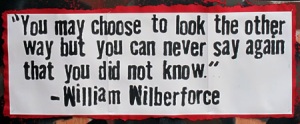
There is something deeply wrong with this United State’s moral core at present—and, yet again, few of us are doing anything about it. We treat many of our fellow Americans badly, it is alarmingly clear that racism is alive and well, and we have evolved a surveillance state, complete with militarized police forces, of formidable power—which seems quite content to use that power to suppress dissent using whatever means are effective (whether legal or not).  

Along with other military thinkers and reformers (a relatively small but interesting bunch which I am proud to be associated with), I have personally put considerable effort into endeavoring to help the U.S. military retain its lead—and intend to continue to do so—but I will confess I am greatly concerned. Am I doing the right thing—or am I part of the problem?

Wwilburforce on injustice

VOR words 845.


Monday, December 8, 2014

(#68-1) December 8 2014. I love photography—but words even more. But, I hope to get back to photography, if only as an amateur. It’s a great thing to capture a special moment.

SOME FORTUNATE PEOPLE HAVE THE EYE

VICTOR - SHOT BY MICK - ENHANCED

MY TALENTED PHOTOGRAPHER SISTER, LUCY, IS ONE OF THEM

LUCY TOOK THIS FROM THE TOP OF A BUS WITH HER CELL. IT’S A RATHER DIFFERENT SLANT ON LONDON

I was in business before I opted for a career in the creative arts—not  that I wish to suggest that business cannot be creative. But, the underlying ethos of business is to make money—in many cases regardless of the means—whereas, although you need enough money to survive in the creative arts too, your main priority is the work itself. Your mission is to create—which means to change things in some way—however small or significant. You are a disruptor of the status quo.

Why are some of us like that—and most so accepting, willing to toe the line? I don’t think any of us know with any precision. I tend towards the view that all of us are born creative in some way or other, but that society’s relentless pressure to conform—typically starting off with one’s parents (assuming you have two—which is an assumption I shouldn’t make) or parent, and closely followed by school—beats it out of you (sometimes literally).

Sir Ken Robinson is the man to hear on this important subject.

Society calls crushing creativity ‘socialization’ and regards it as a worthy cause.

I regard as a truly staggering waste of latent talent which we should be encouraging.

But why do some people resist the socialization process, and go on to be creative?

I can only conclude that the reasons are both genetic and environmental.. In my case, I have always had an unusually inquiring mind—and I was certainly brought up in a creative environment. I was abused both physically and emotionally for many years, but even some of that was creative (albeit derivative).

At one stage, having foolishly confessed my secret fear of being roasted to another boy in boarding school (the incident actually features in the book Tom Brown’s Schooldays—and was my mother’s only guide to how to treat boys) he responded by spreading the story to the point where I was roasted. Now how many people does that happen to?

Let me tell you that being spread-eagled in font of a roaring open fire by four boys—all bigger, stronger, and older—is not fun. Frankly, I doubt I would have felt much better if they had been girls—but it was a boy’s only boarding school. It actually happened in the library of St. Gerard’s School, Bray, Co. Wicklow, Ireland. I was about eight. 

I remember it well!

My eventual response to  being bullied was to learn how to fight creatively—and that I certainly did. I learned how to hit and hurt—mainly from books. I was very cold-blooded about it. I wanted my victims to remember the pain—and to leave me alone. I didn’t particularly enjoy hurting people—but I guess I did enjoy the tactical side. I became an advocate of surprise, maneuver, unpredictability—and execution. Bluffing was not an option. If I attacked somebody, I wanted them to remember rather more than a simple punch. This wasn’t boxing. It wasn’t a sport. I had no interest at all in fighting fairly. I wanted to induce enough fear so that they would back off in the future.

The bullying stopped. Creativity was  clearly a good thing. Funnily enough, that experience of having to fight creatively—because I was virtually always outnumbered—is an asset I still draw upon to this day—and it is particularly useful when writing action sequences in my books. I don’t just imagine them. I live them—and, of course, I have actually done that when the stakes were decidedly higher than bullying at school.

Such war stories apart, my dangerous, but charismatic, mother was a writer and painter, my much loved step-father astonishingly creative across the board—and, when I was at home—not so often given boarding school, and that I tended to be farmed out to stay with my grandmother or aunts—we were immersed in the arts—not to mention a constant stream of writers, artists, musicians, and movie and theater people. Lawyers and accountants scarcely featured. My mother, who was the social magnet, and who had a real talent for finding interesting people, never ceased hauling them in—and she ran a very social house, where glasses were filled full and re-filled often.

I should know. One of my first chores as a kid—even when I was quite small—was to fill glasses and empty ashtrays at parties. Since I was never taught otherwise, I tended to pour with a generous hand. When I encountered the social norm in other houses, I was initially quite shocked at such meanness. I still tend to be generous when I pour a drink.

We had one family friend who was an architect—an actual professional—but he became an honorary creative because he was the father of a school friend of mine. His brother went on to become the Irish prime minister (called the Taoiseach in Ireland—sounds like a sneeze).

I was always very fond of the Fitzgerald family and rather fancied the two daughters—Katherine and Caroline, if memory serves.

Sometimes I wonder why I ever went into business. There were actually quite a number of reasons.

  • Back in 1964—the year I graduated from university—there were very few jobs of any kind available in Ireland, and creative jobs paid a pittance. I had this unpleasant truth rammed home again and again because both my sister and a girlfriend were actresses, As stated, I had numerous other movie and theatrical connections, and other friends were writers and photographers. They all lived a decidedly marginal existence.
  • My mother—an extremely forceful personality—was keen that I go into business and re-build the family fortunes.
  • My talents were well suited for business in many ways—a fact that I have demonstrated repeatedly over the years (although I have had my failures too).
  • There is a great deal about business I like—from the people to the creative aspects. I am also gifted with a strong strategic sense, so again and again I have identified trends and developments years before they became generally accepted.

All in all, I guess I was behaving quite rationally when I opted for business in the initial years of my working life—though I was undoubtedly seriously conflicted.

Then came my epiphany, and the blinding and truly wonderful insight that I didn’t want to live a sensible rational life—but needed to create and have adventures.

It was an imperative.

I have endured great difficulties throughout my creative life, but have never regretted my decision to chose this direction.

I also rather enjoy the irony that at this stage of my life, at the age of 70, both my creative and business talents are coming together.

If I succeed, it will make for an extremely neat ending.

If I fail, be confident that I’ll still be trying until the moment I die. As with writing itself, the struggle is the thing—because you never write quite as well as you want. If you do, you raise the bar.

I feel much blessed—and downright amused.

VOR words 1,183.