Friday, November 28, 2014

(#58-1) November 28 2014. Flying is a many splendored thing—especially if you have three wings

YET ANOTHER OFF-THE-WALL AIRCRAFT PROJECT

VICTOR - SHOT BY MICK - ENHANCED

I LOVE THIS STUFF

The Faradair BEHA concept is intended to be one of the world’s quietest, most efficient an...

THE FARADAIR BEHA CONCEPT

‘BEHA = BIO-ELECTRIC-HYBRID-AIRCRAFT’

I am not a scientist—rocket or otherwise—but I love technology, and have been involved (one way or another) in a number of fascinating technology oriented developments (space related and otherwise—including helicopters and armored vehicles).

We thriller writers get around.

I take the view that creativity is not—and should not be—limited to the arts, so a writer and generalist, like myself, should stretch his brain a little from time to time by becoming involved with projects that are really beyond his technical competence.

Besides, you don’t necessarily need to be technical to evolve a better way of doing things (though you normally do to implement). Sometimes, if you understand the principles, and have perspective, you can make a contribution. Given the chance, the human brain is amazingly versatile.

In that spirit, I have long wondered whether there still isn’t some mileage in bi-planes. Yes, I know that the extra wing imposes a vicious amount of drag, but the extra lift you get is phenomenal. As a consequence, you can take off and land in very short spaces, and you can lift a great deal—providing you are not after speed.

DH 82A Tiger Moth - N81DH.jpgI well recall seeing a bi-plane, a Tiger Moth (see picture), both land and takeoff in well under half of a rugby pitch when I was at school—something I would have said was impossible if I hadn’t witnessed it.

The full size of a rugby pitch—in case you are dead keen to know—is 133.4 x 74.3 yards. It landed and took off diagonally but I doubt more than 70 yards was involved.

A Tiger Moth’s stall speed can be as slow as 25 knots. That extra wing makes quite a difference.

By the way, a staggering 8,868 were built. It was a very neat, and flyable, aircraft—and deservedly popular as a trainer. Fast, it was not. Primarily is was flown around 100 knots.

Well, we tend to associate flying with speed, but it is not always a requirement. For instance, if you want to do surveillance, it can be quite handy to patrol very slowly—much as a helicopter can do, but at a fraction of the cost—and more safely. Alternatively, because you aren’t road bound, and can fly in a straight line, you can often get to a location much faster than a ground vehicle even if your flying speed is quite modest.

Bi-planes apart, other minor obsessions of mine are hybrid electric aircraft—which are long overdue, in my opinion—and greater use of electric motors in aviation.

Faradair have gone one better than a biplane. They are proposing a triple box-wing design—three wings. Let me quote from that wonderful site www.gizmag.com:

Touted as the world's first true hybrid aircraft, the Faradair BEHA (Bio-Electric-Hybrid-Aircraft) is a triple box-wing design concept that combines electric motors and a bio-diesel engine. Fitted with a range of energy conservation and recovery technologies, including solar panels on all flight surfaces and high-lift, low-speed flight capabilities, the BEHA is intended to be one of the world’s most environmentally friendly aircraft.

Aimed at the traditional multi-role light aircraft market, the BEHA concept is premised for a range of operations with lower cost overheads and minimal environmental effect. Included in a potential list of users are those who are engaged in inter-city travel, operate flight schools, run observation and emergency services, or simply want a low running cost aircraft for recreational use.

To this end, the designers of the BEHA claim that their concept electric design offers true "hybrid" dual-fuel capability with a combined bio-diesel/electric propulsion combination that will put it into a different league from currently available electric aircraft, by no longer requiring ground-based recharging. As such, it is intended that the Faradair craft also employ such energy recovery technologies as all flight surfaces being skinned with solar panels, along with wind-turbine technology to allow battery-charging for the vehicle whilst it is in-flight or on the ground.

The plan is to equip the BEHA concept with twin electric fan motors (from the company's renderings, somewhat similar in appearance to those used on the recently flown Airbus E-Fan electric aircraft) that deliver some 200 hp (150 kW) each, in combination with a similarly powerful bio-diesel generator incorporating a ducted pusher propeller. Designed to take off and land using electric power, the bio-diesel engine is intended to recharge the batteries whilst the craft is cruising to increase the overall performance and flying time.

"Markets will be opened up as this lightweight, state-of-the-art, carbon fiber, high-lift designed aircraft will negate night flight restrictions and pollution concerns," says Neil Cloughley, Managing Director of Faradair Aerospace Limited. "Its truly radical and futuristic design aims to follow in the footsteps of other great aviation achievements by becoming a game changing aircraft that helps transform aviation as we know it today."

Solar panels are on the topside of all lifting surfaces (Image: Faradair)

"This aircraft will be one of the most eco-friendly and safest aircraft in the world, costing somewhere close to $1m US Dollars per aircraft," says Cloughley. "Plus our production facility will be equally environmentally focused."

Recently launched on Kickstarter, the company intends to spend the next 12 months through 2015 on Research and Development, with a specific aim to complete specifications and fabrication of prototype parts, provided its £20,000 Kickstarter aspirations are met.

The video below shows the company's Kickstarter pitch and some animations of the concept.

Source: Faradair

VOR words 304


Thursday, November 27, 2014

(#57-1) November 27 2014. Because of my Anglo-Irish background, I tend to think of Christmas as the ultimate feast day—but Thanksgiving is growing on me.

HAPPY THANKSGIVING EVERYBODY!

VICTOR - SHOT BY MICK - ENHANCED

THANKS TO YOU, MY FRIENDS, I HAVE MUCH REASONS TO GIVE THANKS. I CONSIDER MYSELF AN EXCEPTIONALLY FORTUNATE MAN.

I WILL ALSO REPEAT SOMETHING THAT I HAVE BECOME TO BELIEVE IN ABSOLUTELY—NO ONE EVER ACHIEVES ANYTHING WORTHWHILE ALONE. THERE IS ALWAYS AT LEAST ONE OTHER PERSON HELPING—EVEN IF SOLELY IN INTANGIBLE WAYS.

AN AUTHOR MAY WRITE ALONE, BUT THAT IS NOT THE SAME THING AS BEING ALONE

If my current project succeeds—and it is really a series of inter-related projects—it will not only be the hardest thing I have ever done, but only have reached a desirable outcome because of the help of quite a number of people. In most cases, this help hasn’t been massive—but it has certainly been timely—and is deeply appreciated. In particular, I have been subject to much generosity recently, so today seems an excellent day to say, ‘Thanks’ yet again—and from the bottom of my heart.

Given that I live a fairly solitary life—I write alone as you surely know—I am surprised I have as many friends as I do; but I do, and I value you—and them—greatly.

It is also a good time to give thanks to my friends who have died. Too many have.

To say one builds on the shoulders of giants is something of a clichĂ©—though very true. Still, though the sentiment is clear, it evokes a rather strange mental picture.

Let me compound the problem. I write on the shoulders of my friends.

Thank you.

VOR words 250


(#57-2) November 27 2014. Thanksgiving—what a good idea!

THE TROUBLE WITH BEING A PHOTOGRAPHER IS THAT GOOD PHOTOS OF YOU TEND TO BE HARD TO FIND

VICTOR - SHOT BY MICK - ENHANCED

AT LAST A PRETTY GOOD PHOTOGRAPH OF MY SISTER LUCY—AN EXCEPTIONALLY TALENTED PHOTOGRAPHER—AND HER DAUGHTER, FAITH.

YES, THEY ARE A DECIDEDLY  ATTRACTIVE PAIR—AND I AM APPROPRIATELY PROUD OF THEM (AND OF LUCY’S OTHER FOUR CHILDREN).

LUCY IS ON THE LEFT IN SUNGLASSES.

I am the eldest of 12—five fathers were involved—and have written often of my own rather traumatic upbringing. I was abused both physically and mentally, packed off to a boarding school at the age of five—where, being younger and smaller than everyone else, I was bullied for years—and typically sent off to stay with my grandmother (whom I loved dearly) or a pair of aunts during two out of the three annual vacations.

Though I had a home, I rarely saw it—and when I was there, I primarily interacted with the staff. We routinely had two maids and a full-time gardener in those days—at one stage topped up with a butler and house boy. None of them, sad to say, was overly bright, and I was so badly fed when I was a toddler that I got rickets. That is a condition that results from a severe nutritional deficiency—not something that should happen to a child coming from a wealthy, upper-class family.

Meanwhile, my mother lived an almost entirely separate life focused around her drawing room, dining-room, bedroom—social life and lovers. She never had a job. She wrote, but primarily she painted.

The lover I remember best was an Austrian count, Count Taaffe, whose father had twice been prime minister to Emperor Franz Joseph of the Austro-Hungarian empire. I didn’t really believe this until years later I went to see the movie, MAYERLING, where the villain of the piece was a Count Taaffe—acted by James Mason. Mother had a weakness for counts, eventually married a Polish count, and died a countess. My brother Rex’s father was an Austrian count.

That adds up to three that I can remember—but who’s counting!

Later, after we moved house to an even larger dwelling, she added a second drawing room and a studio to her private domain. We children were the responsibility of the servants, and rarely seen by her except for a few minutes before going to bed.

All in all, the first nine years of my life were—by any standards—appallingly difficult—and were characterized by a truly lousy relationship with my charismatic, but dangerously unpredictable, and emotionally unstable, mother. In sum, she was an only child, and entirely clueless about how to handle a boy—so resorted to violence at the slightest provocation (real or imagined). She also had a dominant personality and was highly articulate so she could wound with a sentence. There were no limits to what she would say to achieve such an objective. She could be a frighteningly cruel woman—and excelled at destroying one’s confidence. Few could stand up to her.

Having a thoroughly miserable childhood isn’t all bad because somehow it seems to set one up for a creative life in a way that emotional stability does not. Why is this? I don’t really know, but if you talk to enough creative people, you will soon find that many of us share that background. In my case, I am extremely empathetic and sensitive to atmosphere—and equally observant—characteristics that were undoubtedly fostered by my being in harms way so often. They are invaluable when it comes to writing. The more you sense, observe, and experience, the more you have to write about.

They say that if you are to remain emotionally sane, all you really need is for one person to love you. In my case, that was my grandmother, Vida Lentaigne, a remarkable woman by any standards, whom I miss every day. Granny kept me, more or less, sane.

I don’t want to overdo my claims to sanity because those early years certainly left their scars—and were, at times, pretty terrible.

But enough of such gloom. As we writers like to say, “It’s all material,” and the good news is that my mother mellowed over the decades to the point where the youngest member of the family, Lucy (pictured above) is not just sane, and remarkably well balanced, but has raised her five children to be of similar caliber.

Lucy, the youngest, is now the matriarch of the family—and we are lucky to have her.

Thanksgiving seems like a good day to acknowledge, yet again, that pleasing fact.

VOR words 753


Wednesday, November 26, 2014

(#56-1) November 26 2014. The ‘we have only one earth, and we are doing it a lot of damage’ department.

ENVIRONMENTAL STUFF

VICTOR - SHOT BY MICK - ENHANCED

AND IT SEEMS HIGHLY LIKELY THAT WE ARE DOING NO END OF DAMAGE TO OURSELVES THROUGH PRODUCING FOOD BY WAY OF MONOCULTURE AND GLYPHOSATE

I don’t regard myself as an obsessive environmentalist—but it seems to me that we should take a great deal more care of this earth of ours than we do. After all, it is the only one we have—and if we do screw it up, we’ll all die—and probably rather unpleasantly. Best avoided, don’t you think?

There is a whole group of people—mainly Right Wingers—who seem to think that the earth is so robust we can do what we like to it and it will recover. Why do they think that? It suits them politically. It’s all apiece of belittling government, opposing all regulations, and arguing that corporations should be allowed to do pretty much anything—with  competition being the only discipline.

Only there have been so many mergers and acquisitions that in many business sectors there isn’t much competition left.

The evidence is almost completely against such an attitude, but since such people don’t believe in evidence, they don’t either change their minds or moderate their opinions.

Since one cannot fight all the battles—and ‘environment’ covers so much—though I follow developments overall, I have tended to confine my focus to sustainable energy and the food chain. Here, since sustainable energy really does seem to be making amazing progress, my main area of concern is the food chain.

We seem to be doing bad things to the land through monoculture, and our industrial approach to farming generally, so are producing foodstuffs which look great, but which are substantially less nutritious than their predecessors. Frankly, that is serious enough in itself—but the possibility that Monsanto’s glyphosate is damaging to our health (and there is increasing evidence to that effect) is truly scary because glyphosate is pervasive and so extremely hard to avoid. If you haven’t heard of glyphosate, it is better known as Roundup. It is used just about everywhere for weed control. If is conclusively proved to be harmful to our health, we will have a nightmare of a problem on our hands. It will mean we have been poisoning ourselves for years. 

The argument that is constantly pounded in to us is that industrial farming, even if one does accept the disadvantages (and many do not)  is the only alternative to expensive food and widespread food shortages.

It is a compelling argument—and widely believed. But is it true? I have long wondered about it, but never did the necessary research because—as mentioned previously—although I am a concerned citizen, this sector is not one I focus on primarily. Nonetheless, every now and then I would run across a mention that suggested that monoculture is not the only way to go—and that other approaches may, in fact, not only be more sustainable, but be more productive. In short, given the same amount of land and water, alternative approaches could produce more in terms of both quantity and quality—and at lower cost. They also result in much healthier soil.

A recent article in truthout.com quotes two major reports—one coming from the UN and the other from the Rodale Institute validating the alternative approach. Contrary to what Monsanto likes to argue, we can produce sufficient quantities of food by way of organic farming.

If that is the case, we are enduring the considerable negative consequences of industrial agriculture for no good reason. You also have to wonder why there is virtually no discussion about a matter which directly affects the health of over 320 million Americans—not to mention millions more abroad.

Right now, industrial farming based upon monoculture—combined with CAFOs (Concentrated Animal Feeding Operations) and extensive fracking—is producing:

  • Exhausted soil
  • Weeds that are increasingly glyphosate resistant.
  • Massive contamination of our rivers, lakes, and the oceans
  • Less nutritious food.
  • Food contaminated by glyphosate
  • Food contaminated by other pesticides and herbicides.
  • Food contaminated by fracking chemicals.
  • Massive abuse of animals.
  • Meat contaminated by antibiotics fed to animal to counter the negative effects of CAFOs.

Americans live sicker and die several years sooner than the citizens of most other developed nations.

Food for thought—no pun intended.

VOR words c. 641


Tuesday, November 25, 2014

(#55-1) November 25 2014.

STUFF I THINK ABOUT FROM TIME TO TIME

VICTOR - SHOT BY MICK - ENHANCED

IS WHAT I READ OF ANY USE—OR AM I JUST STUDYING FOR FUN?

I spend a formidable amount of time researching matters that interest me—and sometimes feel quite guilty about it. Shouldn’t I be writing instead? Am I researching the right things? What’s the point of all this work?

I don’t think too much about the last concern. Given that we end up dead just about everything we do might be considered pointless. On the other hand there is always “meanwhile”—a word I’m particularly fond of (as I think I remarked previously). Life is really about “meanwhile”—which is fine by me.

In fact my research is relatively disciplined though I certainly don’t confine it to the specifics required for a single book. Instead, I like to keep well informed about whole sectors from which I draw detail as and when required—and, of course, sometimes zero in on detail and focus only on that. I hold to the view that knowing the context in some depth increases a writer’s confidence and influences the writing even if much that the writer knows is not used directly. It enhances both authority and credibility.

My main areas of interest are:

  • Military matters—and the U.S. Army in particular. This interest has its roots in my being a war baby and then reading adventure stories—starting when I was about 9. That means I have been studying the military, one way or another, for 61 years. Ye gods! That’s a rather sobering thought. I have also spent time with units, lived with terrorism within easy commuting distance, had the dubious privilege of being under fire, been nearly killed on more than a few occasions, and had more fun in the field than I probably deserve (and been injured).  Do I know enough? Hell, no—but I know a lot. I also hold soldiers in high regard. I just wish the end result wasn’t breaking things and killing people. But, I suppress my qualms and write about this stuff because it fascinates me—and although war is a manifestation of man at his worst, it can also bring out the best in people. I am particularly interested in how to fight smarter—and thus in special forces and irregular warfare. But, if you read my books, you will know that already.
  • How countries work—or don’t. In the past I have tended to say that I study the economy (which is true) but actually what I am really trying to do is find out what are the elements which make some countries work, and be successful, while other nations remain mired in poverty, or are just plain stuck. This interest has its roots in my growing up in a very dysfunctional and poverty-stricken Ireland where unemployment hovered around 20 percent—and which seemed to be permanently doomed to be an economic failure. A relatively small group of us thought otherwise, and lobbied hard in the early Eighties to change the system (the task looked impossible) and, amazingly we did (though I paid a high price). That success—albeit in a tiny country—has persuaded me that systems can be changed (regardless of the odds) so now my focus is the U.S. Can its decline be reversed? Absolutely—though it might help if more people knew that we are in such trouble. But, I remain an optimist, and don’t accept the much used argument that the U.S. is too big to govern. I also have a Masters in Economics which gives me a useful base of knowledge. This area has been an interest since I was 16 so I have been at it for 54 years. Wow!
  • Creativity, Technology, and Innovation.  The way my mind works, I can scarcely look at anything without wondering how to improve it, so I am forever attracted by human creativity and ingenuity—particularly where it solves some fundamental problem like housing. Here, I suffer from the fact that I am not technical. On the other hand, I am now widely read enough to be able to make sense of most things—even if only in a non-technical way. Normally, I am content enough if I can master the gist of things. I leave detailed scientific expertise to the experts.
  • Computers, Software, and Personal Productivity. Here, I am hampered by the fact that not only do I have no natural talent for this area, but also also I have never received any formal training in any aspect. Nonetheless, I see this field as a giant lever for my mind (and a compensation for its inadequacies) and devote serious time to it in the hopes of being more productive. Despite having had more failures and disasters than I really care to think about (the early days of Windows were truly horrendous) I do seem finally to be getting somewhere. Given that I have had a computer full time since 1986, I should damn well hope so! I experimented with computers as early as 1981 and even had a Next at one stage. All in all, it has been quite a saga—some 33 years if I start in ‘81. Frankly, by this stage, I though a rock solid operating system would have emerged—but, if it has, no one has told me about it—and Windows 8.1 certainly isn’t it. Still, for all the headaches, I owe a great deal to computers and their associated software—and certainly couldn’t cover the ground I do without both them and the internet. On that basis, I feel a singularly lucky man.

On the face of military matters and the economy seem to be entirely unrelated, but I hold to the view that not only are they connected, but that military costs should receive a great deal more attention than they do. For instance, where the U.S. is concerned, we have evolved the most costly way of war yet devised in human history, yet it is highly questionable whether it is the most effective.

Be that as it may, recent developments seem to indicate that I haven’t been wasting my time and that all my research will be relevant—and will be put to productive use in some multimedia form. My conscience is assuaged. It appears I haven’t been wasting my time.

Note that I said multimedia. Interesting!

VOR words 1050


Monday, November 24, 2014

(#54-1) November 24 2014. This English expression seems to fit. “There is nowt (nothing) so daft as folks.”

SOME CALL IT ‘SOCIAL GLUE’

VICTOR - SHOT BY MICK - ENHANCED

THOUGHTS ON OUR FADING FAITH IN U.S. INSTITUTIONS

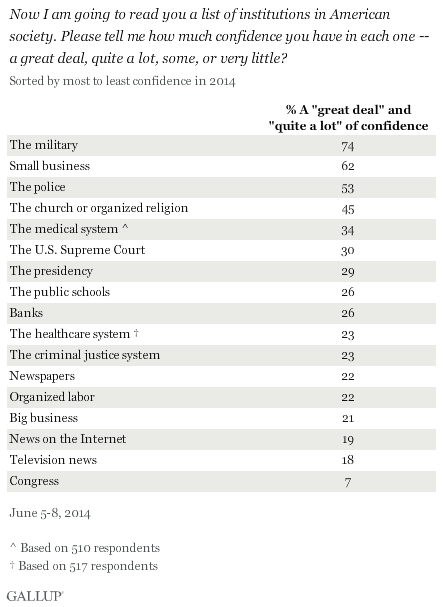
Gallup: confidence in institutions

For any society to function effectively, you need a considerable amount of trust. Rules, regulations, and the legal system can only take you so far. Anyway, any society where behavior is that tightly controlled is invariably oppressive and unpleasant to live in. There are so many variations in human behavior and circumstances that you need both flexibility and tolerance to be integral to the the culture—or to put matters another way, common human decency is a must if the business of daily life is to be tolerable.

Trust is the great enabler, and its decline is a case of concern. Because it is an intangible, and we tend to take it for granted, we don’t seem to talk about trust much—but perhaps we have reached the stage where we should. In more than a few cases, public trust in some of our institutions has sunk so low that it is impeding both their functionality—and our way of life.

Public trust has deteriorated to the extent it has for these main reasons:

The performance of the institution—or group of institutions in question. Here, Big Business is a perfect example of a sector which is deservedly held in low esteem. It has violated its social contract in numerous ways, seems to operate without a moral code, and no longer appears to have any regard for the society which allows it to function. Its offenses include overpaying its CEOs, avoiding taxes, financial engineering, exporting jobs by the million, largely removing job security, failure to implement working conditions which are the norm in other developed countries, failure to invest, the arbitrary closure of plants to the detriment of local communities, and massive destruction of the environment. In addition, you can add in numerous ways in which Big Business makes dealing with it unpleasant. These span the gamut from secrecy to quality deficiencies to deceptive practices to rigging the legal system to give it special favors.

Are there exceptions to this rather grim picture? Of course there are. There are many fine companies out there who do an excellent job, look after their employees well, and do a great deal of good for their communities. Nonetheless, it is hard not to have the feeling that they are in a minority. Accordingly, Gallup’s finding that only 21% of people have a great deal of confidence in Big Business seems reasonable.

The second main reason why trust has deteriorated is that there has been a deliberate campaign to undermine trust in government operating since the early Seventies. This has been operated by Right Wing interests for political reasons—and specifically to keep taxes on the rich and on Big Business down—and has been highly successful. It advances the argument that government is inherently less efficient at doing just about anything than the private sector—and therefore the less of it we have the better. The trouble is that the evidence does not support that. Also, there many things which are near impossible to achieve without society cooperating—and the manifestation of such cooperation is government.

Here, I don’t pretend that government is blameless, but merely make the point that government can be highly effective—and is right now in some other countries. In short, the issues of concern should be the caliber of the people in government together with their policies—as opposed to government itself. A further point is that if the proposed alternative to government is Big Business—which is what is normally suggested—one has to wonder on what grounds it should be considered superior.

The third main reason why people’s trust is in decline is because the economic health of most Americans has been slowly deteriorating since the Seventies. For several decades this degradation was scarcely noticed, but the Great Recession and its aftermath have shaken people to the core—and it is now fairly clear that this widespread economic insecurity is contributing to the general sourness that people feel.

A fourth main reason why people are losing faith in U.S institutions has to do with the fact that a great many members of the public are either under-informed or misinformed—and, as such, prone to rely more on prejudice than rational analysis. This relatively high level of ignorance exists for a host of reasons stretching from our inadequate education system to the poor quality of news coverage on national TV, and its effect is significant.

It would be hard to find a better example of widespread ignorance than the high regard in which people people hold the military. Here, no less than 74% of people have a great deal of confidence in it—without making any distinction between the soldiers who do the fighting—and deserve all the support they can get—and the MICC (Military Industrial Congressional Complex) which is deeply corrupt  and operates far more for the benefit of its members than the nation as a whole.

It could well be that the problem here lies far more with the question than anything else—in this specific case—but I hold to the view that blind support of the military, without knowing something of the details, is exceedingly dangerous.

It means that:

  • We spend an excessive amount of money on defense without there being any full accountability.
  • It encourages a culture in the MICC where corruption is the norm.
  • It means we embark on wars which again and again we fail to win—at vast cost in blood and treasure.

A supreme irony in relation to our high regard for both the military and police is that both are government institutions. In fact, the military in particular, are run by that very same Federal Government which so many of us profess to despise.

As for the fact that only 7% of people have confidence in Congress, I guess that figure speaks for itself.

VOR words 975


Sunday, November 23, 2014

(#53-1) November 23 2014 The Social Media are a communications phenomenon which we still don’t seem to know how to use to society’s advantage.

THOUGHTS ON SOCIAL MEDIA

VICTOR - SHOT BY MICK - ENHANCED

GIVEN ‘THE WISDOM OF CROWDS,’ HAS IT MADE THE WORLD A BETTER PLACE?

I have every reason to be grateful to social media, because without e-mail (which I guess can be so classified) I might well have given up writing. Traditional publishers are notoriously bad at passing on fan mail and it wasn’t until my third book—and only the paperback edition of that – that I asked for my e-mail address to be inserted. Up until then, despite having written a Best Seller, I had received almost no mail from readers—and I was somewhat disconcerted.

Either my writing was not resonating with readers—or my publisher was not forwarding my mail. After I found some mail addressed to me in my editor’s office—stuffed some place out of mind—I began to suspect the latter. Later I heard from writer friends that they had experienced the same thing—and that such neglect (part of a much greater pattern of indifference) was commonplace.

Why have traditional publishers treated so many so many of their authors so badly for so long? Because they could. They had the power—and there was always another writer waiting in line. A second reason is that the profit motive is not necessarily conducive to good behavior. I hope this doesn’t come as a shock to you, but business is not synonymous with either honesty or manners. When you think about it, that shouldn’t be a surprise. Historically, if you wanted to get a little richer, you just went and grabbed it (“it” being gold, your neighbor’s wife, land, whatever). Despite the form being modified, the substance hasn’t changed that much—and neither has human nature.

I wrote that traditional publishers “had the power”—the past tense—because whether they are still in the same position of strength that they were is a moot point. On the face of it, they have been weakened by the fact that publishing independently is now a practical proposition. On the other hand, traditional publishers have the vast financial resources to dominate—whereas self-published writers, by and large, do not. But, at least traditional publishing is no longer the monopoly it once was—and new forms of publishing will emerge. Cooperation by groups of indies seems to be to me to be the most attractive route. But almost anything would be better than the dominance of publishing by a handful of large corporate entities.

I worry greatly about the dominance of our society by large corporate entities—particularly because they are not delivering the economic prosperity for most Americans they have long promised. They have now worked out how to skim the cream—so to speak—but let the rest go sour. Hence we have booming corporate profits—and a seemingly ever rising  stock market—but the earnings of most Americans are in decline. Is there a national outcry over this (and there certainly should be)? No. Our movers, shakers, and the media they own avoid such issues like the plague—and voters largely don’t vote. 

After my e-mail address appeared, a deluge of fan mail resulted—many thousands (and climbing)—which persuaded me that I should hang in there—and I have. I give thanks every day for that fact—and I hold my fans in very high regard (none more so than my #1 fan—and very special friend, Deb Wagoner). I should add that most of my readers, whom I have got to know personally, have become friends. Clearly, I have a high class of reader!

I regard it as a great and wonderful thing to be able to communicate with my readers directly—and vice versa—but I also have to say that e-mail is the greatest distraction from serious writing yet invented. Hell, it is the greatest distraction from just about anything. It’s a time sink. Does the good outweigh the bad? I think it does, but it is finely balanced.

Blogging is another matter. I would like to say that I took to it immediately, but the opposite was the case. Also, I read some very bad blogs early on which doubtless colored my views.

A core problem was that I had great difficulty blogging myself. I had trained myself to write books—and mostly fiction at that—so couldn’t quite see where writing about myself entered the picture (and many of the early blogs I read were highly personal). One the other hand, I could see that my readers could well be interested—particularly about my writing progress. Unfortunately, writing about a book before it is finished violates my writer’s superstition that a book in progress shouldn’t be talked about.

What to do? Nothing wasn’t an option for two reasons: Firstly, a writer needs every exposure to the marketplace he can get. Secondly, my good friend, Tim Roderick, kept urging me (in the nicest possible way). Tim is a former Apache AH-64 attack helicopter pilot and a decorated gunship pilot—and is nothing if not persistent. I was outgunned.

I finally decided to blog without planning—to make the whole thing an exercise in spontaneity—and to write about whatever came to mind regardless of whether it concerned me, my writing, or not.

Since I normally have some idea of what I am going to write before I even sit down at the computer, this new approach would really take me out of my comfort zone. The pain! The pain! On the other hand, I was curious to see what my mind might come up with. It would be a great challenge—and like cod liver oil, even if unpleasant, probably good for me.

Galloping grasshoppers! Spontaneity has worked. Of course, I do work in stuff I read and so on—which suggests an element of planning—but normally I do that in hot blood, or don’t include it. Paradoxically, I now find it easier to write when I don’t have such a focus. I’m finding that spontaneity is fun—and terrific exercise for the mind.

Overall, I find blogging a very good thing. Here, I am not primarily commenting on my own positive experience, but am much influenced by the high quality of some other blogs I have discovered. These now rival the best of journalism. I read them with the same focus I give magazines such as THE ATLANTIC MONTHLY. That is high praise, by the way.

We now come to Facebook. Here, I admit defeat so far. I have had a Facebook page for over four years but have never written in it regularly because I find most of the content pretty trivial. I have the feeling that this is arrogance on my part because I do understand the advantages of keeping in touch with people you would otherwise drift way from. I am far less convinced by the advantages of building up numerous “Facebook friends” you don’t know from a hole in the wall.

These days Facebook has made so many changes I don’t even know how it works. Accordingly, my plan it to recruit a guide and assault its bastions once again. It is such a major presence that—like it or not—I don’t think it can be avoided—and I am much influenced by the fact that more than a few people I love use it (though seemingly, where they are siblings, cannot—or will not—write letters).

My track record at instantly understanding Social Media really isn’t good at all. I like to think I have an open-mind, and on many issues I do, but Social Media caught me decidedly short. I screwed up again when it came to LinkedIn after I was introduced to it by my good friend, GI Wilson (a former Marine colonel of some distinction). Fortunately, in this case, I eventually took the time to write an adequate profile—and I have been somewhat amazed at the response. Simply put—LinkedIn works—and  and I intend to give it even more attention in the future.

Has Social Media made the world a better place? Well, it has certainly made the world a different place—but different is not necessarily better.

If you believe in the Wisdom of Crowds—the concept that many minds can normally come up with a superior answer—you would think that we would merely have to list the problems society faces—and the answers would be forthcoming now that communication has become a resource accessible (more or less) to us all.

I see scant evidence that this is the case. Perhaps this is because it is early days and we don’t know how to make optimum use of it yet—or perhaps crowds are not really that wise.

I haven’t given up hope yet. In some ways, somewhat to my surprise, I am an optimist.

WOR words 1,203