Writing is the only way I have to explain my own life to myself.”
Pat Conroy, My Reading Life
“I'm a writer by profession and it's totally clear to me that since I started blogging, the amount I write has increased exponentially, my daily interactions with the views of others have never been so frequent, the diversity of voices I engage with is far higher than in the pre-Internet age—and all this has helped me become more modest as a thinker, more open to error, less fixated on what I do know, and more respectful of what I don't. If this is a deterioration in my brain, then more, please.”
Andrew Sullivan

I appreciate that some readers of this blog must find the subjects I write about a somewhat eclectic collection. Well, I have explained my reasons before, but since it is something of a hassle to search back, let me repeat them—probably not identically. One’s thinking evolves.
WHY BLOG AT ALL? I didn’t like blogging at all at first—I’m a relatively private person for starters—but then I found that the discipline of having to think about a different subject to write about every day (and then to write about it) was having a positive effect.
Secondly, when I stopped blogging for a while, I requested numerous request to head back down the salt mines.
I also learn a great deal through blogging. But my rationale is as follows.
- To keep in touch with readers
- To communicate to family and friends.
- As a writing exercise—to ensure I write something every single day and as a daily discipline in its own right.
- To clarify my own ideas
- To try and resolve a few demons.
- To advocate change in certain key area.
Do I think blogging can change anything? Actually, I do. In fact, you don’t need to reach a large number of people to make a difference. The important thing is to reach the right people.
Change is peculiar. Just when you think you are getting nowhere, it all starts to happen.
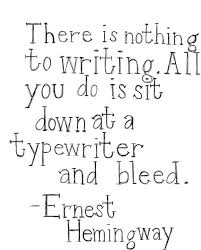 WHY WRITE SO MUCH ABOUT WRITING? I have learned a great deal from reading the experiences and thoughts of other writers so in some ways I’m merely putting something back into the pot.
I find myself thinking with particular concern about the aspiring writer, and hope my tales about the early days will provide some comfort as well as practical advice. You feel so alone when you are learning to write at a professional level for the first time, that it is comforting to read that others suffered ahead of you—and survived..
My writing oriented essays will also be used as the basis for a book on writing—target primarily at the aspiring writer. In fact, it is close to being finished.
 CREATIVITY & THE ARTS. I had a decidedly strange upbringing—unpleasant in many ways—but, for all its negatives, it was creatively stimulating. In addition, I am innately intellectually curious. This combination has led me to have a deep belief in creativity to the point where I have formed the view that we should do vastly more to encourage it. Instead, we suppress it in many ways. I write about this area in order to promote creativity and to try and advance more own ideas on the matter. I also have numerous connections in this area and like writing about them. My uncle by marriage, GODFREY QUIGLEY (see photo) was a highly successful producer, director and actor and had major roles in BARRY LYNDON, GET CARTER, EDUCATING RITA, and CLOCKWORK ORANGE amongst other movies. He was one of my favorite people. He was the first person to teach me how to pour a beer—and when he was at university, he let me take over his mother’s apartment (she had died). Strangely enough, my first serious girlfriend ended up falling for him—and they were together until he died of Alzheimer’s. A little later, having announced her intentions quite clearly, she killed herself.
 TERRORISM. It would be strange, indeed, if I didn’t write about terrorism. It has been an interest of mine since my mid-teens—and, of course, I lived with it in Ireland for many years. It wasn’t of major concern in the South—though there was some spillover—but the North, in those days, was a war zone. Also, all my thrillers feature terrorism. It is, if you will, one of my areas of expertise.
My real interest is not just in terrorism, but in small wars, irregular wars, and terrorism since 1945—so I don’t limit my interest to guys who don’t wear uniforms and blow up civilians.
The aspect that interests me most is asymmetric warfare—how conventional military power can be countered so effectively by the weak. Here, I tend to empathize with both sides. One the one hand, Ireland won its independence through terrorism—and my Irish blood supports that. On the other hand, I certainly didn’t support the 30 year campaign the IRA (and various spinoff groups) launched in 1969.
Mostly, I’m against terrorism. However I do understand it. Primarily, it’s a tactic of desperate people. We need to understand the causes more than we do. By and large we’ve chosen to demonize terrorists instead. This is not a wise attitude.
 MILITARY. I have so many military connections—both family and friends—I scarcely know where to start. I have also done a considerable amount of military related work, and have more than a little expertise in this area. Apart from being innately interested, I am also on a countdown to complete a major novel on the U.S. Army.
Dave Petraeus commanded the unit of the 82nd Airborne I researched back in the early 90s. He was a colonel then—and singularly impressive. He has served his country with distinction. Personally, I think the president should have refused his resignation. We need immensely able people like him. But, I’m biased, of course. I like him personally.
WEAPONS & RELATED EQUIPMENT. You have got to remember I’m a thriller writer—so am constantly looking for items to make my books more interesting. That apart, I like to keep my military knowledge up to date.
 AVIATION. I have been fascinated by aviation from an early age. I was about four when I first flew on a DC-3 from Dublin, Ireland, to Northolt Airport near London. I was six when I fist saw a jet in the sky and was absolutely thrilled. I did a great deal of flying in small, rather dangerous aircraft when I was in my early 20s (thanks to the woman in my life). Suffice to say that I have loved aviation since I was very young. My interest is kept alive through my friendship with Tim Roderick, a former Apache attack helicopter pilot who has been one of my closest friends since the mid 90s—and yes, I have flown in an Apache (a life changing experience).
 THE ECONOMY. I have a Masters in this area—but don’t consider myself a particularly good statistical economist. My specialty has long been behavioral economics—which focuses more on human behavior. Though I have never practiced as an economist, it has emerged as an ever increasing passion—and I have now become really quite good at reading an economy. In fact, I’m now in my eleventh year of studying the U.S. economy and have evolved some strong views on the subject.
My intention is to move my economic comments onto a separate web site—but so far I haven’t found the time.
HEALTHCARE. Frankly, I’m surprised that more Americans don’t write about healthcare. The present system is so expensive, corrupt, and inefficient that we should be all rioting in the streets. True, Obamacare looks like easing certain elements, but the rot is so deep—it will need more fundamental reform. I’m also surprised that more Americans are not concerned that our longevity is roughly three years less that that of the citizens of other developed countries.
Why should those pesky Europeans live three year longer? Maybe we should be trying somewhat harder to answer that question.
 FAMILY HISTORY & MEMORIES. I had a difficult upbringing—which was not without its positive aspects (particularly in relation to encouraging creativity). I write about it for a number of reasons.
- It’s therapeutic.
- It’s interesting.
- Aspects are extremely amusing.
- I intend to turn all of this into an autobiography fairly soon.
The photo is of my much loved stepfather, Alfred Lyons, when he was in his prime. He did tragically far too young.
BOOKS. Actually, I’m surprised I don’t write more about books. They have been fundamental to my life from the time I could read—and saved me when I was at boarding school. Ironically, I have never read fewer books than this year probably because I have been writing so much. The good news is that the books I have read have been outstanding. I hereby resolve to write more about books.
THE ENVIRONMENT. It seems to me that we should all be a great deal more concerned about the environment than we are. I was introduced to this area when I was still very young by my grandmother—who was a pioneer when it came to environmental concern.
 SOCIAL JUSTICE. I am, I freely admit, socially concerned. I suspect I get this from may grandmother, Vida Lentaigne, a high minded woman whose father was a British Liberal MP—not to mention a wealthy textile magnate. Anyway, my grandmother was heavily involved in liberal causes from early days, and did a huge amount of good in her life. I absolutely adored her.
The painting is a portrait of my grandmother as a young woman by Sir John Lavery. It used to hang in out dining room—and I loved it. It was sold by my mother before she moved from Ireland to Spain. That tells you all you need to know about their relationship. I went into shock when I heard. Hell, I think I’m still in shock.
 WOMEN, I like most women (subject to some notable exceptions)—and, mostly, they seem to have liked me. I don’t just like women sexually—although sex has played no small part in my life—but I enjoy the company of women. They/you have a different perspective from men, and, in many ways are smarter (except when it comes to men).
They/you are a pleasure to talk to—and, generally speaking, are better communicators.
What I don’t understand is why we continue to treat women so badly. It’s completely wrong that women are only paid 77 cents to the male dollar, for instance. Similarly, women would benefit disproportionately if the minimum wage was increased significantly.
I’m truly puzzled as to why women accept second class citizen status.
I hope to write more about women in the future than I have.
Why is Rosie the Riveter my graphic? Because I don’t want to make this section all about sex—yet I would certainly like a more feminine looking woman displayed than the muscular Rose. But, who is the question. I am temporarily stumped? There is an excess of choice. There seem to be more beautiful women in Seattle alone—and of all ages—that I could ever have imagined when I was a sex-starved teenager.
Do I go for a particular type? No, I don’t—though I have a weakness for intelligence, a good voice, and long legs. So, in view of my indecision, Rosie is my placeholder.
 CURRENT PERSONAL STATUS. A confession is in order here. I rarely write about my current status at all—even though I know I should. Let me explain why.
- As stated previously, I am a fairly private person in the first place.
- I have been trying to reorganize my way of working fundamentally since 2010 and have had more than a few setbacks. I guess I am too embarrassed to want to document all my mistakes publicly (though it would probably make for an interesting story). But, I’m reluctant to tell it until I have some success under my belt. I guess that is pride talking.
- In fact, I have enjoyed considerable successes in some areas, but mostly they are not the kind of things that would mean much to other people—although they mean a great deal to me.
The bottom line is that it is my intention to make this blog more personal as soon as I have a clearer path ahead. Am I close to that? Yes, I think so.
Have I the courage to do so?
My courage is like the curate’s egg—good in parts. That means there are times when I’m not as courageous as I would like.
The truth is that I don’t know. Wait and see is the answer.


 So far, I haven’t much felt like listening to the recordings, but am giving though to doing so since nearly four years have now passed. I’m not afraid of listening to them though I know they’ll move me to tears. They’ll also make me laugh. Joe had a bawdy sense of humor and didn’t suffer fools.


