Friday, September 26, 2014

September 26 2014. ISIS has its uses after all. The F-22 is in action at last—thus justifying its existence.. Good value, by Air Force standards, at only $370 million a copy (by that I mean ONE single aircraft). This is the aircraft equivalent of ‘too big to fail.’ It’s too expensive to lose—and damn nearly too expensive to fly. Its cost per flying hour is $68,362. That’s about three times the cost per flying hour of an F-16. Meanwhile the long-term unemployed get no assistance. Do we have our priorities straight here?

If our nation goes over a financial Niagara, we won't have much strength and, eventually, we won't have peace. We are currently borrowing the entire defense budget from foreign investors. Within a few years, we will be spending more on interest payments than on national security. That is not, as our military friends say, a 'robust strategy.'

Mitch Daniels

Maxim 11:
Everything is air-droppable at least once.
The Seventy Maxims of Maximally Effective Mercenaries”
Howard Tayler

“Maxim 36:
When the going gets tough, the tough call for close air support.
The Seventy Maxims of Maximally Effective Mercenaries”
Howard Tayler


The Air Force’s F-22 is being flown in combat for the first time. Specifically, it is being used against ISIS in Syria. It’s considered ideal for the task because is is stealthy—and Syria has some highly capable anti-aircraft missile defenses. These belong to the Assad regime, not ISIS.

The F-22 has been declared combat ready since 2005—so why wasn’t it used in either Iraq or Afghanistan? Or is too expensive to lose?

The Air Force paid nearly $70 billion for 187-F-22s—which works out at $370 million each, or roughly twice the price of an F-35 (depending in which model and whether you believe the F-35 figures). The F-22 figure reflects the development costs as well. The Air Force likes to forget about these and quote flyaway cost (the marginal cost of one extra aircraft).

Amazingly, given that truly astounding cost, the F-22 was designed solely to achieve air superiority. It was only in the early Nineties that the decision was taken to add bomb-dropping capabilities.

By all accounts the F-22 is a magnificent aircraft, but one has to wonder whether it makes sense to buy aircraft at this cost. You could, for instance, buy seven Grippen state of the art fighters for the same money. Yes, I did say SEVEN—and the Grippen is a very serious machine.

Actually the ideal aircraft to use to degrade ISIS is the A10 Warthog which was designed specifically for this kinds of work—and which we already own. However, the Air Force is trying to get rid of it in favor of the technically challenged and vastly expensive F-35.

The U.S. military have a habit of not using a perfectly good weapons system they own because they want to justify something new and shinier. Accordingly they moan about the old weapons system, starve it of maintenance funds and so on (and then complain about it’s unreliability) instead of fixing the problems and up-grading the thing.

The Army did this with the tracked M-113 because they wanted the wheeled Stryker even though an upgraded M-113—the version known as an MTVL—would have not only been much cheaper, but would have delivered superior off-road performance. And do we ended up with the Stryker, at huge cost despite the fact that its off-road performance sucks.

The Air Force is doing much the same thing with the A-10 in order to justify the F-35.

I’m all for a militarily strong U.S. but there is a profound difference between strength and extravagance.


Thursday, September 25, 2014

September 25 2014. How do you learn to write about action (by which I mean combat of some type or another)?

My whole life experience feeds into my writing. I think that must be true for every writer. Clearly the Army and combat were major influences; just the same, you need to understand that many of the writers we have now couldn't load a revolver.

Gene Wolfe


Funnily enough, Newt Gingrich asked me that very same question when I visited him—at his invitation. He is (or was) a fan. At the time he was Speaker of the House—third in line for the presidency—and preparing to write a series of action books (which he did not mention). I’m not sure I’d buy a used car from Newt.

But he’s a terrific speaker.  From a distance, he looks like an affable farmer. Up close and personal, somehow the warmth you would expect is missing.

I have been told I write very good action. If I do, it is because most of the action I describe is based upon a specific personal experience combined with a good imagination.  It is not that I have been through everything I write about in my books in a littoral sense. It is more that in most cases I take something I have been through and extrapolate it—sometimes a great deal. But the initial impetus tends to be grounded in reality in some way or other.

Is it the right way, or the best way? No, I don’t want to suggest that for a moment. All I am saying is that it is a way that has worked well for me.

The foundation, of course, as with most everything to do with writing, is reading. If you read as many adventure stories, and as much military history as I have over the years, it would be strange indeed if I couldn’t write action—given the experiences I have had as well.

Could I write action without the experiences. I’m not sure I could—though I’m sure others could—and have. Imagination is a powerful thing. I’m not lacking in that area. Nonetheless, I seem to need to ground my fiction in some degree of reality.

Quite early on—before, in fact, I committed to writing full time—I set out to establish what I tend to think of as a “base of experience.’ This has involved spending time with military units, visiting places where there was action but which were relatively safe and accessible (I have learned there is no such thing as a ‘safe war’), cultivating sources in the security services and military—and generally endeavoring to become comfortable with the various cultures I thought I would be writing about in the future.

This practice has served me well. In fact it led me to meet some of the major players in the U.S. Army, such as General Dave Petraeus—and for my working for General Jack Keane, then the Army Vice Chief of Staff, for a while. In retrospect, although my experiences were fascinating, I probably went too far. Military work took me away from serious writing for some years. A writer should stay a writer. Our job is to observe, record, analyze, illuminate, and communicate. When you become a player, you lose your perspective—and there is a good chance there will be a conflict of interest. Your integrity may well be put at risk.

On the other hand, you can learn a great deal. It’s a classic Faustian situation.

When I write an action scene, essentially I write and shoot a mini movie in my head. Since I think visually, that is not so hard—and, after I have run through it a few times, it becomes virtually real to me, to the point where I can re-run the movie on demand. Somehow, in the process, a great deal of the necessary detail tends to get filled in. Here, I guess my subconscious is just reaching down for what it needs from the deeper recesses of my memory.

Let me stress, I am neither particularly brave, nor physically courageous. However, what does tend to happen is that I somehow feel protected if I am researching a story. Such a feeling has no rational basis—but I’m not unique in having it. I’m told many combat photographers feel exactly the same way.

I do tend to think tactically fairly well. That has its roots in a combination of reading and learning to fight after having been bullied at school. There, even after I grew tall enough to take care of myself, I was always outnumbered so I soon learned to maneuver—and to be quite violent if I though the situation demanded it.

I abandoned that particular slippery slope after I nearly killed another boy by accident. That frightened me more than I can say. I even liked the guy I nearly killed. But when you hit someone in the throat with your extended fingers, and they start to turn blue, you are a hair’s death from serious trouble. My victim couldn’t breath properly. I wasn’t aware of the condition then, but had turned away because assembly had been called.

He turned up very late and still blue. But, he was alive.

The next person I saw that was blue—and this was over 20 years later--was the hanging victim  I found near William Randolf Hearst’s old Castle in Wales. He had moved on to the next stage. He was freshly, but decidedly, dead.

It was that event, as I have described previously, which led to my first book, GAMES OF THE HANGMAN.

The blue condition is called cyanosis. It isn’t a deep blue. It is more of a pale blue sheen—though it is still very noticeable. It is a symptom of low oxygen saturation. That tends to happen when you can’t breathe. Mind you, your don’t need to breathe when your neck is broken.

It would represent a pointless expenditure of energy (if you had any).That man had the longest neck I’ve even seen.

He did, in a sense, give one last breath. After he had been cut down, the air from his lungs was squeezed out as we laid him on the ground. He gave a long groan.

‘Scary’ does not capture the spirit of the moment. Next time I catch the top half of a hanged body, I’ll take it in my stride.

Maybe not.

In truth, when I had him in my arms—just before lowering him to the ground—and the groan—a wave of compassion swept over me.

So young. So dead. So pointless. So sad.

I wanted to make him alive again. He was 19—and, in real-life, he was Dutch. I set the book in Switzerland because I had a Swiss girlfriend. It was to become several Swiss girlfriends. I like the Swiss.

Best you get through  life without seeing the physical consequences of a hanging.

I have both seen and experienced enough violence over the years to have developed a thorough dislike of the reality. Nonetheless, I still enjoy a good thriller, or action movie, so expect I’ll continue to write action until I die.

Will I visit any more ‘safe wars?’ Frankly, I think I have enough experiences under my belt to keep me going for as many books as I’m likely to have time to write. That said, I have a yen to visit Israel.

Make me an offer to visit a combat environment which is so interesting that I can’t refuse—and who knows—70 or not, I might just accept.

I make no pretense to be one—but I enjoy the company of warriors. “Camaraderie’ is not just a word. It means a willingness to die for each other—and they do. Tougher still, they live with scars both visible and invisible—and society doesn’t treat them that well.

War is the worst of things—but it has the capacity to bring out the best in some people. More than a few are my friends, and I fell much honored that I have been so accepted.


Wednesday, September 24, 2014

September 24 2014. Are you suffering from IOSD—Information Overload Stress Disorder. It is also known as ‘Writer’s Syndrome.’ Or is this all hogwash?

“There are many things of which a wise man might wish to be ignorant”
Ralph Waldo Emerson

“distringit librorum multitudo
(the abundance of books is distraction)”
Seneca

One of the effects of living with electric information is that we live habitually in a state of information overload. There's always more than you can cope with.

Marshall McLuhan

I have a theory about the human mind. A brain is a lot like a computer. It will only take so many facts, and then it will go on overload and blow up.

Erma Bombeck


How to cope in a world that's gone beyond information overload/yoga meditation

I’M COMING AROUND TO THE VIEW THAT EVERY WRITER SHOULD DO SOMETHING LIKE THIS.

MAYBE WE ALL SHOULD.

I have no idea whether IOSD really exists—or ‘Writer’s Syndrome.’ Since shrinks seem to make a great deal of this stuff up as they go along—I thought I’d follow their example. What I can say is that striking a balance between what you need to know and the mass of other information out there—much of it interesting, but irrelevant—is both difficult and stressful.

For a host of reasons—including the deaths of people I cared about (such as my much loved stepfather) whose condition seemed to deteriorate after their treatment—I don’t hold psychiatrists in high regard. And I have had some personal experience of the breed.

Medical Definition of PSYCHIATRY

: a branch of medicine that deals with the science and practice of treating mental, emotional, or behavioral disorders especially as originating in endogenous causes or resulting from faulty interpersonal relationships

When I was very small—approaching five—and my mother found she couldn’t handle me, I was taken to a series of shrinks in the hope I could be made more biddable.

I soon formed the view that they were basically con men. One shrink’s party trick was to put the child in a room where he could “let go of his inhibitions.” In practice, this meant you could throw sand around, write on the walls, splash paint—and so on. I thought it was bizarre. I didn’t feel inhibited. I just thought I was being beaten too much—and I wasn’t going to take it.

The shrink was very proud of this room. I guess it earned him a great deal of money. Anyway, after I was led into the room, he looked down at me and said something like, “Little boy, you can do absolutely anything you want in here.”

Young though I was, I had already learned that adults lied a great deal –and I was fairly sure he was lying in this case. So I looked up at him and said: “May I break the windows, sir?”

The shrink turned brick red with rage and he snarled. “No, you—may—absolutely—not!”

I recall that occasion with the greatest pleasure—and regard it as one of the high points of my life. I was to pay a high price for it.

Why was I so difficult? I don’t think I was really—although I was intensely intellectually curious, and probably was a pest with my questioning. But the real issue was that I had been brought up by a nurse, May, who I loved to bits—and when she was suddenly fired some months after my fourth birthday (because mother became jealous) I resented it. As far as I was concerned, May was my mother.

My real mother responded to my defiant attitude by trying to beat me into submission—daily—which only made me fight harder. For instance, I refused to kiss her goodnight—you fight with the weapons you have. But underlying that was the fact that mother had been an only child without a father—my grandmother had been widowed early (grandfather had made it through WW I and had then died from cholera in Burma)—and had no idea how to bring up a child, let alone a boy. In addition, she didn’t really want an overly inquisitive child hanging around. She was still a young and attractive woman and wanted to have fun—nightclubs, men, alcohol, and sex—which was why I was sent to Red Lodge (which I have written about previously) and then boarding school at the age of five (where I was the youngest and  smallest boy in the school and thus a predictable target for bullying). The next years would have been intolerable—except I learned to read and to write. And when you can read, you can escape. I was physically in boarding school, but, that technicality apart, I travelled the world.

This is a sad story really—well, until I reached the age of 10. I suddenly grew—and I started to write and win prizes.

Still, abusive treatment during childhood does seem to foster creativity—and I am truly grateful for that gift.

Incidentally, I do believe it’s worthwhile talking out your troubles every now and then. In my case, I normally talk to friends—though I have also had considerable success with two outstanding pastors. My dislike of organized religion doesn’t mean I don’t appreciate that some very fine people work for such organizations.

Back to the topic at hand.

The good news is that, somewhat to my amazement, I do seem to be making some progress at managing it. Enough progress? Possibly not—but at least the situation seems to becoming more manageable.

Why so? The most effective technique seems to be to set limits. To paraphrase Parkinson’s Law, browsing expands to fill the time available unless you set limits. Be ruthless.

  • I have been limiting my areas of interest with some success.
  • I have become more familiar with the websites I need
  • I’ve become faster at searching online so am storing less.
  • I rarely browse at random. I’ll do a search and when I find what I’m looking for, I’ll stop.
  • I’m using software that works well—specifically Evernote, Insightly. and Google Contacts.
  • I blog daily, but limit my involvement with social media.
  • I rarely text.

Well, so much for the good news. E-mail (which I love—except for the volume, and its remorseless nature) still remains a problem—but I guess it does for most of us. Sanebox.com –which is trainable—does help (but still needs a great deal of training).

I’m completely mind-boggled by the amount of work involved in coming to terms with all this. There is so much to learn, and it changes so fast.

I don’t resent it. It’s fascinating in its way. I just wish I was better at it. Still, given that I was brought up in the age of the dip pen—though I graduated to the cutting edge of writing technology, a fountain pen—I’m agreeably surprised that I have adjusted as well as I have.


Tuesday, September 23, 2014

September 23 2014. Is it possible to become too focused on writing?

“It sometimes takes a state of solitude to bring to mind the real power of companionship.”
Stephen Richards

“Focusing is about saying No.”
Steve Jobs

“One of Job's great strengths was knowing how to focus. " Deciding what not to do is as important as deciding what to do, " he said. " That's true for companies, and it's true for products.”
Walter Isaacson, Steve Jobs

“Inspiration is the windfall from hard work and focus. Muses are too unreliable to keep on the payroll.”
Helen Hanson

“When you fully focus your mind,
you make others attracted to you.”
Toba Beta, Betelgeuse Incident: Insiden Bait Al-Jauza

“Ah yes, the head is full of books. The hard part is to force them down through the bloodstream and out through the fingers.”
Edward Abbey, Postcards from Ed: Dispatches and Salvos from an American Iconoclast


It’s tough being honest with oneself. There tends to be a  natural human desire to justify one’s behavior to others—or rationalize it to oneself. But, of course it’s possible to overdo anything. I should know. I do.

I have never been particularly good at balancing my life. I tend to be passionate about what I do—and to commit to projects which are too hard for me to do, but which I am determined to do anyway. I don’t really know why I do that, but it has been the pattern through my life. A consequence is that I have always had to struggle—so rarely have had the time to just chill out. This doesn’t mean I can’t—more that, after endless failures and prevarication, I have always felt I should make one more effort to resolving the issue at hand.

I won’t pretend for a second that that I regard that as wise. I will say that such an approach has worked for me many times.

It does not, however, make for a balanced existence.

Right now I’m about as committed to writing as I have ever been in my entire life—so my inner voice is telling me to cool it a bit. I’m finding that very difficult to do. I love writing so much I find it almost physically painful to tear myself away. I don’t feel insecure about the writing process—quite the opposite in fact—but when I am away from the keyboard, I do wonder how long the magic will last, and whether I will lose my hard-won ability to snap right into focus and write almost immediately.

It is every writer’s dream to be able to do that—so right now I feel like someone who has found the Holy Grail—and is then expected to put it back in its place of concealment, and hope it is still there when he returns. And this in a land of knaves, varlots, cut-purses, and cut-throats.

I don’t know why I’m bringing traditional publishers (and their agents)into all this.

But I’m also professional and experienced enough to know that I’ll write better if I get more balance into my life. Sometimes, you need a little distance from what you—and who—you love—to fully appreciate it—or  them. We’re back to that invaluable aid to sound judgment—perspective.

Man doesn’t live for writing alone. Actually, he does. But he lives even better if…

On the other hand, knowing you should do something—and actually doing it are two different things.

I don’t intend to give up writing every day—hopefully ever (though death may slow me down) but I am giving thought to limiting writing to an hour, or two (or three), for three days a week—and filling the balance with more sociable activities.

I miss interviewing, for example. A good interview is quite a high—a wonderful human interaction. It’s  very special when someone truly open ups.  Such experiences can be intense, emotional, cathartic, to the point of disturbing. When people let their guard down—something they rarely d0—a remarkable intimacy can develop.

You, the interviewer, have to proceed with care—people are vulnerable under such circumstances—but you must proceed. As one-eyed Israel general, Moshe Dayan, liked to say, “You must exhaust the mission.”

I tend to remember interviews with particular clarity—much as one recalls a particularly good movie or play. Such experiences resonate, and stay with you.

As I have tried to explain—I’m not anti-social. I just need solitude to write. Long hours of solitude. Solitary solitude—and no—this is not personal.

What can I say! Writing is an activity which breaks your heart—and uplifts your soul.

But, do we have a soul? Prove to me we have souls.

Well, here’s the thing. Despite my protestations of rationality—on that issue, I don’t demand proof. I believe we have something—and soul is as good a word as any.


Monday, September 22, 2014

September 22 2014. Stealth—one small example of how we are manipulated. How so? Well, the promise of stealth (being invisible to radar) may be oversold. You see the fact is that stealthy aircraft are detectable by some radar systems—such as Australia’s recently updated Jindalee. Stealth isn’t as stealthy as we are led to believe. Once again, the MICC has overpromised—and is under-delivering.

In the councils of government, we must guard against the acquisition of unwarranted influence, whether sought or unsought, by the military-industrial complex. The potential for the disastrous rise of misplaced power exists and will persist.

Dwight D. Eisenhower

The prison-industrial complex and the military-industrial complex are here with us and are multi-billion dollar enterprises. We can make more money off the kid in Compton if he's a criminal instead of a scholar. It's business.

Henry Rollins


ABOVE—WORLD WAR II RADAR

BELOW—THE WAR OF THE WORLDS

It’s quite an experience to see a major radar installation. Unlike WW II type radar installations—or the radars we see at a typical airport—which are relatively compact—a major military national security installation is more akin to to a veritable forest of antenna of a wide variety of types covering the ground for as far as the eye can see (or else it is linear and stretches for miles—as is the case of Australia’s Jindalee).

Such an installation is a sobering spectacle. It helps to give you an insight into the awesome scale of the destructive forces arrayed against each other in this nuclear age—and, to be quite frank—is rather frightening. You feel so insignificant in the scheme of things—entirely vulnerable, helpless—as if you faced the implacable machines in WAR OF THE WORLDS. True, you know that intellectually—though it is scarcely a thought most of us like to dwell upon—but it is another matter entirely when that grim truth is rammed home in such a way that it is inescapable.

I have seen such installations twice. The first was somewhere in the UK—I forget the actual location but I only saw it from a distance. I saw the second—which was near RAF Akrotiri—from much closer, largely because I had gone looking for it.

I was in Cyprus to experience a ‘safe war’ (the Greeks were having a go at the Turks) which turned out to be not so safe. Then the Turks invaded.

The British maintain a sovereign base there because it’s an excellent location from which to spy on, or attack, various countries of interest in the Middle East. And where the British are, so is the U.S.

I was reminded of reminded of Akrotiri when I ran across an article about Australia’s vast Jindalee over the horizon radar system which is so big it stretches across the Outback. Its job is to protect the whole continent of Australia so the scale is understandable. It is also immensely powerful and has a reported range of 3,000 kms (1,900 miles)—and almost certainly a great deal more in reality.

A JINDALEE RADAR. AUSTRALIA HAS THREE. THEY CAN DETECT TARGETS ASMALL AS JET TRAINERS,  OR 300 FOOT PATROL BOATS (WELL, THAT IS THE ADMITTED CAPABILITY—IT MAY WELL BE RATHER BETTER).

Aviation Week comments:

With little publicity, the defense department and its contractors have completed a major upgrade of Jindalee, whose three enormous antenna installations, ranged across the Outback, bounce high-frequency radio beams off the ionosphere to observe aircraft and ships at least 3,000 km (1,900 mi.) away, perhaps as far as the South China Sea. The upgrade has increased the speed, sensitivity and precision of the sensors, and knitted them into the national command and control system of the Royal Australian Air Force(RAAF).

Over-the-horizon radars have the key advantage of defeating stealth. Igor Sutyagin, Russian studies fellow at Britain’s Royal United Services Institute, pointed to such capabilities of very-long-wave radars in a paper released this month. “Longer wavelength, decameter-band radars” such as the Russian Rezonans-NE could be effective against the Northrop Grumman B-2 and other targets designed to evade detection by very-high-frequency (meter-band) radars, Sutyagin says.

Jindalee operates in a similar band. According to one U.S. technical paper, at very long wavelengths that are close to the physical size of the target, conventional radar cross-section measurement and reduction techniques do not apply, and the target’s detectability is a matter of its physical size.

Such sensors detect targets by Doppler, the slight shift in frequency of the reflected radio waves caused by a target’s motion toward or away from the radar. They are challenged not only by the vagaries of the ionosphere, which acts as a blurry, unstable mirror for bouncing the beam, but also by the colossal ranges at which they are operating: The returned energy from a target thousands of kilometers away is minuscule. The arrays are necessarily huge. The transmitter at Alice Springs is 2.8 km (1.7 mi.) long.

The significance of Aviation Week’s piece is pretty clear. As matters stand, stealth is not what it is widely claimed—and understood—to be to be.

Why is this significant? Well, the U.S. taxpayer is currently in the process of paying out over $1 trillion on the F-35 aircraft—and a major justification for the high cost of the program is that the F-35 is stealthy.

The MICC (Military Industrial Congressional Complex) operates by creating and fostering a climate of fear, seeding it with more specific threats, and then coming up with ultra expensive technological solutions (which almost always come in delivering less than originally promised, behind schedule, and over budget). The MICC has been at this since the end of WW II—nearly 70 years—and has become even greedier and more corrupt over time.

But does it ensure that we do well in war? At least that would be some consolation.

Our track record since WW II is pretty much a long litany of military disasters at huge cost in both blood and treasure—and despite the consistent courage of the fighting military. The problems lie elsewhere—at a higher level.

MICC contracts are normally obtained by bidding low and then escalating the price over time. They are able to do this because such contracts always allow for escalation when changes are requested—and changes inevitably are requested because technology changes so fast (or it suits some MICC member’s agenda). 

Changes, as far as the defense contractors are concerned, have the added advantage of justifying being behind schedule—which extra time allows for even more changes and even further cost escalation. It is a well established pattern, and is one reason why major defense contracts take such a long time to deliver a usable result—even in time of war (something that was decidedly not the situation in WW II). Today, it is not uncommon for a defense contract to take decades. Who is to blame for such delays. It becomes virtually impossible to find out because the serving military, in particular, get moved around so often.

This clearly raises major questions about the nature of such contracts—and the integrity of both the process and the people who manage it.

This situation continues because the very people who are supposed to oversee the MICC are the MICC. These include senior officers (both serving and retired), the CEOs and senior executives of defense contractors, members of Congress (the very same people who are charged with oversight) members of various think tanks (which are funded by the MICC) and co-opted media (whose corporations are owned by the same people who own defense corporations.

Do I have a solution to the MICC?

The person best equipped to take on the MICC is the president. That said, no president since Eisenhower has dared to.

The MICC is a manifestation of the excessive corporate power which is is such a feature of the U.S. today. Given that corporations are primarily owned by the ultra rich, it is fairly clear who is ruling the U.S. today—and for whose benefit.

Sadly, it is not ‘We The People.’


Sunday, September 21, 2014

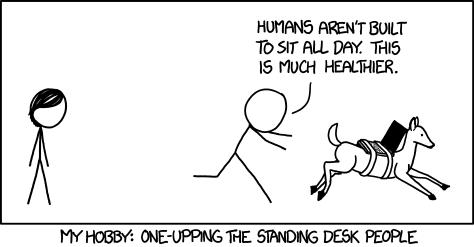
September 21 2014. Is writing sitting oneself to death? I’d like to think there is considerably more to writing than that. Still, the data on sitting are sobering. Perhaps a better word would be frightening. In truth, I tend to believe that too much sitting is killing us. What to do about it is the question. It is not a threat that can be ignored. Or is it all Sitting Bull?


standing

I haven’t been as conscientious about my health as I should have been for most of my life—a fact I deeply regret. I have tended to associate exercise with compulsory sports at school (which I hated—because they cut into my reading time!) in defiance of my intellect which has long known the value of exercise. Actually, I did like athletics and cross country running. Who knew a javelin would be so hard to throw. It looks so easy in the movies. There is something weirdly satisfying about pushing yourself to the limit.

I have been gifted with considerable intelligence, but am far from sure it has been matched with adequate common sense—specially when it comes to practical matters. Once, when I was on a photographic assignment in France—I was covering a rather spectacular coastal fire—I was so focused on framing my next shot, I stepped over the edge of a cliff—and wouldn’t be here today except that a firefighter yanked me to safety. My only excuse is that it was night and I was looking at the flames—not where I was going.

Come dawn, the fire now under control, I returned to Monte Carlo in the fire-truck—all sweat, wine, salami sandwiches, garlic, the smell of smoke, and Monegasque firefighter camaraderie. It was one of the great experiences of my life—and the strange thing about near-death experiences is how alive you feel afterwards.

Monaco isn’t actually French as I’m sure you know—though the fire was actually in France. If you know your geography, you will correctly deduce that this was on the French Riviera.

I still have a tendency to look at the flames.

Still, I have always been a walker—an activity which has served me well—and, more recently, I have become very diet conscious. In fact, these days, I don’t eat during the day at all—and don’t seem to need to (I’m sure I would if I was doing something physically demanding). One benefit—of several—is that I don’t get lethargic after lunch. No lunch. No lethargy.  Much easier to write. In fact, writing demands such intensity of focus that I rarely feel hungry until the evening. Then I suddenly realize I’m starving.

Still, if hunger is not of serious concern during my creative day, the consequences of sitting certainly are.  I have conditioned myself to stand and move around several times every hour—and I walk every day—but I still don’t think it’s enough.

Since most of us sit too much, I thought I would pass on this excellent post on the matter. Catherine Cellier-Smart has done us all quite a service in assembling the links in particular.

We writers, who work alone, are entirely responsible for our own routines—but I have to wonder what responsibility employers have in all this--where office workers are concerned. In effect, the working conditions they impose are seriously damaging to health.

Congressional action? Ironically, they are the one group which doesn’t sit enough.

IS OUR JOB KILLING US?

Posted by Catharine Cellier-Smart (Smart Translate) in health September 20, 2014

Are we ‘active couch potatoes’? Is it only me, or has there recently been much talk of the negative impact of too much sitting? Take a look at just a few of these recent articles:

Inactivity ‘killing as many as smoking’ - BBC News, 18th July 2012

Sitting is the New Smoking – Even for Runners – Runners World, July 20th 2013

‘Get Up!’ or lose hours of your life every day, scientist says – LA Times, 31st July 2014

I don’t automatically believe or react to every health scare I hear about, and I’m sure if we look hard enough there’s plenty of articles that will tell us sitting is fine. Also,initially I didn’t feel concerned by these headlines as I do an hour of sport every day, and a few years ago when I had a salaried, sedentary office job was the period of my life when I was the leanest and fittest. But as an employee I was actually regularly getting up from my desk to see colleagues or management, to deal with clients, or to go to see the factory production line. Even the toilet was several minutes walk away! Now I no longer interact with flesh-and-blood colleagues, I have no boss apart from myself, and I barely see one physical client a day. I regularly go to the gym at midday, which gives me a physical break halfway through the working day, but even then I can still find myself sitting at my desk from 2 to 7pm, and five or more hours of sedentary sitting, according to Dr. David Agus, a professor of medicine, is the health equivalent of smoking a pack and a quarter of cigarettes.* And a study of marathoners found that participants trained an average of 40 miles per week, but also sat idle for nearly 12 hours per day.*

sitting-is-killing-you-791x1024

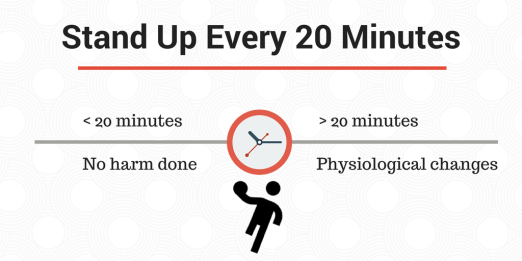
So what can we do about it? Back in 2008 fellow translator Corinne McKay was already blogging about treadmill desks; I also have a friend who posts his Jawbone Up results on Twitter daily (Jawbone Up is an activity tracker that provides feedback on your sleep, exercise and steps). But treadmill desks need quite a lot space, and while apps like Jawbone can give you feedback, as far as I know they don’t provokeactivity. Some people rave about stand-up desks, and while apparently they create more space to hang photos of good-looking members of the opposite sex, other desk workers remain to be convinced, saying standing is not necessarily better than sitting if you do it for a prolonged period of time. There are intermediate solutions, like the Kangaroo Pro or Varidesk adjustable standing desks, but in the end it all boils down to getting more activity and this doesn’t necessarily have to be intense, high-level activity either – some of the longest-living people on earth owe their longevity to having to walk up and down flights of stairs or getting up from a sitting position on the floor**. The debate rages as to how often we need to move, but for example this study suggests that interrupting sitting time with short bouts of walking every twenty minutes may be an important strategy for reducing cardiovascular risk.

3035367-inline-copy-of-the-creativity-spectrum

So on my computer I recently dusted off my Time Out app, which I’ve set to grey out my screen every 20 minutes in order to remind me to get out of my seat and walk about unless I hit the ‘skip break’ or ‘postpone’ buttons. Time Out is a free app for Mac; solutions for PC-users apparently include Work Pace or BreakPal. What about you? Please let me know what solutions you’ve adopted (if any) in the comments below.

P.S. While we’re on the subject take a look at these computer monitor test pages that allow you to test and adjust your monitor settings to get the best possible picture quality and thus avoid eye strain.

Further reading:

* see A user’s guide to standing while you work

** see Why I Killed My Standing Desk, and What I Do Instead – Lifehacker

Why I’m a Convert to Standing at Work

Stand up at office to lose weight, says exercise scientist; A sitting person’s guide to standing up and Treadmill desks: How practical are they? – BBC News

The Stand Up Desk – Lifehacker

I Tried Out A Standing Desk For All Of The Benefits — Here’s Why I Quit – Business Insider

Standing up at your desk may energize you, but it also may be tough on your legs – Washington Post

A Formula for Perfect Productivity: Work for 52 Minutes, Break for 17 – The Atlantic

3 Minute Mini Walk (video)

standing

Acknowledgements to friend and freelance home-working editor Karen White ofWhite Ink Limited for the cartoon above, and whose recent Facebook post inspired me to finally get round to writing this blog post that I’d been mulling over for a while.

Share this:

Saturday, September 20, 2014

September 20 2014. How important is dialog in fiction—and how do you learn to write it?

“Always get to the dialogue as soon as possible. I always feel the thing to go for is speed. Nothing puts the reader off more than a big slab of prose at the start."

(Interview, The Paris Review, Issue 64, Winter 1975)”
P.G. Wodehouse


THE ANGEL OF THE NORTH BY ANTHONY GORMLEY

The Angel of the North is a contemporary sculpture, designed by Antony Gormley, which is located in Gateshead, Tyne and Wear, England. It is a steel sculpture of an angel, 20 metres tall, with wings measuring 54 metres across. Wikipedia

The above has nothing to do with dialog. In fact, the first time I saw it, it rendered me speechless. It is a truly magnificent creation.

There was a Gormley in my year at school and I though at first the sculptor might be him. The dates didn’t match. This Gormley must be a younger brother or something—but he did, indeed, go to Ampleforth.

So did Julian Fellowes who writes DOWNTON ABBEY. In truth, I never regarded SHAC (stands for School House Ampleforth College) as creatively inspirational (it wasn’t) but a few of us seem to have survived it nonetheless. The place is now co-educational. Unbelievable! Lucky sods. I’d have killed for a woman in those days.


DIALOG

Back in the 19th century—when a great many fine novels were written—it seems have been quite acceptable for endless pages of prose to go by without being broken up by dialog.

In those days they were into lengthy descriptions and considerable introspection.  And people liked that because there was no TV, movies hadn’t been invented, and even photographs were relatively rare—so if you wanted to find out about a place or a situation, words were your camera. Yes, there were drawings and paintings—but they take a great deal more work to produce so there were less of them.

Today, we are so saturated in knowledge of the world from every form of media that lengthy descriptions are normally unnecessary—because people already know. You merely need to supply a context and a prompt.

As a consequence, fiction manuscripts have become less dense—and, perhaps because dialog drives movies and TV, more dialog is expected. Besides, people find dialog easier to read.

The bottom line is that dialog is immensely important in fiction today—which means that a writer has to develop a facility for writing it.

Dialog needs to operate at a number of levels:

  • It needs to serve the story—advance it, and otherwise contribute..
  • It needs to develop character and be consistent with it
  • It needs to be entertaining.
  • It can’t be too littoral. You want to make things clear—but not too clear. Readers should be kept in a curious fuzz. Think of them as greyhounds. Your business is to dangle the rabbit.
  • Don’t provide too much information at once. Tantalize your readers. Leave them wanting more.
  • It needs to be subtle.
  • It needs to sound natural—even if it isn’t. In real life people tend to be very sloppy in their speech but if you do the same in writing, it will drive the reader nuts.
  • There needs to be a rhythm to it.
  • Every now and then, it needs to be memorable. You don’t need to be memorable with every line—but every now and then you need to impress.
  • It is helpful if it works at a number of levels. For instance, apart from apart from imparting the necessary information, it may also serve to build tension and hint at what might be to come.

The hardest part about writing dialog, as far as I am concerned, is writing in such a way that people sound different. Since I don’t think I’m very good at that, I try and achieve the same effect by introducing people’s reactions to the dialog. This works particularly well when there is a difference between what people say, and what they think.

I like to incorporate considerable humor into my dialog—though mostly in a dry way. And I like the twist—to introduce the unexpected.

I’m naturally articulate—one had to be to survive at home (my mother was highly verbal and my step-father a formidable, witty, knowledgeable, and merciless debater) so I don’t recall having great trouble writing clear dialog. However, I sweated blood—and still do—try to elevate it from serviceable to include the other necessary attributes.

As far as I am concerned, dialog has to sound right—so I will tend to read it over and over again until it has the right rhythm.

It can be helpful if you can convey the right body language.

How do you learn to write dialog?

  • Read so that you can see how others do it.
  • Listen to how people actually speak and record the results.
  • Fail until you succeed. Failure doesn’t get the credit it deserves (except, perhaps, in Silicon Valley). It’s a great teacher—arguably the best of them. Of course it’s a bit depressing—after years have passed and you are still struggling—but, as the military like to say with their normal compassion: “Suck it up.”