Thursday, December 26, 2013

#26 DEC 26 2013: YOU CAN WRITE WITH THE SIMPLEST OF DEVICES—BUT IT WOULD BE A FINE THING TO BE EQUIPPED WITH THE NEW MAC PRO. IT LOOKS ABSOLUTELY MIND-BLOWING! AND IT’S tiny!


The new, completely redesigned Mac Pro

When discussing technical matters, I am normally interested, frequently fascinated, and sometimes surprised—but rarely shocked.

About twenty years ago—perhaps a little more—I was shocked rigid when a friend in the computer industry told me that computers were now as powerful as were needed, but that the software still had to catch up.

I thought then that he was nuts—and still do—because I had already come to the conclusion that power was the way to go even if one’s primary task was something as relatively undemanding (in CPU terms) as writing. Even then, when the internet was still a toddler, I could see a time when it would not be unusual to have a dozen programs (or more)running-and it was my ambition to be able to be able to switch from task to task instantly so that my focus would be entirely on my work, and not on the sputtering of the computer.

Sputtering is being polite. The dinosaur days of Windows were awful, computers were grossly under-powered, RAM was expensive and so inadequate, and hardware reliability left a great deal to be desired. We pressed on because the promise was there, but I have to say I thought it would be realized sooner. My worst case scenario was that by 2010, computers would be near instantaneous, operating systems would be stable and user friendly—and software would be relatively bug-free.

Well, clearly I was wrong—especially where the Windows  world is concerned—though my friends with Macs seem happy enough. So my general sense is that we are getting there, albeit behind my schedule. By that, I don’t mean that computers won’t need to get ever more powerful (“Speed is life,” as fighter pilots like to say), or that software development will plateau out (quite the contrary), but more that authors like me will be able to work at our respective peaks without running out of system resources, being hindered by slow hard drives—and so on.

Apple’s new Mac Pro seems like a quantum leap in that direction. I’m truly blown away by their creativity. Just for starters, for all its power, the thing is tiny! It’s just 9.9” tall and 6.6” in diameter though its specs project raw power starting off with a quad-core Intel Xeon E5 processor.

Best you check out the Mac Pro on Apple’s site, but now you know what I hope will turn up in my Christmas stocking (as and when). I rather fancy working with a truly powerful computer before checking-out.

Meanwhile I think Apple are to be congratulated for raising the bar yet again.

Happy New Year!


Wednesday, December 25, 2013

#25 DEC 25 2013: MOUSE OR MAN (WHICH APPLIES TO THE FAIR SEX TOO) MERRY CHRISTMAS ONE AND ALL

Never give up

I have experienced some bizarre Christmases in my time, not to mention mixed fortunes, but I love Christmas nonetheless. Of course, being Irish (Anglo-Irish, if you want to get technical) I tend to think of Christmas as being a roughly ten day period including New Year’s Day. I don’t believe in treating Boxing Day as a normal working day—and taking off New Years Day is little more than common sense. You need time to recover. As for the rest of the Christmas period, you don’t need an excuse—it’s Christmas!

True, I’ll almost certainly write every day during Christmas—and some might categorize that as work—but writing, as far as I am concerned, is the most fun you can have with your clothes on. In fact, it’s fun even if the subject matter is grim (as was the case yesterday).

I don’t know what possessed me to write about such a serious matter as the effect of propaganda on the U.S. on Christmas Eve, of all days, but I expect the barrage of near desperate consumerism brought it to the forefront. Then I started to try and get a grip on my ever elusive thoughts—always a challenge—and the piece just escalated.

I think it’s a screamingly important subject though few others seem to. That should scarcely surprise me. The whole point of conditioning is keep one’s victims biddable—and that we clearly are (at least in relation to the blatant corruption of our political system, the economy, and the declaration of yet more unnecessary and expensive wars).  It’s as if we are on drugs (and, of course, the sad truth is that many of us are—and legally at that).

The above cartoon comes from a consistently provocative website fabiusmaximus.com run by Fabius Maximus (who I don’t know) and some friends of mine. Anyway, their blog of December 20 2013 demonstrates that I certainly don’t have a monopoly of concern about the U.S. – not that I ever thought I had.

It starts:

How can we arouse a passion to reform America in the hearts of our neighbors?

Summary:   People usually focus on the details of reform, such as the specific policies that if enacted will reform America. But that’s the easy part of the process, and several steps down the road. Instead we should focus on the first steps, such as how to arouse Americans and motivate them to work for reform. Today we try for a different perspective on this task: how to rekindle America’s passionate love of liberty.

It ends:

The comments to these posts prove my analysis to be a dead end, similar to the results of others (e.g., Naked Capitalism, to name one of hundreds or thousands). We producing entertainment, like News at 11.

Well, given that it is Christmas Day, I’m content enough with entertainment. So I have borrowed the mouse cartoon I found on the FB site—because it absolutely fits the mood—and now I’m heading out for Christmas dinner with some remarkably nice people.

Happy Christmas


Victor.


Tuesday, December 24, 2013

“AND THE TRUTH WILL SET YOU FREE!” (If you can find it—if, indeed, you care to look—if your conditioning will let you—if you are prepared to accept it) ‘IF’ is a profoundly useful word. It does not guarantee delivery.


I’m not quite sure what age I was when I decided that a great deal of what I was told in life was untrue, but I know I was pretty young—perhaps seven or eight.

I’d had my suspicions way before that, but I didn’t consciously reach that conclusion initially. I wanted to believe that conventional wisdom was correct, if only because it was clear that life would be much easier if one went with the flow. Besides, questioning and analyzing everyone and everything—thinking, if you will—was, and remains, hard work. It was much easier to accept things whether they made sense of not—whether they seemed right or not.

If you did that, you were accepted. If you didn’t, you were “not one of us.” And you made people uncomfortable. Accordingly, the sensible thing to do—surely, the only thing to do—was to conform.

Most were clearly happy to do so. A very few of us were not.

It was not in our nature.

What were some of the things I was brought up to believe? Let me give you a taste.

  • That the British Empire was the natural order of things—and beneficial to mankind.
  • That British boarding-schools offered the best all round education.
  • That people of color were, by definition, inferior to whites.
  • That the villainous Germans had started the war for no reason at all.
  • That Ireland should have remained inside the British Empire.
  • That the Irish were inferior to the British.
  • That women should know their place and leave the leadership role to men.
  • That homosexuality was a vice, was rightly illegal, and should be condemned at every opportunity.
  • That practically everything to do with sex was a sin.
  • That only Catholics could get into heaven.
  • That it was a sin to eat fish on Fridays.

And so it went—it was a long list--and when you are in boarding school, you are a captive audience. You can’t escape such propaganda.

The word ‘propaganda’ loomed large in my consciousness from an early age. I had been born in 1944, had heard endless stories about the war, and my grandmother was heavily involved with helping refugees. That gave me plenty of people to question—and that I certainly did.

Few would talk about combat—it wasn’t the done thing in those days—but virtually all would discuss other matters like the Blitz, rationing, shortages, what they had thought about at various stages, and the Germans—and why they had done what they did. Again, and so soon after WW I (And it is worth recalling that the Germans had invaded France in 1870 as well—and in 1815. One way or another, they seemed to be a bloody-minded bunch despite all their kultur).

One matter which obsessed me was how Hitler had come to power. How could ordinary decent people elect such a monster—or were ordinary people that decent?

It’s a matter I still ponder. 

It seemed to me, exposed to his image again and again through newsreels (televisions were rare in those days) that he was a singularly unattractive figure, so I was puzzled by his appeal. I also thought he was a terrible speaker though whether I was fit to judge when still only a young child—who did not speak German—is a good question. That said, even at that age, I found Churchill compelling.

In contrast, Hitler came across like a raucous buffoon. However, he was a buffoon who was elected into office. Hitler didn’t have to seize power. It was handed to him. We tend to forget that fact—and we shouldn’t. It’s pivotal.

I saw as many newsreels as I did—often many times in a single session—because my mother liked to dump me in a newsreel cinema while going about other business. Since the newsreels were packaged with cartoons, she knew I would stay glued to my seat even if I had to watch the same program repeatedly—and in those days there were usherettes to keep an eye on things. 

What is an usherette?  These were women with dimmed flashlights who showed you to your seat and tried to keep the most dubious behavior of the audience in check. I’ll leave the details to your imagination.  At the ages we are talking about, I was entirely screen focused.

I loved the movies and newsreels in particular. They were a window on an exciting world.  I enjoyed some cartoons and tolerated others. I loved Bugs Bunny, but thought Mickey Mouse was a wimp. Popeye converted me completely to spinach. I remain addicted.

The answers I was given again and again seemed to coalesce around the word ‘propaganda’—but I was led to believe that propaganda was particularly evil and unique to the Nazis and people like Goebbels, their Minister of Propaganda. I envisaged it as a sort of malevolent ray, near impossible to resist—and Goebbels looked like a movie villain. Most of that crew did.

When I had my epiphany that I was adrift in a world where lies outnumbered the truth by a fair margin, I didn’t immediately appreciate that propaganda was practiced by all sides, and at all levels, but instead contented myself with being skeptical of the world around me, but no more.

Such an attitude still made me a difficult child to handle, and certainly limited my popularity amongst my peers—though I made some very good friends—but it helped me academically. Good teachers tend to warm to the intellectually curious, and I was blessed with some exceptionally fine teachers. True, I loathed boarding-school—I regarded it as prison—but there were trade-offs. I had access to some some sterling minds and there were the libraries.

After I became an adult—less a date than a process—I became increasingly dubious of much of what passed for a successful lifestyle and mentally rejected much of it. I learned that it was wiser to keep many of my opinions to myself—because they would be considered outright heresy—but I remember being completely appalled by the notion that one should blithely spend one’s life doing something you didn’t enjoy for money.

Good grief, your time was short and not something you could purchase.

I was unconvinced of the merits of living one’s life being dependent on the automobile, regarded commuting as a dubious practice, and increasingly began to believe that corporate power was shaping up to be as potentially dangerous as fascism and communism.

Above all, I craved time to read, think, and write—to explore intellectually. It seemed to me that the answers to many of the issues that confronted us were out there, but somehow we weren’t taking the time to look. In fact, society seemed to be structured rather like boarding school where the whole idea was to keep you either working or distracted (normally through sports), when you weren’t asleep—because  otherwise you might start thinking for yourself.

Distraction is a major component of the conditioning process—as is the constant repetition of the Big Lie combined with a constant undercurrent of fear, financial insecurity, and the threat—and use—of violence.

As I have said: remarkably like boarding school.

I still hold to the view that the answers to many societal issues are at hand. We are faced with some ‘wicked problems’ (a philosophical term, by the way) but the solutions to most of the issues which prevent a good quality of life in the U.S. lie within easy reach—and are eminently affordable. It’s just that we choose not to avail of them, largely because of ideology and its close friend, greed. Another factor that comes into play, all too often, is an attitude of  superiority and self-righteousness whereby we deny the less fortunate because they are the less fortunate—and, therefore, deserve their fate. It thrives in the South. It is rampant there.

Ideology and rational thinking have a hard time coexisting. In fact rigid adherence to a set of opinions in the absence of proof, and in defiance of the facts—though common (perhaps even normal)—is the very antithesis of rationality.

And here is the kicker. Ideology is propaganda based, and governments do not have a monopoly of propaganda.

In fact, one of the greatest propaganda victories achieved in the U.S. has been for major corporations to demonize government while at the same time:

  • Denying U.S. workers the rights enjoyed by virtually all workers in the rest of the developed world.
  • Abolishing defined pensions.
  • Shifting an increasing proportion of healthcare costs onto the workforce.
  • Both neutralizing and demonizing the unions.
  • Largely eliminating job security.
  • Diminishing the availability of well-paid jobs.
  • Exporting millions of manufacturing jobs.
  • Causing the earnings of most workers to decline.
  • Suborning Congress and government at all levels.
  • Switching the tax burden from the rich to the less well off.

It adds up to deception and hypocrisy on a scale that would have had Goebbels reeling in admiration—and it’s an ongoing program. It is in active use.
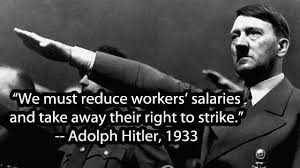
In the U.S., the evidence would seem to indicate that propaganda both works and rules. On just about every level, this is a manipulated nation. From the time you are born to the time you die, you are conditioned to follow a certain pattern of behavior by a stream of propaganda unprecedented in world history—as are the means of delivery. The message is delivered by any and all means, and we first encounter it in the womb. In a word, it is relentless, much of it advocates a consumer culture—and its factual content is untrue.

Quite how we can consider ourselves independent thinkers in the face of such a fire-hose of misrepresentation defies rational thought in itself. We hold such thoughts because we are conditioned to hold just such thoughts (regardless of evidence to the contrary). In fact, conditioning forms the basis of much of what constitutes ‘The American Way of Life.’

The current consensus is that ‘Big Government’ is the villain of the piece despite the fact that any Americans love individual programs—such as Social Security—and depend on them. This is decidedly not rational, but it’s a pervasive view nonetheless.

We would be better served if we examined who really pulls the levers of power. There, the answer is clear.

Corporate power controls the U.S. and virtually controls the government. So who controls corporate power? A relatively small number of very rich people plus their henchmen.

In a way, the structure is positively feudal with the barons standing in for the rich, the management and professional classes equating to the barons’ armed followers, and the oppressed middle class and the poor being broadly similar to the long-suffering peasantry.

But feudal society was headed by a king?

Very true. Our modern equivalent is the presidency. In both cases, executive power—whatever be the theory—was (and is) heavily constrained by the barons (whether they be feudal or corporate). 

The most disturbing manifestation of corporate power is the degree to which it controls our minds, and, thus, our behavior. It conditions how we think to a much greater extent than we are prepared to admit. We like to think of ourselves as independent thinkers in the finest American tradition.

In practice, few of us are—and all of us are influenced. In reality, most of us are socially controlled to a degree which is truly alarming. Tragically, most of us are either unaware of that fact—or just don’t care. But even if we are aware and determined to resist, we are influenced,  Some might not not be persuaded, but—I am truly ashamed to admit—we are all influenced.  Propaganda works.

We are conditioned not to care==and to respond to our national mythology—even if it has scant basis in fact.

America remains the finest country in the world, is the richest country in the world, offers the greatest economic opportunity in the world, is the most socially mobile, boasts the most prosperous Middle Class, is the most innovative, has the best healthcare system in the world and—above all—is free, and the world’s greatest democracy.

Americans are self-reliant rugged individualists who neither want nor need more than a minimum of government in their lives. And they certainly don’t need unions.

 Conditioning works. It is particularly effective at conditioning us to believe we are not conditioned—and it is positively brilliant at persuading us to vote against our own interests. We are a propagandist's dream.

“The receptivity of the masses is very limited, their intelligence is small, but their power of forgetting is enormous. In consequence of these facts, all effective propaganda must be limited to a very few points and must harp on these in slogans until the last member of the public understands what you want him to understand by your slogan.”
Adolf Hitler

The fates are not without a profound sense of irony. They are presiding over a tragedy,

This is a great country—which has lost its way—which (mostly) doesn’t seem to know it..


Monday, December 23, 2013

#23 DEC 23 2013: ONCE UPON A TIME THERE WERE FIXED WING AND HELICOPTERS. NOW SOME VERY STRANGE MACHINES ARE FLYING AROUND—AND SOME DON’T EVEN HAVE PILOTS!

'Quick Robin, to the AirMule!'

You can make a good case that the Israelis are the most innovative nation around these days. Hard to be sure. Innovation knows no borders. Certainly, they seem to be when it comes to the military sector—especially when you consider their limited resources. But much of what they develop has civilian application too—and such is the case where the AIRMULE from Israel’s TACTICAL ROBOTS LTD is concerned. Simply put, it is an unmanned rotary aircraft designed to carry stuff. It’s an aerial pickup-and about the same size (though lighter).

Rotary? Surely those ducted fans at its tail aren’t sufficient for it to take off and land vertically?

No, they are not. The heavy lifting (no pun intended) is actually done by shrouded blades inside the aircraft. This makes them highly efficient, quiet, and the AirMule itself capable of landing in confined spaces (430.5 square feet—which is no bigger than many domestic living-rooms.

The AirMule is made by Israel's Tactical Robotics Ltd., and can be flown either by remote control or using its own autonomous control system – there's no onboard human pilot. Among other things, it's intended for the evacuation of wounded personnel in war zones while under anti-aircraft fire.

In its current form, it weighs 770 kg (1,700 lb), can carry a payload of up to 640 kg (1,400 lb), has a potential top speed of 180 km/h (112 mph), and can reach a maximum altitude of 12,000 ft (3,658 m).

So where does the cargo go?

Your guess is as good as mine. But note the payload it can carry. 1,400lbs is a useful quantity for such a small aircraft.


Sunday, December 22, 2013

#22 AMAZON SEEMS DETERMINED TO CONQUER THE WORLD, AND, AT THIS RATE, SEEM QUITE LIKELY TO SUCCEED. FOR THEIR NEXT TRICK, THEY ARE TAKING ON HOLLYWOOD…

In truth, Amazon Studios were launched in 2010, but I don’t think they were taken too seriously originally. They should have been—because, as always, they moved fast.

Check out the sheer volume of material writers have submitted to Amazon Studios. I’ve highlighted it below.

Is this a competitive business or what?

Clearly, we writers are both masochists and optimists—and you can make a good case that we have a few screws loose. Alternatively, it is hard not to be impressed by the sheer courage and tenacity of the creative community.

The photo is of famed author, Michael Connelly.

Read and wonder:

ABOUT AMAZON STUDIOS

Amazon Studios launched in 2010 as a new way to develop feature films and episodic series--one that's open to great ideas from creators and audiences around the world. Anyone can upload a script and will then be notified within 45 days if that script is optioned. Amazon Studios will read and review all submissions and those who choose to make their projects public may also receive feedback from the Amazon Studios community. Recently, Amazon Studios announced 11 new pilots including: kids pilots Gortimer Gibbon's Life on Normal Street, Grid Smasher, Hard-Boiled Eggheads, The Jo B. & G. Raff Show, The Maker Shack Agency and Wishenpoof!; half-hour pilots Mozart in the Jungle, The Rebels and Transparent; and hour pilots Bosch and The After. The pilots will be available on Amazon Instant Video and LOVEFiLM early next year for all customers to watch and provide feedback. Last month, Amazon Studios debuted its first comedy series Alpha House and Betas available exclusively on Prime Instant Video and Amazon LOVEFiLM in the UK.

Since launch, more than 19,000 movie scripts and 5,000 series projects have been submitted to Amazon Studios. Amazon Studios continues to invite creators to upload their proposals for drama, comedy and children's programming at http://studios.amazon.com/getting-started/series or submit them privately via Amazon Studios.

Comprehensive cast and crew information, including bios and filmographies, is available on Amazon's IMDb (www.imdb.com), the world's most popular and authoritative source for movie, TV and celebrity content.

I’m constantly being told my books would make great movies—and they have all being optioned—but statistically the odd are against it. That said, if we authors contemplated the odds against writing success, we’d choose another line of work.

Every day, I give thanks that I didn’t.

Saturday, December 21, 2013

#21 DEC 21 2013: FIRST FLIGHT OF THE SCORPION. FROM CONCEPT TO FLIGHT IN UNDER TWO YEARS. HOT DAMN, BUT THESE GUYS ARE GOOD!

Scorpion

Most U.S. military aircraft are developed—not surprisingly—by one of the services, and have a tendency to take decades to transfer from design stage to flight.

Why so long? Well, it would take a book to explain that, but the short explanation is that the Pentagon excels in canceling itself out. For every effort, there seems to be a near equal and opposite effort—so people often work very hard—but get nowhere. And that’s a very good thing because if they got somewhere they would be working themselves out of their jobs—and that would never do.

In addition, it is extremely hard to pin down accountability because although people don’t lose jobs, they change jobs so often. And if they don’t change their jobs, they change their titles. And they are always changing their acronyms. Clarity is frowned upon in The Building. It makes things way too easy for the enemy.

What enemy? That is classified.

On top of all that, no Pentagon battle is every really over. A decision may go your way one day, but be reversed the next. Stir in constantly changing specifications and, with luck, you’ll never have to build anything so you won’t have be worried by the fact that it (whatever it is) doesn’t work.

But surely someone must be responsible? What about the chain of command?

The chain of command delegates. Good grief, what is the point of having a chain of command if you can’t pass the buck. Besides, there are always civil servants to blame. And they naturally blame Congress—for very good reason. And Congress doesn’t mind because politicians have notoriously thick skins—and get paid off. And if that doesn’t confuse the issue sufficiently, the services blame each other—which is what they do most of the time anyway. They are the real enemy—and war with them never ends.

Don’t knock all this. It keeps hundreds of thousands of people at work, pays for third level education for their children, finances comfortable retirements, and allows for extensive double-dipping. Besides, it’s all in aid of National Security so it must be a good thing—and it’s almost certainly secret. 

In contrast, the Scorpion is being developed privately by Textron Airland for all those countries who don’t plan to go up against China, but still want an aircraft that looks cool (very important) and can do some damage. Also, it looks like you’ll be able to buy a squadron of Scorpions for the price of one F-35 (not that anyone knows exactly what an F-35 costs—the Pentagon isn’t very good at book-keeping and has a creative approach to facts).

What else can I tell you?

That you don’t mean all that stuff about the Pentagon. Surely, it can’t be like that.

Hmm!

Friday, December 20, 2013

#20 GOODNESS GRACIOUS! IT MUST BE GREAT TO BE GOOGLE

Apparently U.S. mobile ad spending now accounts for more than 22% of all U.S. digital ad spending—and it was less than 3% as recently as 2010.


E-BOOKS

The digital world is hard to keep up with these days. E-books looked to be taking over publishing, but their growth slowed dramatically 2013 (and hardback sales actually increased).

It will be particularly interesting to see book market figures for all 2013.


E-READERS V TABLETS

Another matter I’m curious about will be the effect of tablets on reading habits. Tablets seem to dominating the market—but you can do a great deal more than read on a tablet. Will multi-media suppress reading, or will reading thrive on tablets as well?

Tablets are generally considered to be less than idea for sustained reading because of glare. On the other hand, you can set up a tinted background on a tablet which cuts the glare considerably.

Overall, I expect to see the reading quality of both e-readers and tablets to improve considerably over the years—but I doubt e-readers will vanish. They are likely to retain the price advantage. So will reading. Multimedia is just more expensive to produce.

But a lot of multimedia is free!

Same situation with the written word.